star formation tagged posts

Galactic Fireworks: New ESO images reveal stunning features of Nearby Galaxies

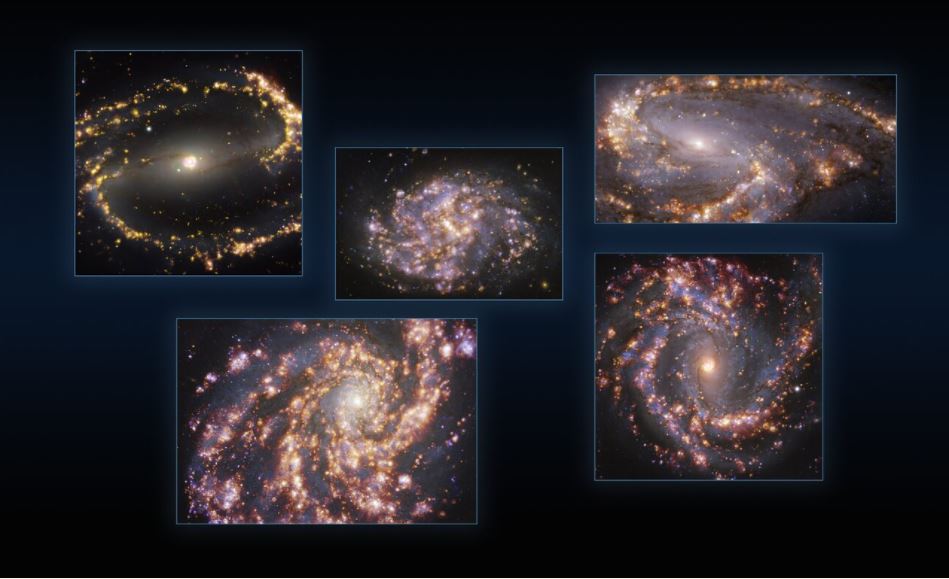
A team of astronomers has released new observations of nearby galaxies that resemble colourful cosmic fireworks. The images, obtained with the European Southern Observatory’s Very Large Telescope (ESO’s VLT), show different components of the galaxies in distinct colours, allowing astronomers to pinpoint the locations of young stars and the gas they warm up around them. By combining these new observations with data from the Atacama Large Millimeter/submillimeter Array (ALMA), in which ESO is a partner, the team is helping shed new light on what triggers gas to form stars.

A team of astronomers has released new observations of nearby galaxies that resemble colourful cosmic fireworks...

Read More

Satellite Galaxies can carry on Forming Stars when they Pass Close to their Parent Galaxies

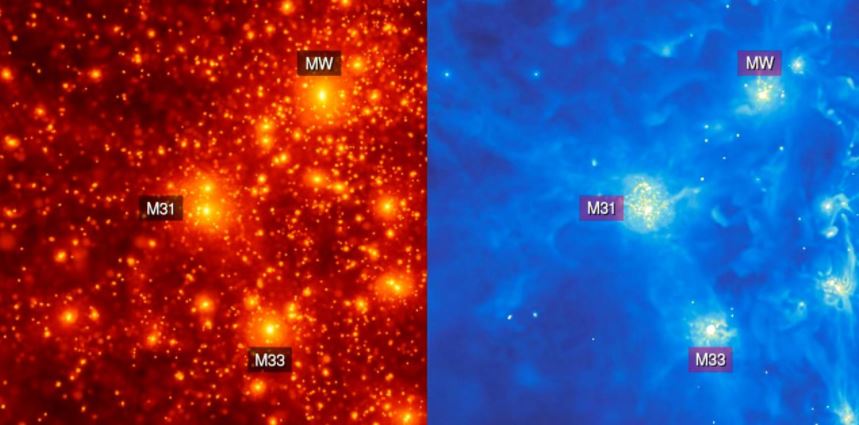
Image of the simulated local group used for the article. Left, image of dark matter; on the right, gas distribution. The three main galaxies of the Local Group (MW, M31 and M33) are indicated. Credit: CLUES simulation team.
Image of the simulated local group used for the article. Left, image of dark matter; on the right, gas distribution. The three main galaxies of the Local Group (MW, M31 and M33) are indicated. Credit: CLUES simulation team

Historically most scientists thought that once a satellite galaxy has passed close by its higher mass parent galaxy its star formation would stop because the larger galaxy would remove the gas from it, leaving it shorn of the material it would need to make new stars. However, for the first time, a team led by the researcher at the Instituto de Astrofísica de Canarias (IAC), Arianna di Cintio, has shown using numerical simulations that this is not always the case...

Read More
36 Dwarf Galaxies had simultaneous ‘Baby Boom’ of New Stars

Dwarf galaxies
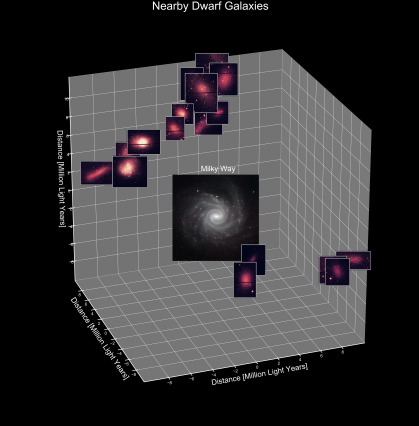
The Milky Way-like galaxy NGC 1232 (center) shows the Milky Way’s location and relative size. Images of dwarf galaxies are centered close to their true locations but have been magnified for visibility. Credit: Charlotte Olsen

Surprising finding challenges current theories on how galaxies grow. Three dozen dwarf galaxies far from each other had a simultaneous “baby boom” of new stars, an unexpected discovery that challenges current theories on how galaxies grow and may enhance our understanding of the universe.

Galaxies more than 1 million light-years apart should have completely independent lives in terms of when they give birth to new stars...

Read More

‘Yellowballs’ offer new insights into Star Formation

"yellowball" image one
An example of a yellowball (left, circled) and a bubble (right, circled) as seen in infrared images from NASA’s Spitzer Space Telescope. A typical yellowball has a diameter of about a light-year, while a bubble can grow to tens of light-years. This false-color image uses a blue-green-red color scheme to depict infrared wavelengths used in the Milky Way Project and gives rise to the ‘yellow’ color of the feature.
Credit: NASA/JPL-Caltech.

A serendipitous discovery by citizen scientists has provided a unique new window into the diverse environments that produce stars and star clusters, revealing the presence of “stellar nurseries” before infant stars emerge from their birth clouds, according to Planetary Science Institute Senior Scientist Grace Wolf-Chase.

“Yellowballs are small co...

Read More