
sunspots tagged posts

How the sun goes to ‘sleep’ could reveal future space weather when it wakes

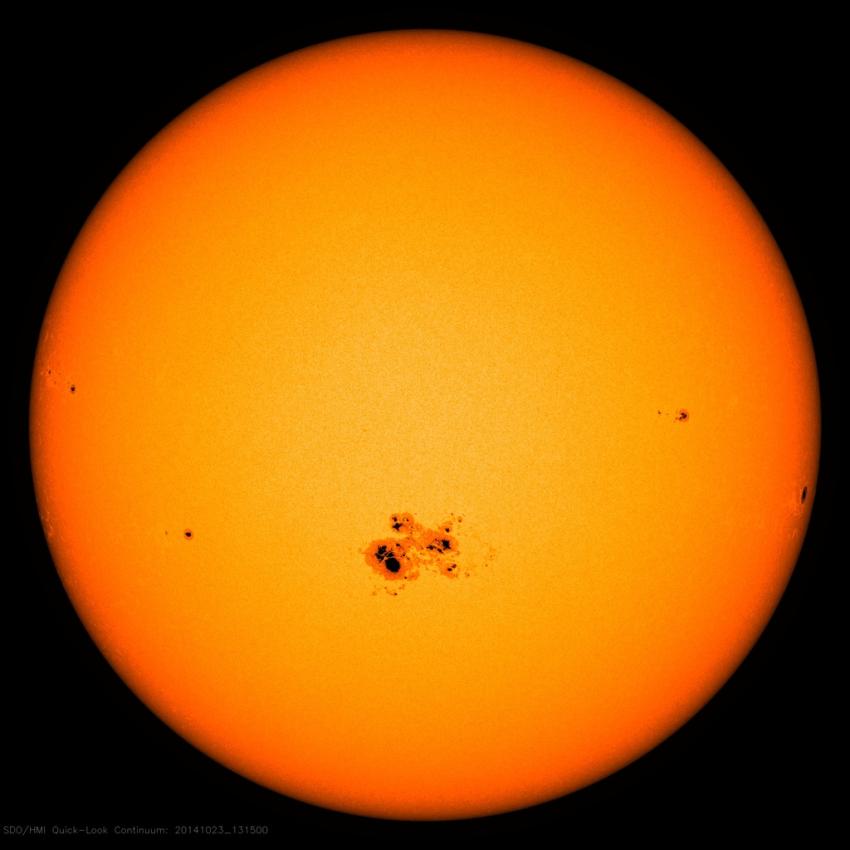
Sunspots are regions of intense magnetic activity on the Sun's surface. The number of sunspots rises and falls over the Sun's approximately 11-year activity cycle and is one of the main ways astronomers track and predict solar activity.
Sunspots are regions of intense magnetic activity on the Sun’s surface. The number of sunspots rises and falls over the Sun’s approximately 11-year activity cycle and is one of the main ways astronomers track and predict solar activity.
Credit NASA/SDO Licence type Attribution (CC BY 4.0)

Scientists have developed a new way to predict the strength of the sun’s next activity cycle up to seven years before it reaches its peak.

The new method uses the number of sunspots at a newly identified “switchoff” point in the solar cycle, when the sun’s most extreme space weather suddenly comes to an end. Using this approach, researchers have made an early prediction for the strength of Solar Cycle 26.

A very early prediction shows a moderate Cycle 26 with a sunspot number of around 100–120, s...

Read More
Nearby Star could help explain why our Sun didn’t have Sunspots for 70 years

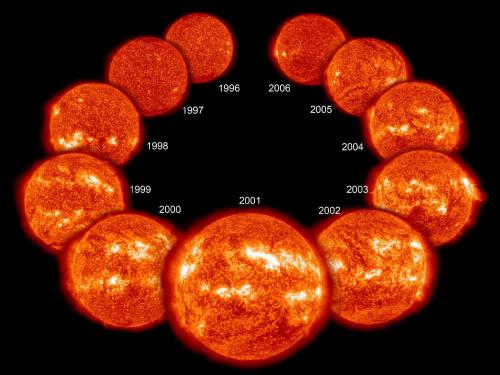
A new study has identified a nearby star whose sunspot cycles appear to have stopped. Studying this star might help explain the period from the mid 1600s to the early 1700s when our Sun paused its sunspot cycles. This image depicts a typical 11-year cycle on the Sun, with the fewest sunspots appearing at its minimum (top left and top right) and the most appearing at its maximum (center). Credit: NASA

Astronomers identified a nearby star whose sunspot cycles appear to have stopped. Studying this star might help explain the unusual period from the mid 1600s to the early 1700s when our Sun paused its sunspot cycles.

The number of sunspots on our Sun typically ebbs and flows in a predictable 11-year cycle, but one unusual 70-year period when sunspots were incredibly rare has mystified s...

Read More

A new look at Sunspots

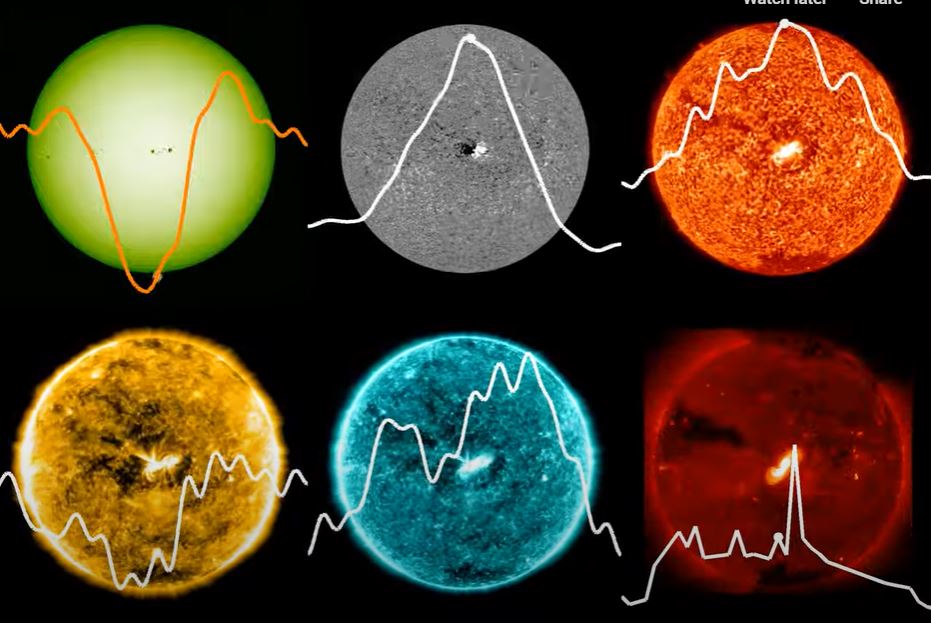
Scientists created light curves using the high-resolution images of the Sun to understand what a sunspot would look like on a distant star. They studied different layers of the Sun from the visible surface to the outer atmosphere using 14 different wavelengths, including the six shown here (top left to right: photosphere, magnetic flux of the photosphere, ultraviolet 304 angstroms; bottom left to right: ultraviolet 171 angstroms, ultraviolet 131 angstroms, x-ray).
Credits: NASA/SDO/JAXA/NAOJ/Hinode

NASA’s extensive fleet of spacecraft allows scientists to study the Sun extremely close-up — one of the agency’s spacecraft is even on its way to fly through the Sun’s outer atmosphere. But sometimes taking a step back can provide new insight.

In a new study, scientists looked at sunspots ...

Read More

Breakthrough method for Predicting Solar Storms

Image of corona from NASA's Solar Dynamics Observatory showing features created by magnetic fields. Image credit: NASA
Image of corona from NASA’s Solar Dynamics Observatory showing features created by magnetic fields. Image credit: NASA

Extensive power outages and satellite blackouts that affect air travel and the internet are some of the potential consequences of massive solar storms. These storms are believed to be caused by the release of enormous amounts of stored magnetic energy due to changes in the magnetic field of the sun’s outer atmosphere — something that until now has eluded scientists’ direct measurement. Researchers believe this recent discovery could lead to better “space weather” forecasts in the future.

“We are becoming increasingly dependent on space-based systems that are sensitive to space weather...

Read More