
Superconductors tagged posts

Scientists just captured a mysterious quantum “dance” inside superconductors

Illustration of an optical lattice, which looks like an egg crate, with pairs of particles sitting in various pockets of the lattice.
For the first time, researchers have imaged how pairs of electrons behave in a superconductor. Lucy Reading-Ikkanda/Simons Foundation

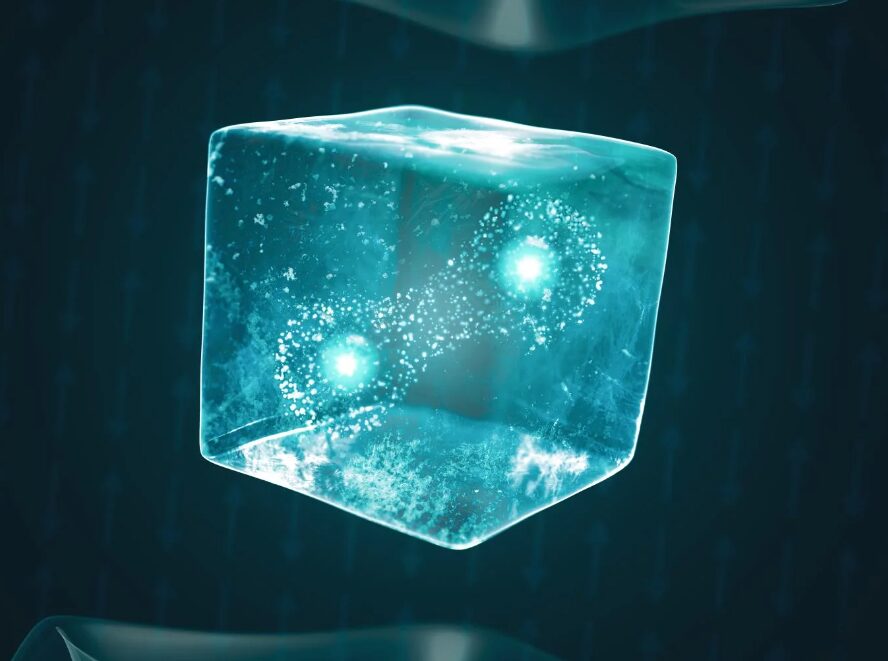
Scientists just spotted a mysterious quantum “dance” that could rewrite superconductivity—and reshape future tech. For the first time, researchers have directly visualized the quantum behavior that drives superconductivity, a state in which paired electrons allow electricity to flow with zero resistance at very low temperatures.

But what they observed came as a surprise.

In a study published April 15 in Physical Review Letters, the team captured images of individual atoms forming pairs inside a specially prepared gas cooled to nearly absolute zero — the unreachable limit to how cold anything can get...

Read More
Researchers observe ‘Locked’ Electron Pairs in a Superconductor Cuprate

For the past century since their discovery, superconductors and their mysterious atomic properties have left researchers in awe. These special materials allow electricity to flow through them without any energy loss. They even allow trains to levitate.

But superconductors typically only work at extremely cold temperatures. When these materials are heated, they become ordinary conductors, which allow electricity to flow but with some energy lost; or insulators, which don’t conduct electricity at all.

Researchers have been hard at work looking for superconductor materials that can perform their magic at higher temperatures—perhaps even room temperature someday...

Read More

Extremely Energy Efficient Microprocessor developed using Superconductors

Extremely energy efficient microprocessor developed using superconductors
AQFP MANA microprocessor die photo. MANA is the world’s first adiabatic superconductor microprocessor. Credit: Yokohama National University

Researchers from Yokohama National University in Japan have developed a prototype microprocessor using superconductor devices that are about 80 times more energy efficient than the state-of-the-art semiconductor devices found in the microprocessors of today’s high-performance computing systems.

As today’s technologies become more and more integrated in our daily lives, the need for more computational power is ever increasing. Because of this increase, the energy use of that increasing computational power is growing immensely...

Read More

Quantum Materials quest could benefit from Graphene that buckles

Graphene buckling
Simulated mountain and valley landscape created by buckling in graphene. The bright linked dots are electrons that have slowed down and interact strongly. Image: Yuhang Jiang

Cooled graphene mimics effect of enormous magnetic fields that would benefit electronics. Graphene, an extremely thin two-dimensional layer of the graphite used in pencils, buckles when cooled while attached to a flat surface, resulting in beautiful pucker patterns that could benefit the search for novel quantum materials and superconductors, according to Rutgers-led research in the journal Nature.

Quantum materials host strongly interacting electrons with special properties, such as entangled trajectories, that could provide building blocks for super-fast quantum computers...

Read More