
supergiant star tagged posts

ALMA uncovers sulfur for the first time around a rare class of supergiant star

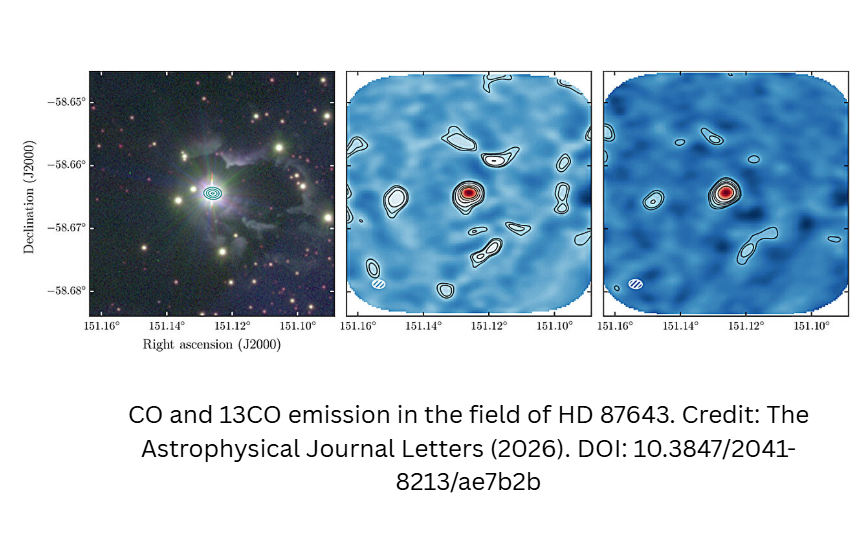
Astronomers have discovered a chemically rich collection of sulfur-bearing molecules surrounding the rare massive star HD 87643. The observations include the first detection of sulfur monoxide and sulfur dioxide around a B[e] supergiant. The paper was published in The Astrophysical Journal Letters on July 1.

Rare and old
B[e] supergiants, or sgB[e], are rare, evolved massive stars that have moved past their main hydrogen-burning phase. They are notable for distinctive emission lines—hence the “[e]” in their name—including rare “forbidden” lines produced by the surrounding gas and dust, along with an infrared glow far more intense than that of ordinary B-type stars.

As these stars approach the final stages of their lives, they shed enormous amounts of material, building up mes...

Read More

Stars Exploding as Supernovae lose their mass to companion stars during their lives

A massive star evolving and becoming a red supergiant, and finally exploding as a supernova. A binary companion may strip the star’s hydrogen away (producing supernova type IIb/Ib), and for a more massive star the stellar wind expels the remaining helium layer (producing supernova type Ic).
Credit: Keiichi Maeda

Stars over eight times more massive than the Sun end their lives in supernovae explosions. The composition of the star influences what happens during the explosion.

A considerable number of massive stars have a close companion star. Led by researchers at Kyoto University, a team of international researchers observed that some stars exploding as supernovae may release part of their hydrogen layers to their companion stars before the explosion.

“In a binary star system, the star ...

Read More

Star-forming ring spotted around distant Supergiant Star Kappa Ori

Star-forming ring spotted around distant supergiant star Kappa Ori

Far-IR Planck 857 GHz (left panel), mid-IR WISE 12µm (central panel, image from Meisner & Finkbeiner 2014) and velocity integrated CO image (right panel, from CfA CO survey of Dame et al. 2001) around Kappa Ori. Green symbols mark the positions of WISE objects with IR excess. Contours are the footprints of XMM-Newton observations. The dust ring is visible at far-IR and millimeter wavelengths while it appears like a bubble of diffuse emission in mid IR. Credit: Pillitteri et al., 2016.

Astronomers have spotted a star-forming ring around a distant star Kappa Ori at the south-eastern corner of the constellation of Orion. The star, also known as Saiph, is a supergiant with a mass of approximately 15 solar masses ~650 light years from Earth...

Read More