supermassive black hole tagged posts

Astronomers spot the ‘Eye of Sauron’ in deep space

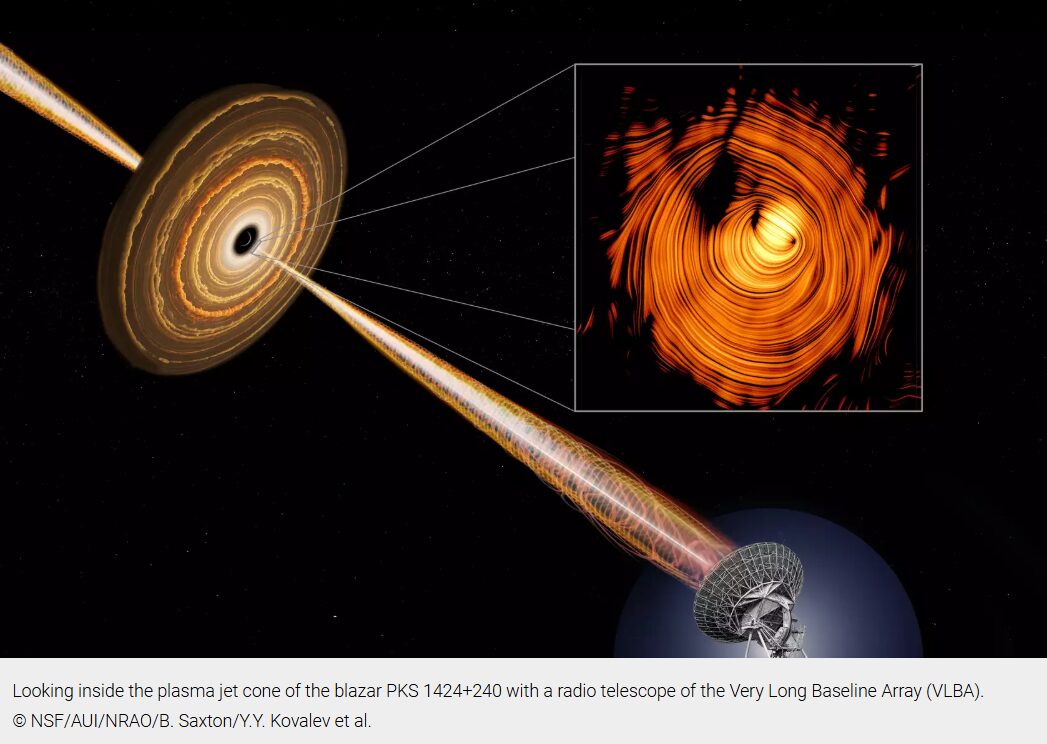
A stunning new image of a cosmic jet has helped astronomers unlock the mystery behind the usually bright emission of high-energy gamma rays and neutrinos from a peculiar celestial object. The source is a blazar—a type of active galaxy powered by a supermassive black hole devouring matter a the heart of a galaxy. They have captured what looks like the mythical “Eye of Sauron” in the distant universe and may have just solved a decade-long cosmic puzzle.

The researchers made a discovery that will help in understanding how a seemingly slow-moving blazar, known as PKS 1424+240, could be one of the brightest sources of high-energy gamma rays and cosmic neutrinos ever observed. The work is published in the journal Astronomy & Astrophysics.

Located billions of light-years away, the bl...

Read More

Supermassive Black Hole Heading Towards The Milky Way Galaxy

The strange behavior of hypervelocity stars suggests a nearby dwarf galaxy must contain a supermassive black hole. If so, a collision with the Milky Way is inevitable.

galaxy
(Credit: Alexcpt_photography/Shutterstock)

Back in 1971, a couple of British astronomers predicted the existence of a black hole at the center of our galaxy. And in 1974, other astronomers found it, naming it Sagittarius A*.

Since then, astronomers have discovered that a similar “supermassive black hole” sits at the center of almost every other large galaxy. In 2019, they took the first image of a supermassive black hole. Today, these exotic objects are a fundamental part of our understanding of how galaxies form and evolve.

But what of smaller astronomical bodies, like the Large Magellanic Cloud, a dwarf sa...

Read More

First-ever Binary Star Found Near our Galaxy’s Supermassive Black Hole

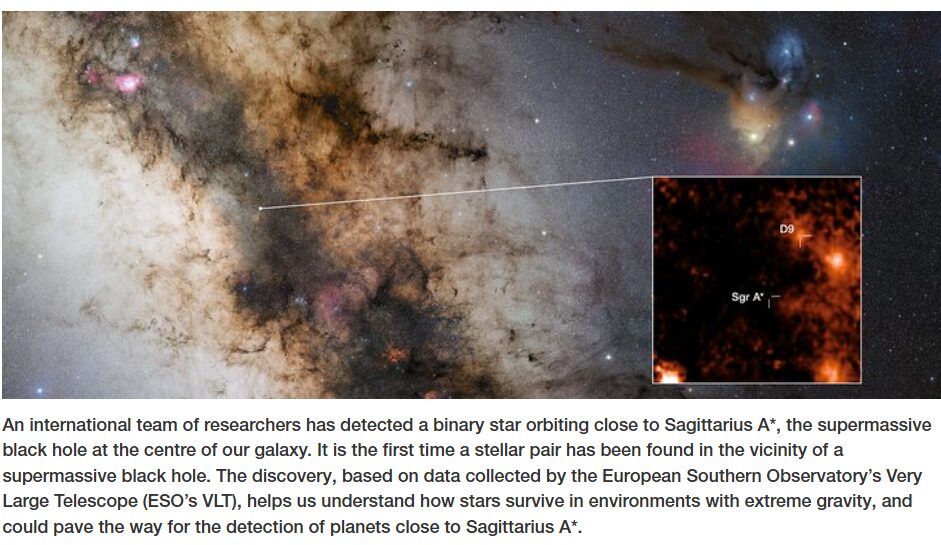
An international team of researchers has detected a binary star orbiting close to Sagittarius A*, the supermassive black hole at the center of our galaxy. It is the first time a stellar pair has been found in the vicinity of a supermassive black hole.

The discovery, based on data collected by the European Southern Observatory’s Very Large Telescope (ESO’s VLT), helps us understand how stars survive in environments with extreme gravity, and could pave the way for the detection of planets close to Sagittarius A*.

“Black holes are not as destructive as we thought,” says Florian Peißker, a researcher at the University of Cologne, Germany, and lead author of the study published in Nature Communications.

Binary stars, pairs of stars orbiting each other, are very common in the univ...

Read More

Astrophysicists Uncover Supermassive Black Hole/Dark Matter Connection in Solving the ‘Final Parsec Problem’

Astrophysicists uncover supermassive blackhole/dark matter connection in solving the 'final parsec problem'
Simulation of the light emitted by a supermassive black hole binary system where the surrounding gas is optically thin (transparent). Viewed from 0 degrees inclination, or directly above the plane of the disk. The emitted light represents all wavelengths. Credit: NASA’s Goddard Space Flight Center/Scott Noble; simulation data, d’Ascoli et al. 2018

Researchers have found a link between some of the largest and smallest objects in the cosmos: supermassive black holes and dark matter particles.

Their new calculations reveal that pairs of supermassive black holes (SMBHs) can merge into a single larger black hole because of previously overlooked behavior of dark matter particles, proposing a solution to the longstanding “final parsec problem” in astronomy.

The research is described in ...

Read More