supermassive black hole tagged posts

Gigantic Jet spied from Black hole in Early Universe

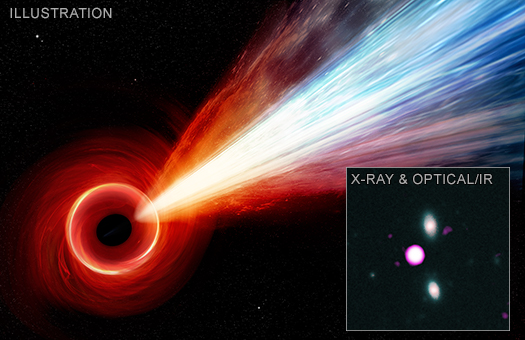
X-ray: NASA/CXO/JPL/T. Connor; Optical: Gemini/NOIRLab/NSF/AURA;
Infrared: W.M. Keck Observatory; Illustration: NASA/CXC/M.Weiss
Press Image, Caption, and Videos

Astronomers have discovered evidence for an extraordinarily long jet of particles coming from a supermassive black hole in the early universe, using NASA’s Chandra X-ray Observatory.

If confirmed, it would be the most distant supermassive black hole with a jet detected in X-rays. Coming from a galaxy about 12.7 billion light-years from Earth, the jet may help explain how the biggest black holes formed at a very early time in the universe’s history.

The source of the jet is a quasar — a rapidly growing supermassive black hole — named PSO J352.4034-15.3373 (PJ352-15 for short), which sits at the center of a young galaxy...

Read More

ESO Telescope sees Star dance around Supermassive Black Hole, proves Einstein right

undefined
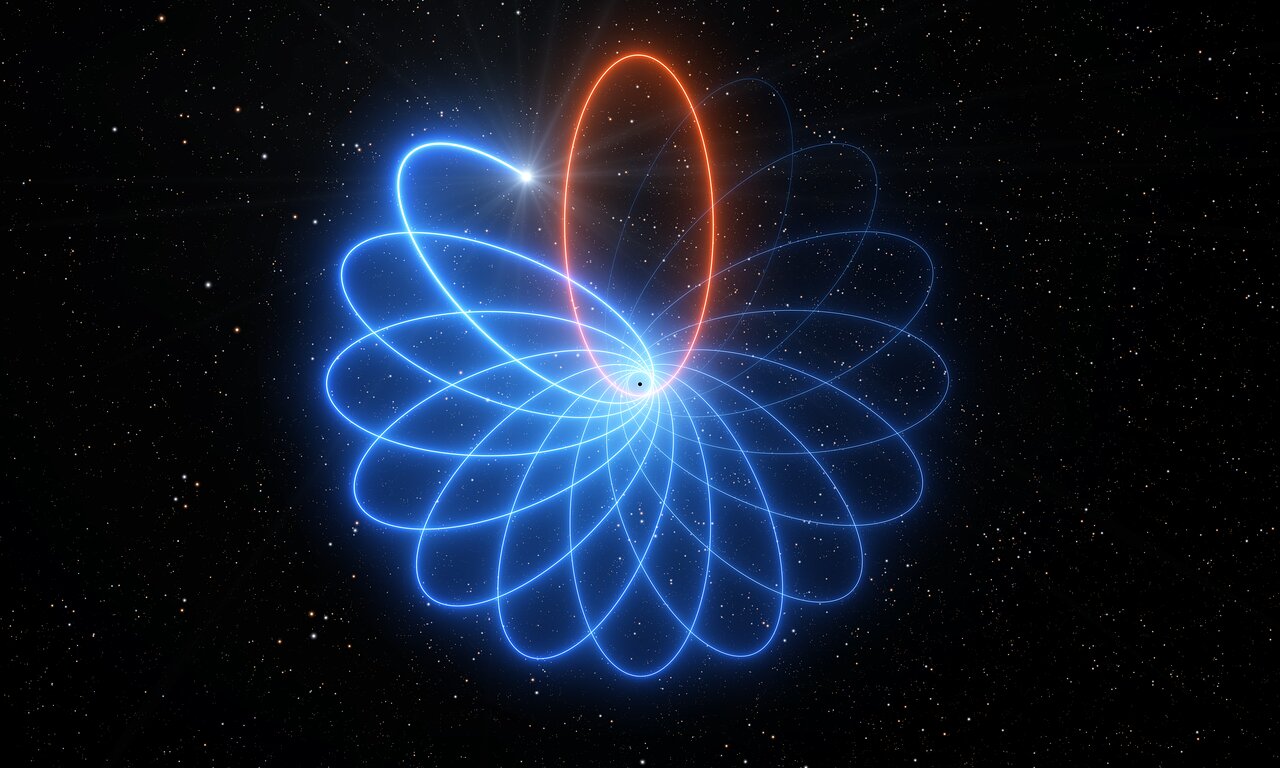
Observations made with ESO’s Very Large Telescope (VLT) have revealed for the first time that a star orbiting the supermassive black hole at the centre of the Milky Way moves just as predicted by Einstein’s general theory of relativity. Its orbit is shaped like a rosette and not like an ellipse as predicted by Newton’s theory of gravity. This long-sought-after result was made possible by increasingly precise measurements over nearly 30 years, which have enabled scientists to unlock the mysteries of the behemoth lurking at the heart of our galaxy.

Observations made with ESO’s Very Large Telescope (VLT) have revealed for the first time that a star orbiting the supermassive black hole at the centre of the Milky Way moves just as predicted by Einstein’s general theory of relativity...

Read More

ALMA resolves Gas impacted by Young Jets from Supermassive Black Hole

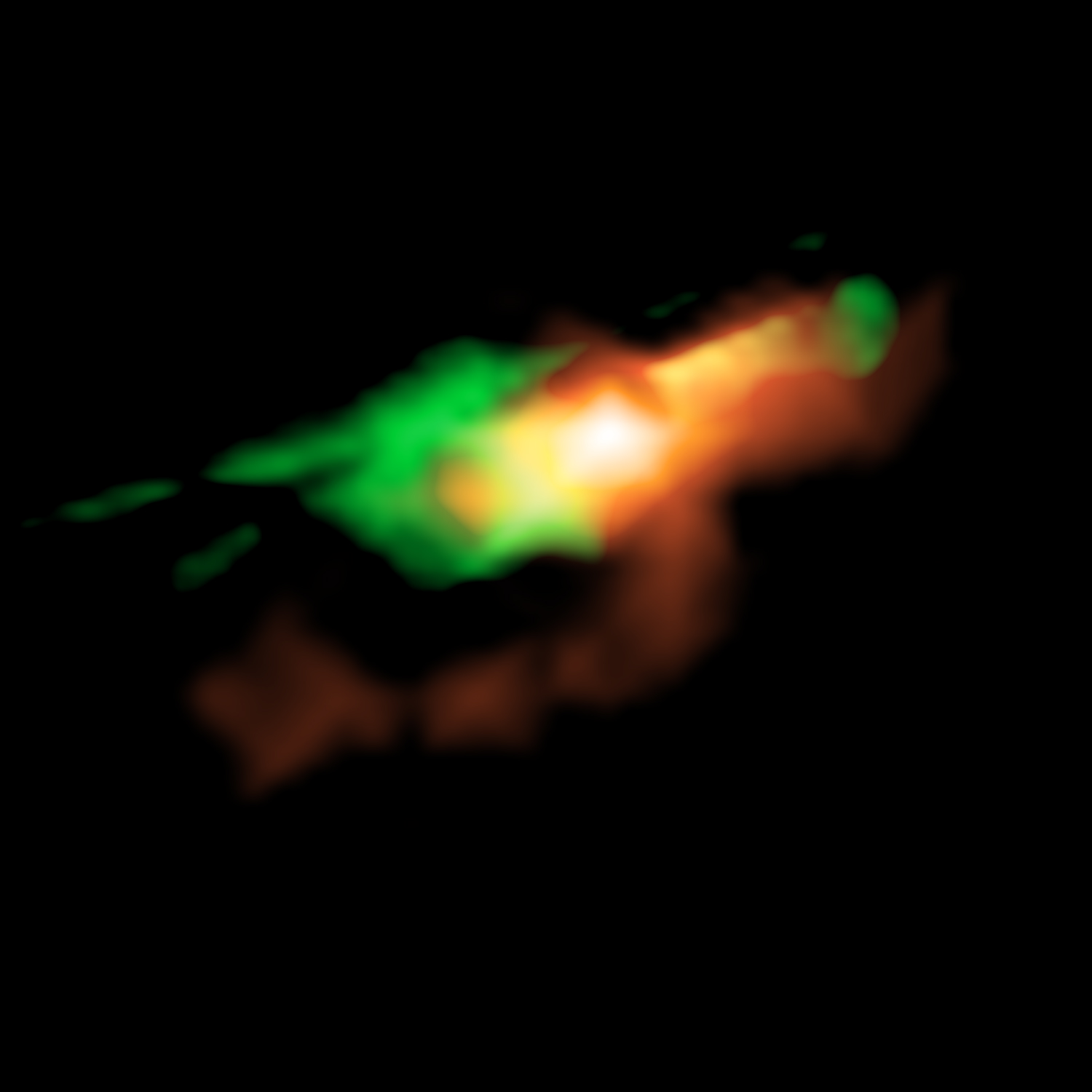
Reconstructed images of what MG J0414+0534 would look like if gravitational lensing effects were turned off. The emissions from dust and ionized gas around a quasar are shown in red. The emissions from carbon monoxide gas are shown in green, which have a bipolar structure along the jets.
Credit: ALMA (ESO/NAOJ/NRAO), K. T. Inoue et al.

Astronomers obtained the first resolved image of disturbed gaseous clouds in a galaxy 11 billion light-years away by using the Atacama Large Millimeter/submillimeter Array (ALMA). The team found that the disruption is caused by young powerful jets ejected from a supermassive black hole residing at the center of the host galaxy. This result will cast light on the mystery of the evolutionary process of galaxies in the early Universe.

It is commonly k...

Read More

Cool, Nebulous Ring around Milky Way’s Supermassive Black Hole

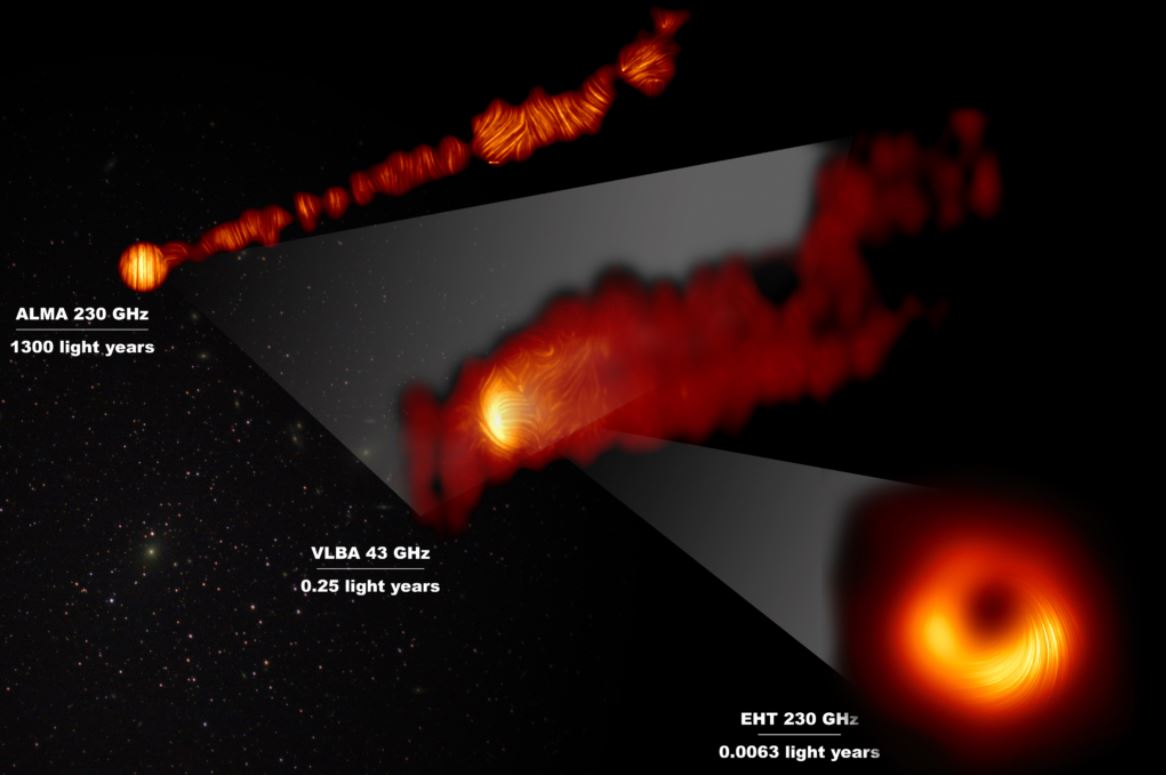
ALMA image of the disk of cool hydrogen gas flowing around the supermassive black hole at the center of our galaxy. The colors represent the motion of the gas relative to Earth: the red portion is moving away, so the radio waves detected by ALMA are slightly stretched, or shifted, to the ‘redder’ portion of the spectrum; the blue color represents gas moving toward Earth, so the radio waves are slightly scrunched, or shifted, to the ‘bluer’ portion of the spectrum. Crosshairs indicate location of black hole.
Credit: ALMA (ESO/NAOJ/NRAO), E.M. Murchikova; NRAO/AUI/NSF, S. Dagnello

New ALMA observations reveal a never-before-seen disk of cool, interstellar gas wrapped around the supermassive black hole at the center of the Milky Way...

Read More