supermassive black holes tagged posts

What makes Black Holes Grow and New Stars Form? Machine Learning helps Solve the Mystery

Intergalactic scene
A pair of disc galaxies in the late stages of a merger. Credit: NASA.

It takes more than a galaxy merger to make a black hole grow and new stars form: machine learning shows cold gas is needed too to initiate rapid growth — new research finds.

When they are active, supermassive black holes play a crucial role in the way galaxies evolve. Until now, growth was thought to be triggered by the violent collision of two galaxies followed by their merger, however new research led by the University of Bath suggests galaxy mergers alone are not enough to fuel a black hole — a reservoir of cold gas at the centre the host galaxy is needed too.

The new study, published this week in the journal Monthly Notices of the Royal Astronomical Society is believed to be the first to use machine learnin...

Read More
Astronomers Detect Oldest Black Hole ever observed

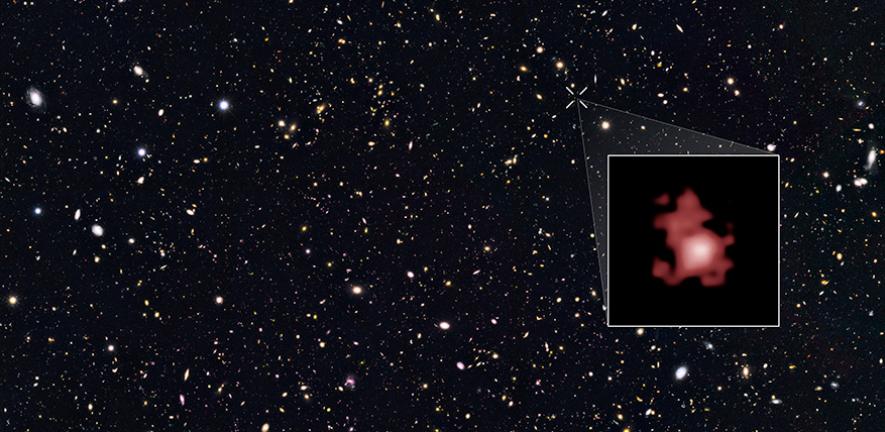
The GN-z11 galaxy, taken by the Hubble Space Telescope

Researchers have discovered the oldest black hole ever observed, dating from the dawn of the universe, and found that it is ‘eating’ its host galaxy to death.

The international team, led by the University of Cambridge, used the NASA/ESA/CSA James Webb Space Telescope (JWST) to detect the black hole, which dates from 400 million years after the big bang, more than 13 billion years ago. The results, which lead author Professor Roberto Maiolino says are “a giant leap forward,” are reported in the journal Nature.

That this surprisingly massive black hole — a few million times the mass of our Sun — even exists so early in the universe challenges our assumptions about how black holes form and grow...

Read More

Scientists discover how First Quasars in Universe Formed

A supercomputer simulation of the birth of a primordial quasar. Image shows tiny red dots on a central green and yellow splodge of colour on a blue background
A supercomputer simulation of the birth of a primordial quasar

The mystery of how the first quasars in the universe formed—something that has baffled scientists for nearly 20 years—has now been solved by a team of astrophysicists whose findings are published in Nature.

The existence of more than 200 quasars powered by supermassive black holes less than a billion years after the Big Bang had remained one of the outstanding problems in astrophysics because it was never fully understood how they formed so early.

The team of experts led by Dr. Daniel Whalen from the University of Portsmouth have found that the first quasars naturally formed in the violent, turbulent conditions of rare reservoirs of gas in the early universe.

Dr...

Read More

Impact of Black Hole Winds, Radiation examined in new study

Black holes are regions of space where gravity is so strong that nothing can escape. New research is examining the radiation and winds emanating from black hole activity and shows how they may exert effects on nearby planets.

“The impact of AGN outflows on the surface habitability of terrestrial planets in the Milky Way” is a research paper by the team of astrobiologist Manasvi Lingam and astrophysicist Eric Perlman from Florida Tech’s Department of Aerospace, Physics and Space Sciences, as well as researchers from the University of Rome, University of Maryland and Goddard Space Flight Center...

Read More