supernova tagged posts

Calculations Show Close Ia Supernova should be Neutrino detectable offering possibility of identifying Explosion type

Density contour plots including deflagration (white) and detonation (green) surfaces. Credit: arXiv:1609.07403 [astro-ph.HE]  Read more at: https://phys.org/news/2017-03-ia-supernova-neutrino-possibility-explosion.html#jCp

Density contour plots including deflagration (white) and detonation (green) surfaces. Credit: arXiv:1609.07403 [astro-ph.HE]

A team of researchers at North Carolina State University has found that current and future neutrino detectors placed around the world should be capable of detecting neutrinos emitted from a relatively close supernova. They also suggest that measuring such neutrinos would allow them to explain what goes on inside of a star during such an explosion—if the measurements match one of two models the team built to describe the inner workings of a supernova.

Supernovae have been classified into different types depending on what causes them to occur—one type, a la supernova, occurs when a white dwarf pulls in enough material from a companion, eventually triggering carbon fus...

Read More

Examining Exploding Stars through the Atomic Nucleus

Imagine being able to view microscopic aspects of a classical nova, a massive stellar explosion on the surface of a white dwarf star (about as big as Earth), in a laboratory rather than from afar via a telescope.

Imagine being able to view microscopic aspects of a classical nova, a massive stellar explosion on the surface of a white dwarf star (about as big as Earth), in a laboratory rather than from afar via a telescope.

Cosmic detonations of this scale and larger created many of the atoms in our bodies, says MSU’s Christopher Wrede, who presented at the American Association for the Advancement of Science meeting. A safe way to study these events in laboratories on Earth is to investigate the exotic nuclei or “rare isotopes” that influence them. “Astronomers observe exploding stars and astrophysicists model them on supercomputers,” said Wrede, physics assistant professor, MSU...

Read More

Astronomers Predict Explosion that will Change the Night Sky in 2022, Supernova-like, but different

Astronomy prof, student predict explosion that will change the night sky

Molnar’s prediction is that a binary star (two stars orbiting each other) he is monitoring will merge and explode in 2022. Credit: Calvin College

Calvin College professor Larry Molnar et al are predicting a change to the night sky that will be visible to the naked eye. “It’s a 1-in-a-million chance that you can predict an explosion,” Molnar said. “It’s never been done before.” Molnar’s prediction is that a binary star he is monitoring will merge and explode in 2022, give or take a year; at which time the star will increase its brightness 10000X, becoming one of the brighter stars in the heavens for a time. The star will be visible as part of the constellation Cygnus, and will add a star to the recognizable Northern Cross star pattern.

Molnar’s exploration into the star known as KIC 98322...

Read More

Ocean Sediment sample holds Iron believed to be from a Supernova

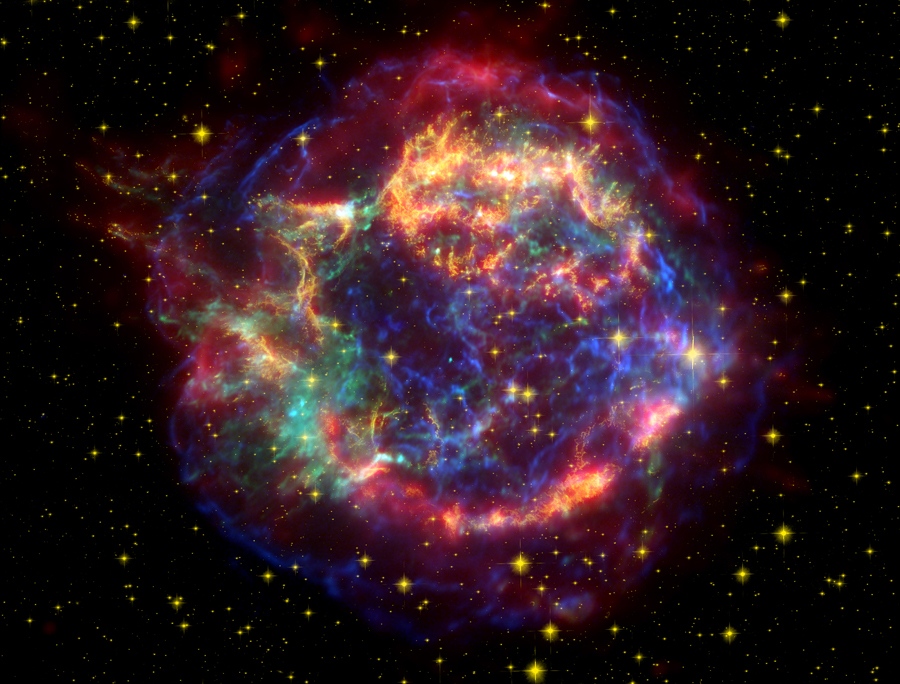
NASA/JPL-Caltech/STScI/CXC/SAO Oceanic sediment contains an iron isotope that ancient bacteria accumulated 2.2 million years ago when debris rained on Earth from a supernova explosion. Shown are the remnants of a much younger supernova remnant, Cassiopeia A, shown in a composite image from three NASA observatories.

NASA/JPL-Caltech/STScI/CXC/SAO Oceanic sediment contains an iron isotope that ancient bacteria accumulated 2.2 million years ago when debris rained on Earth from a supernova explosion. Shown are the remnants of a much younger supernova remnant, Cassiopeia A, shown in a composite image from three NASA observatories.

A team from Germany and Austria has found possible evidence of iron from a supernova in sediment cores taken from the floor of the Pacific Ocean. The study began when team members came across information regarding magnetotactic bacteria during internet searches. It is a type of bacteria that lives in ocean sediments and absorbs tiny amounts of iron. As sediment builds, the bacteria die leaving behind bits of iron in the layers of sediment...

Read More