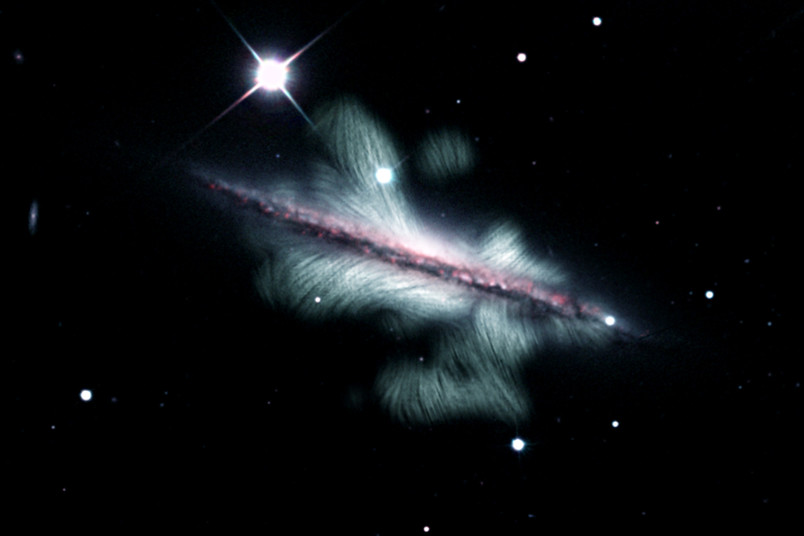
The spiral galaxy NGC 4217 has a huge magnetic field that is shown here as green lines. The data for this visualisation were recorded with the radio telescope Karl G. Jansky Very Large Array (VLA) of the National Science Foundation. The image of the galaxy shown from the side is taken from data from the Sloan Digital Sky Survey and Kitt Peak National Observatory.
Superbubbles, giant loops and X-shaped magnetic field structures – this galaxy boasts a veritable wealth of shapes. Spiral galaxies such as our Milky Way can have sprawling magnetic fields. There are various theories about their formation, but so far the process is not well understood...
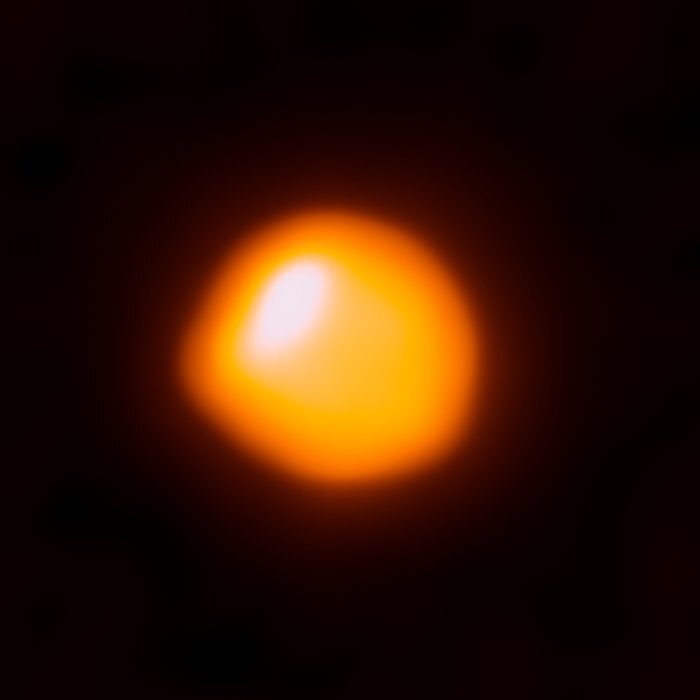
Unlike most stars, Betelgeuse is large enough and close enough for scientists to resolve with instruments like the ALMA telescope. Credit: ALMA (ESO/NAOJ/NRAO)
Betelgeuse has been the center of significant media attention lately. The red supergiant is nearing the end of its life, and when a star over 10 times the mass of the Sun dies, it goes out in spectacular fashion. With its brightness recently dipping to the lowest point in the last hundred years, many space enthusiasts are excited that Betelgeuse may soon go supernova, exploding in a dazzling display that could be visible even in daylight.
While the famous star in Orion’s shoulder will likely meet its demise within the next million years—practically couple days in cosmic time—scientists maintain that its dimming is due to th...
A massive star evolving and becoming a red supergiant, and finally exploding as a supernova. A binary companion may strip the star’s hydrogen away (producing supernova type IIb/Ib), and for a more massive star the stellar wind expels the remaining helium layer (producing supernova type Ic). Credit: Keiichi Maeda
Stars over eight times more massive than the Sun end their lives in supernovae explosions. The composition of the star influences what happens during the explosion.
A considerable number of massive stars have a close companion star. Led by researchers at Kyoto University, a team of international researchers observed that some stars exploding as supernovae may release part of their hydrogen layers to their companion stars before the explosion.
The effects of a supernova – and possibly more than one – on large ocean life like school-bus-sized Megalodon 2.6 million years ago are detailed in a new article. About 2.6 million years ago, an oddly bright light arrived in the prehistoric sky and lingered there for weeks or months. It was a supernova some 150 light years away from Earth. Within a few hundred years, long after the strange light in the sky had dwindled, a tsunami of cosmic energy from that same shattering star explosion could have reached our planet and pummeled the atmosphere, touching off climate change and triggering mass extinctions of large ocean animals, including a shark species that was the size of a school bus.
The effects of such a supernova – and possibly more than ...






Recent Comments