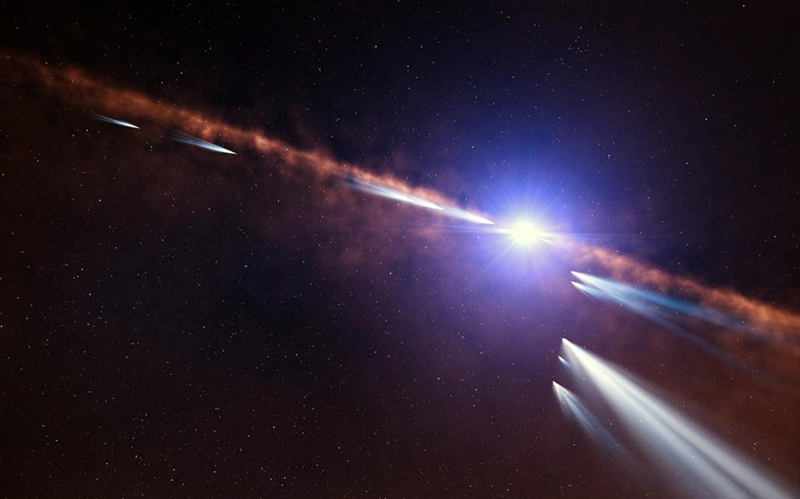
This artist’s impression shows a two-star system where micronovae may occur. The blue disc swirling around the bright white dwarf in the centre of the image is made up of material, mostly hydrogen, stolen from its companion star. Towards the centre of the disc, the white dwarf uses its strong magnetic fields to funnel the hydrogen towards its poles. As the material falls on the hot surface of the star, it triggers a micronova explosion, contained by the magnetic fields at one of the white dwarf’s poles.
A team of astronomers, with the help of the European Southern Observatory’s Very Large Telescope (ESO’s VLT), have observed a new type of stellar explosion — a micronova. These outbursts happen on the surface of certain stars, and can each burn through around 3...
Artist concept of TESS observing an M dwarf star with orbiting planets. (NASA’s Goddard Space Flight Center)
A team of astronomers have made the discovery of a lifetime that will help answer burning questions on the evolution of stars. The group is led by Evolutionary Studies Initiative member and Stevenson Professor of Physics and Astronomy, Keivan Stassun.
Stassun’s team generated a new model that greatly improved the way stars are measured in 2017.
“Being able to combine all of the different types of measurements into one coherent analysis was certainly key to being able to decipher the various unusual characteristics of this star system,” Stassun said.
The model helps predict the types of planets orbiting distant stars—called exoplanets...
An optical/near-infrared image of the sky around the TESS Input Catalog (TIC) object TIC 400799224 (the crosshair marks the location of the object, and the width of the field of view is given in arcminutes). Astronomers have concluded that the mysterious periodic variations in the light from this object are caused by an orbiting body that periodically emits clouds of dust that occult the star. Credit: Powell et al., 2021
The Transiting Exoplanet Survey Satellite, TESS, was launched in 2018 with the goal of discovering small planets around the sun’s nearest neighbor stars. TESS has so far discovered 172 confirmed exoplanets and compiled a list of 4703 candidate exoplanets...
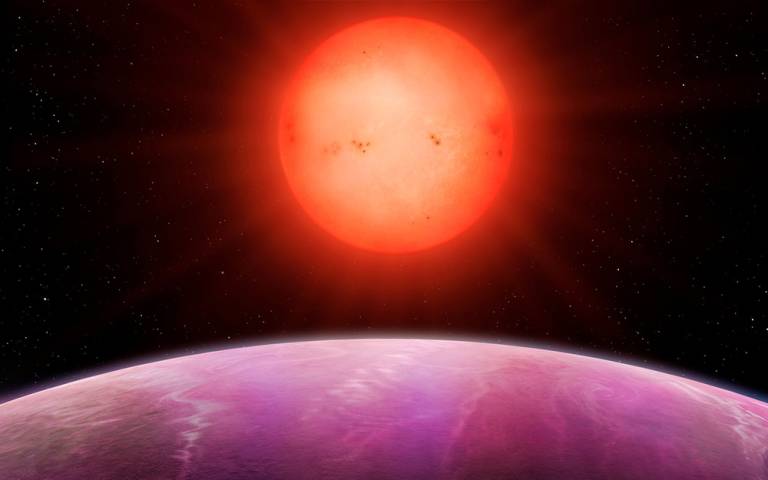
Caption:An illustration of a red dwarf star orbited by an exoplanet. Credits:Credit: NASA/ESA/G. Bacon (STScI)
The boiling new world, which zips around its star at ultraclose range, is among the lightest exoplanets found to date. The TESS mission has discovered an ultra-short-period planet (USP) that is also super light. The planet is named GJ 367 b, and it orbits its star in just eight hours. The planet is about the size of Mars, and half as massive as the Earth, making it one of the lightest planets discovered to date.
Ultra-short-period planets are small, compact worlds that whip around their stars at close range, completing an orbit — and a single, scorching year — in less than 24 hours...
Recent Comments