Artist’s conception illustrating the aftermath of an intermediate-mass black hole tearing apart a passing star, resulting in an accretion disk and narrow relativistic jet (top left). The dotted line indicates our line of sight from Earth. The jet’s off-axis afterglow only became visible once the expanding radio emission (bottom right) had grown wide enough to sweep into our line of sight, causing that emission to brighten dramatically years after the initial event. Credit: NSF/AUI/NSF NRAO/M.Weiss
Chinese astronomers report the detection of a peculiar optical transient event that occurred in the center of a dwarf galaxy. The newly discovered event, designated AT2019ijncn a paper published July 6 in The Astrophysical Journal Letters.
One of the rarest transients Among astronomical tra...
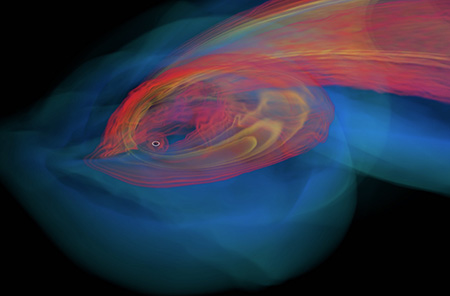
This image from a computer simulation shows the rapid formation of an accretion disk during the disruption of a star by a supermassive black hole. (Image credit: Jamie Law-Smith and Enrico Ramirez-Ruiz)
When a star passes too close to a supermassive black hole, tidal forces tear it apart, producing a bright flare of radiation as material from the star falls into the black hole. Astronomers study the light from these “tidal disruption events” (TDEs) for clues to the feeding behavior of the supermassive black holes lurking at the centers of galaxies.
New TDE observations led by astronomers at UC Santa Cruz now provide clear evidence that debris from the star forms a rotating disk, ie an accretion disk, around the black hole...





Recent Comments