



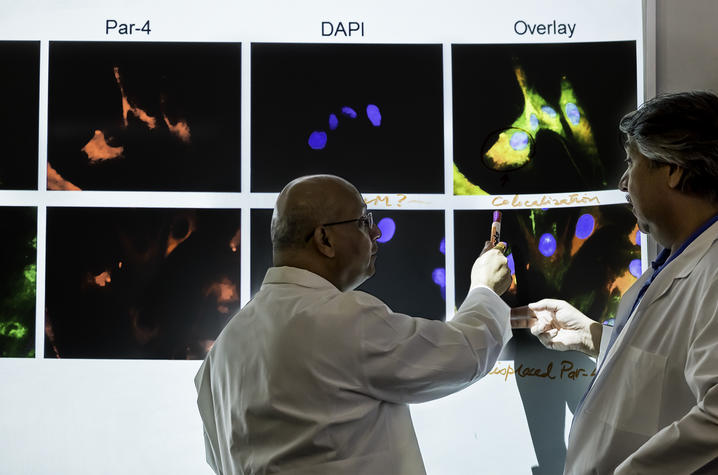
UK’s Vivek Rangnekar, left, and Ravshan Burikhanov.
A new study by University of Kentucky Markey Cancer Center researchers shows that when therapy-sensitive cancer cells die, they release a “killer peptide” that can eliminate therapy-resistant cells. Tumor relapse is a common problem following cancer treatment, because primary tumor cells often contain therapy-resistance cancer cells that continue to proliferate after the therapy-sensitive cells have been eliminated.
In the new study, published in Cancer Research, Markey scientists identified a Par-4 amino-terminal fragment (PAF) that is released by diverse therapy-sensitive cancer cells following therapy-induced cleavage of the tumor suppressor Par-4 protein...
Read More
Recent Comments