Uranus tagged posts

Voyager missed it, but now we know Uranus has a fiery secret

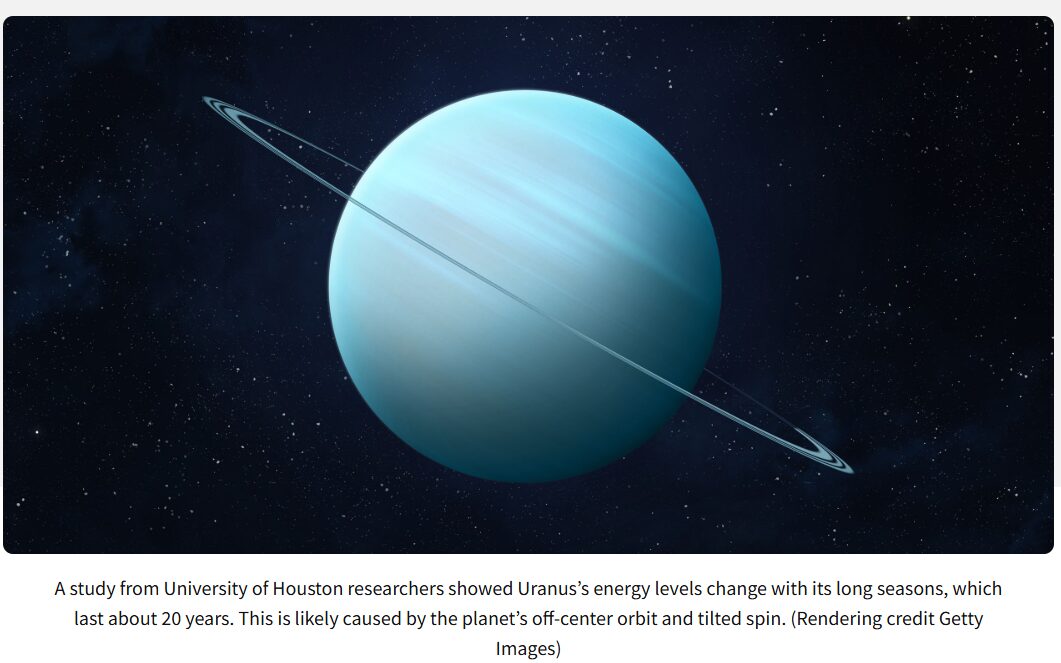
For decades, scientists puzzled over why Uranus seemed colder than expected. Now, an international research team led by the University of Houston has solved the mystery: Uranus emits more heat than it gets from the Sun, meaning it still carries internal warmth from its ancient formation. This revelation rewrites what scientists know about the ice giant’s history, strengthens the case for NASA’s upcoming mission, and offers fresh insight into the forces shaping not only other planets, but also Earth’s future climate.

A new study led by University of Houston researchers, in collaboration with planetary scientists worldwide, suggests Uranus does have its own internal heat — an advance that not only informs NASA’s future missions but also deepens scientists’ understanding of plan...

Read More

New Images reveal what Neptune and Uranus really look like

New images reveal what Neptune and Uranus really look like
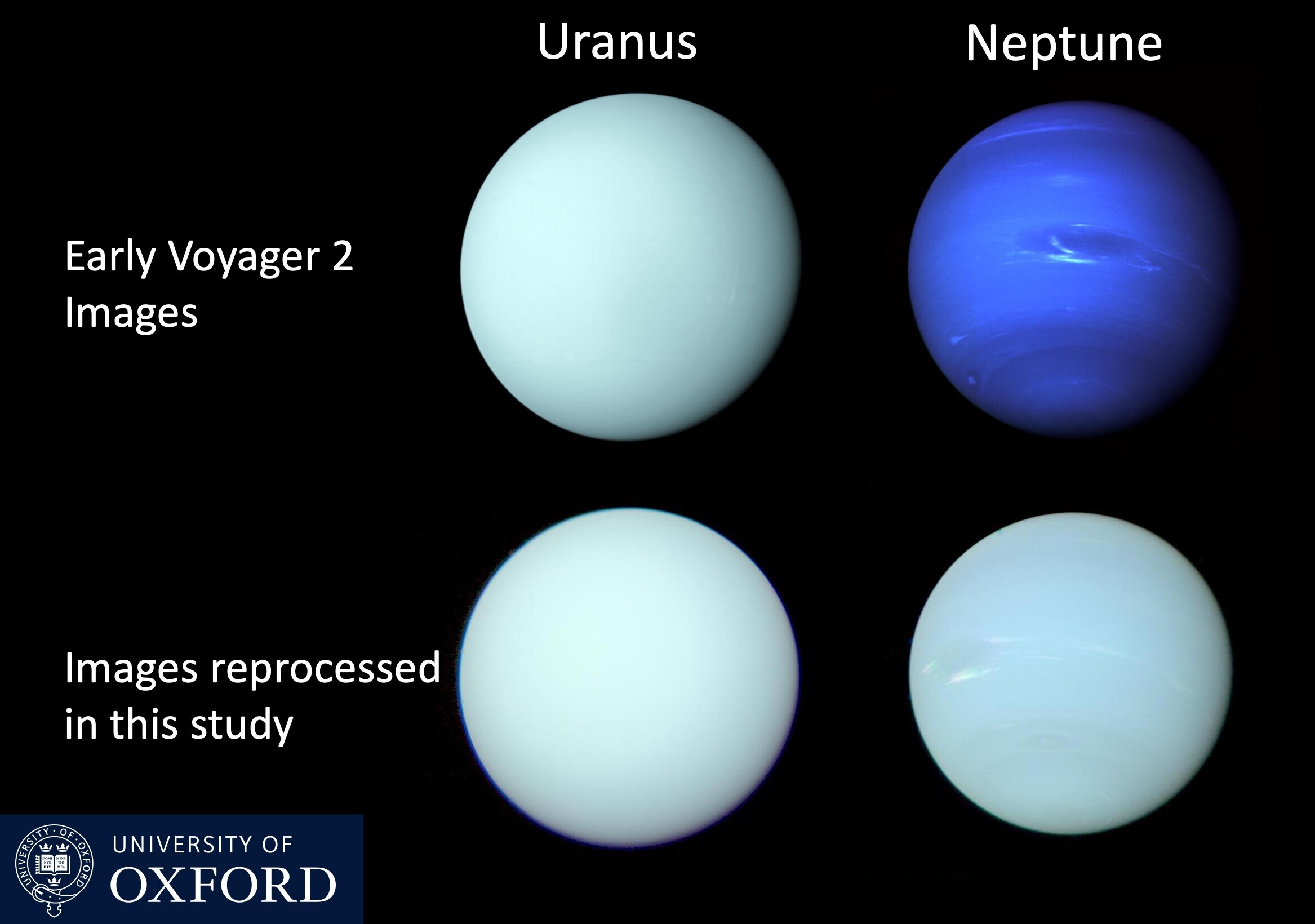
Voyager 2/ISS images of Uranus and Neptune released shortly after the Voyager 2 flybys in 1986 and 1989, respectively, compared with a reprocessing of the individual filter images in this study to determine the best estimate of the true colors of these planets. Credit: Patrick Irwin.

Neptune is fondly known for being a rich blue, and Uranus green—but a new study has revealed that the two ice giants are actually far closer in color than typically thought.

The correct shades of the planets have been confirmed with the help of research led by Professor Patrick Irwin from the University of Oxford, which has been published today in the Monthly Notices of the Royal Astronomical Society.

He and his team found that both worlds are in fact a similar shade of greenish blue, despite the c...

Read More

Webb Rings in Holidays with Ringed Planet Uranus

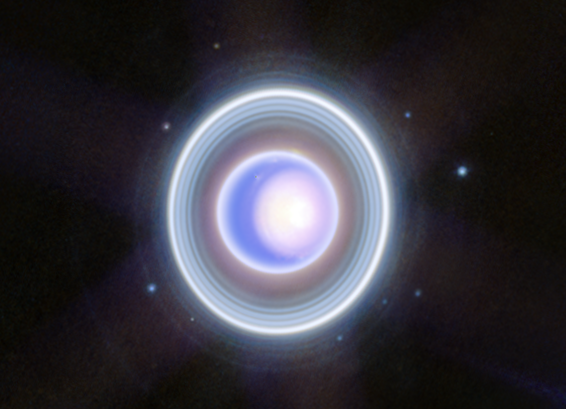
The planet Uranus on a black background. The planet appears blue with a large, white patch taking up the right half. The patch is whitest at the center, then fades into blue at it expands from right to left. A thin outline of Uranus is also white. Around the planet is a system of nested rings. The outermost ring is the brightest while the innermost ring is the faintest. Unlike Saturn’s horizontal rings, the rings of Uranus are vertical and so they appear to surround the planet in an oval shape. There are 9 blueish white dots scattered around the rings.
This image of Uranus from NIRCam (Near-Infrared Camera) on NASA’s James Webb Space Telescope exquisitely captures Uranus’s seasonal north polar cap and dim inner and outer rings. This Webb image also shows 9 of the planet’s 27 moons – clockwise starting at 2 o’clock, they are: Rosalind, Puck, Belinda, Desdemona, Cressida, Bianca, Portia, Juliet, and Perdita.
NASA, ESA, CSA, STScI

The James Webb Space Telescope recently trained its sights on unusual and enigmatic Uranus, an ice giant that spins on its side. Webb captured this dynamic world with rings, moons, storms, and other atmospheric features—including a seasonal polar cap. The image expands upon a two-color version released earlier this year, adding additional wavelength coverage for a more detailed look.

With its exq...

Read More

Water-worlds are common: Exoplanets may contain vast amounts of water

Exoplanets similar to Earth. Credit: NASA

Exoplanets similar to Earth.
Credit: NASA

Scientists have shown that water is likely to be a major component of those exoplanets (planets orbiting other stars) which are between 2 to 4X the size of Earth. It will have implications for the search of life in our Galaxy. The work is presented at the Goldschmidt conference in Boston.

The 1992 discovery of exoplanets orbiting other stars has sparked interest in understanding the composition of these planets to determine, among other goals, whether they are suitable for the development of life. Now a new evaluation of data from the exoplanet-hunting Kepler Space Telescope and the Gaia mission indicates that many of the known planets may contain as much as 50% water. This is much more than the Earth’s 0.02% (by weight) water content...

Read More