Venus tagged posts

Venus ate its moon: How Earth’s ‘twin’ could have swallowed a rocky satellite

Illustration of corona erupting in the southern hemisphere of Venus
Illustration depicts active volcanism in Venus’ southern hemisphere.
(NASA/JPL-Caltech/Peter Rubin)

Scientists have long speculated why Venus, with a size, mass and structure similar to Earth’s, doesn’t have a moon. New UC Riverside research shows that our hungry twin likely swallowed it.

In the past, scientists theorized that Venus possibly had a moon that was hit by something massive, obliterating it. Other theories centered on the idea that Venus never underwent a collision that formed a moon in the first place.

The new research, published in The Astrophysical Journal, shows that neither theory fits.

“My study shows Venus didn’t require a catastrophe to arrive at what we can see today,” said UCR astrophysicist and lead author Stephen Kane...

Read More
Magellan mission reveals possible tectonic activity on Venus

Magellan mission reveals possible tectonic activity on Venus

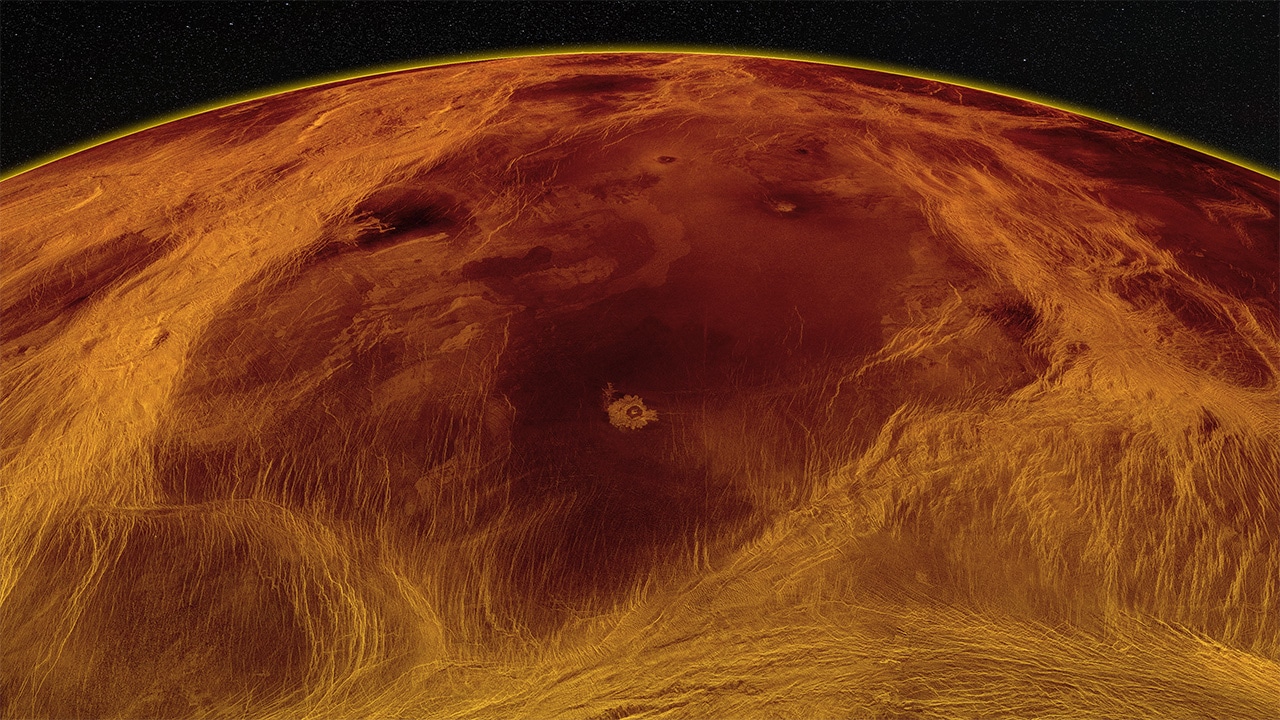
Vast, quasi-circular features on Venus’s surface may reveal that the planet has ongoing tectonics, according to new research based on data gathered more than 30 years ago by NASA’s Magellan mission.

On Earth, the planet’s surface is continually renewed by the constant shifting and recycling of massive sections of crust, called tectonic plates, that float atop a viscous interior. Venus doesn’t have tectonic plates, but its surface is still being deformed by molten material from below.

Seeking to better understand the underlying processes driving these deformations, the researchers studied a type of feature called a corona.

Ranging in size from dozens to hundreds of miles across, a corona is most often thought to be the location where a plume of hot, buoyant material from the p...

Read More

‘Pack Ice’ Tectonics reveal Venus’ Geological Secrets

Venus
An oblique radar view of the largest block in the Venus lowlands identified by Byrne et al. Complex belts of tectonic structures bound the block, but the interior is much less deformed, hosting lava flows and a handful of impact craters. Image: Paul Byrne, based on original NASA/JPL imagery.

A new analysis of Venus’ surface shows evidence of tectonic motion in the form of crustal blocks that have jostled against each other like broken chunks of pack ice. The movement of these blocks could indicate that Venus is still geologically active and give scientists insight into both exoplanet tectonics and the earliest tectonic activity on Earth.

“We’ve identified a previously unrecognized pattern of tectonic deformation on Venus, one that is driven by interior motion just like on Earth,” sa...

Read More

Possible Marker of Life Spotted on Venus

undefined
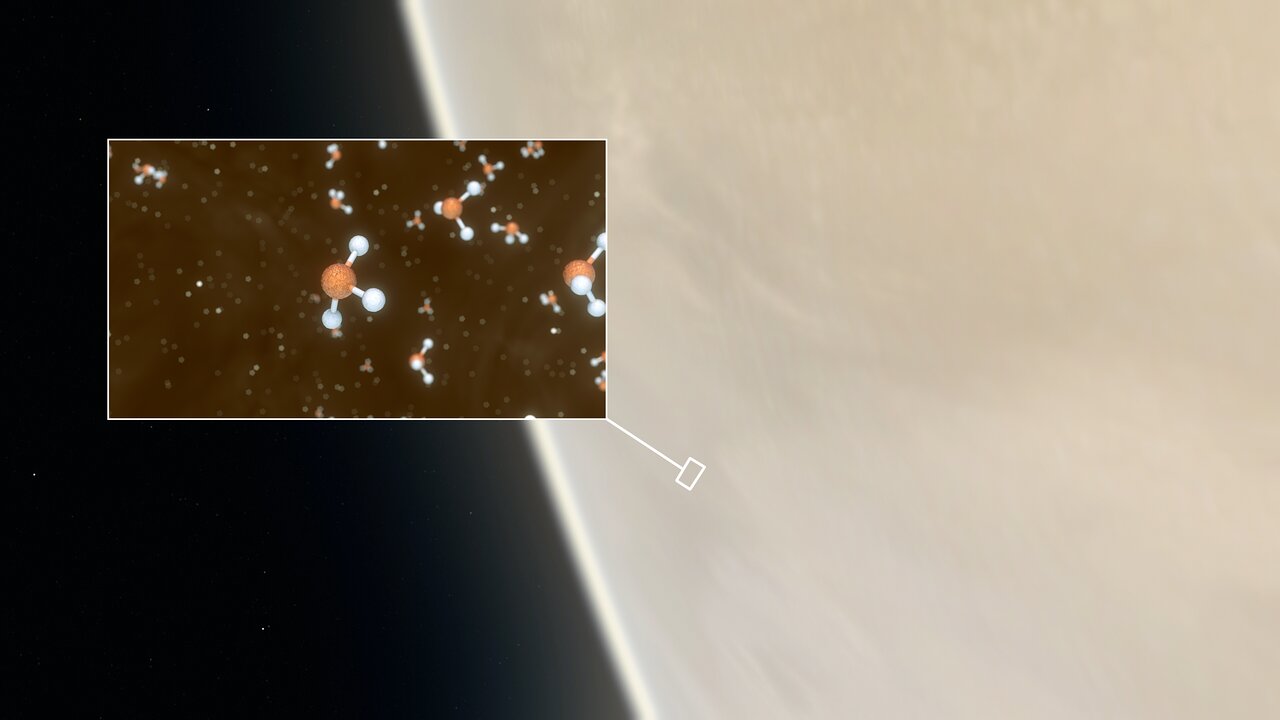
An international team of astronomers today announced the discovery of a rare molecule — phosphine — in the clouds of Venus. On Earth, this gas is only made industrially or by microbes that thrive in oxygen-free environments. Astronomers have speculated for decades that high clouds on Venus could offer a home for microbes — floating free of the scorching surface but needing to tolerate very high acidity. The detection of phosphine could point to such extra-terrestrial “aerial” life.

An international team of astronomers today announced the discovery of a rare molecule – phosphine – in the clouds of Venus. On Earth, this gas is only made industrially or by microbes that thrive in oxygen-free environments...

Read More