
VY Canis Majoris tagged posts

Watching the Death of a Rare Giant Star

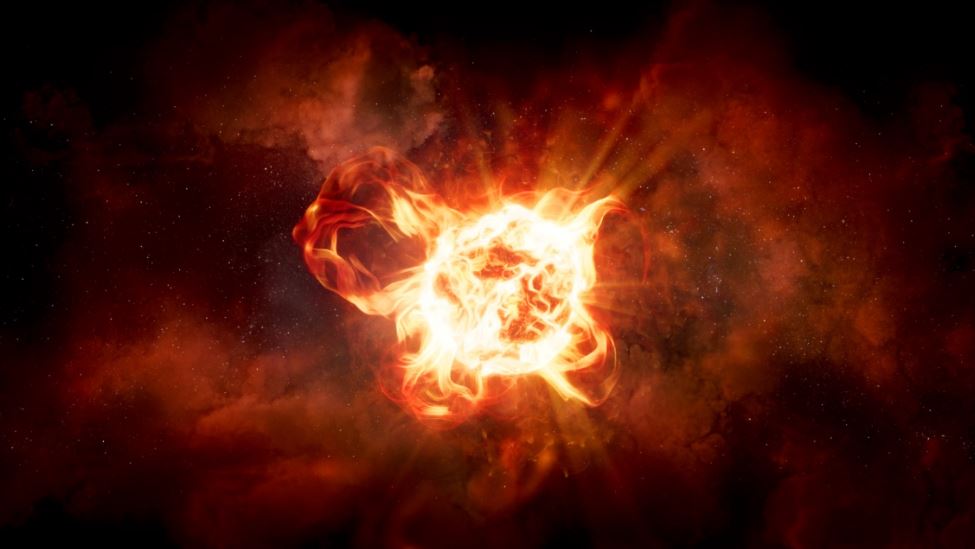
Artist’s impression of the red hypergiant star VY Canis Majoris. Located about 3,009 light-years from Earth, VY Canis Majoris is possibly the most massive star in the Milky Way.NASA / ESA / Hubble / R. Humphreys, University of Minnesota / J. Olmsted, STScI.

A University of Arizona-led team of astronomers has created a detailed, 3D image of a dying hypergiant star. The team, led by UArizona researchers Ambesh Singh and Lucy Ziurys, traced the distribution, directions and velocities of a variety of molecules surrounding a red hypergiant star known as VY Canis Majoris.

Their findings, which they presented on June 13 at the 240th Meeting of the American Astronomical Society in Pasadena, California, offer insights, at an unprecedented scale, into the processes that accompany the death ...

Read More

Aging Star’s Weight Loss Secret revealed

The star VY Canis Majoris is a red hypergiant, one of the largest known stars in the Milky Way. It is 30-40 times the mass of the Sun and 300 000 times more luminous. In its current state, the star would encompass the orbit of Jupiter, having expanded tremendously as it enters the final stages of its life. New observations of the star using the SPHERE instrument on the VLT have clearly revealed how the brilliant light of VY Canis Majoris lights up the clouds of material surrounding it and have allowed the properties of the component dust grains to be determined better than ever before. In this very close-up view from SPHERE the star itself is hidden behind an obscuring disc. The crosses are artefacts due to features in the instrument. Credit: ESO

The star VY Canis Majoris is a red hypergiant, one of the largest known stars in the Milky Way. It is 30-40 times the mass of the Sun and 300 000 times more luminous. In its current state, the star would encompass the orbit of Jupiter, having expanded tremendously as it enters the final stages of its life. New observations of the star using the SPHERE instrument on the VLT have clearly revealed how the brilliant light of VY Canis Majoris lights up the clouds of material surrounding it and have allowed the properties of the component dust grains to be determined better than ever before. In this very close-up view from SPHERE the star itself is hidden behind an obscuring disc. The crosses are artefacts due to features in the instrument. Credit: ESO

Giant star caught in the act of slimming do...

Read More