
wearable devices tagged posts

Highly Stretchable Aqueous Batteries

Schematic showing the sequences in the overall fabrication process. Credit: UNIST

Schematic showing the sequences in the overall fabrication process. Credit: UNIST

A team has succeeded in developing world’s first stretchable aqueous Li-ion batteries that may power the next generation of wearable devices. A recent study, affiliated with UNIST has presented a bioinspired Jabuticaba-like hybrid carbon/polymer (HCP) composite that was developed into a stretchable current collector using a simple and cost-effective solution process. Using the HCP composite as a stretchable current collector, the research team has, for the first time, developed a highly stretchable rechargeable lithium-ion battery (ARLB) based on aqueous electrolytes.

Stretchable electronic devices have recently attracted tremendous attention as next-generation devices due to their immense flexibility...

Read More
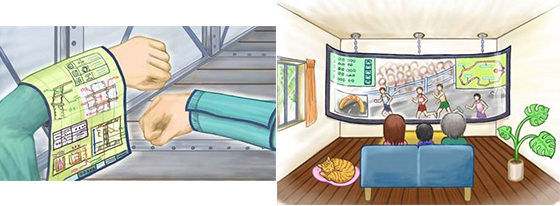
Super-Flexible Liquid Crystal device for Bendable and Rollable Displays

XXXXXXX

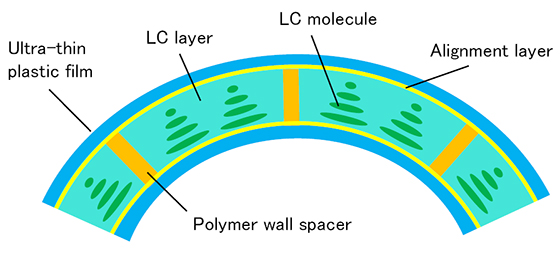
The structure of super-flexible LC device is created by ultra-thin plastic substrates bonded by polymer wall spacers.

The structure of super-flexible LC device is created by ultra-thin plastic substrates bonded by polymer wall spacers.

Researchers at Tohoku University have developed a super flexible liquid crystal (LC) device, in which 2 ultra-thin plastic substrates are firmly bonded by polymer wall spacers. The team, led by Professor Hideo Fujikake and Associate Professor Takahiro Ishinabe of the School of Engineering, hopes the new organic materials will help make electronic displays and devices more flexible, increasing their portability and all round versatility. New usage concepts with flexibility and high quality display could offer endless possibilities in near-future information services.

Previous attempts to create a flexible display using an organic light-emitting diode (OLED) device with a th...

Read More

3D Printing Lightweight, Flexible, and Functional Materials

An Impeller-based active mixer. Each fluid enters the mixing chamber through a separate inlet and is mixed in a narrow gap by an impeller rotating at a constant rate. Credit: Thomas Ober, Harvard SEAS/Wyss Institute

An Impeller-based active mixer. Each fluid enters the mixing chamber through a separate inlet and is mixed in a narrow gap by an impeller rotating at a constant rate. Credit: Thomas Ober, Harvard SEAS/Wyss Institute

>>Researchers have designed new multimaterial printheads that mix and print concentrated viscoelastic inks that allow for the simultaneous control of composition and geometry during printing. Using active mixing and fast-switching nozzles, these novel printheads change material composition on the fly and could pave the way for entirely 3D printed wearable devices, soft robots, and electronics.

To print a flexible device, including the electronics, a 3D printer must be able to seamlessly transition from a flexible material that moves with your joints for wearable applications, t...

Read More