wearable electronics tagged posts

Eco-friendly Micro-supercapacitors using Fallen Leaves?

 Image: The schematic illustration of the production of femtosecond laser-induced graphene.

Femtosecond micro-supercapacitors on a single leaf could easily be applied to wearable electronics, smart houses, and IoTs. A KAIST research team has developed a graphene-inorganic-hybrid micro-supercapacitor made of leaves using femtosecond direct laser writing lithography. The advancement of wearable electronic devices is synonymous with innovations in flexible energy storage devices. Of the various energy storage devices, micro-supercapacitors have drawn a great deal of interest for their high electrical power density, long lifetimes, and short charging times.

However, there has been an increase in waste battery generation with the increases in the consumption and use of electronic equipme...

Read More
Soft Skin Patch could provide early warning for Strokes, Heart Attacks

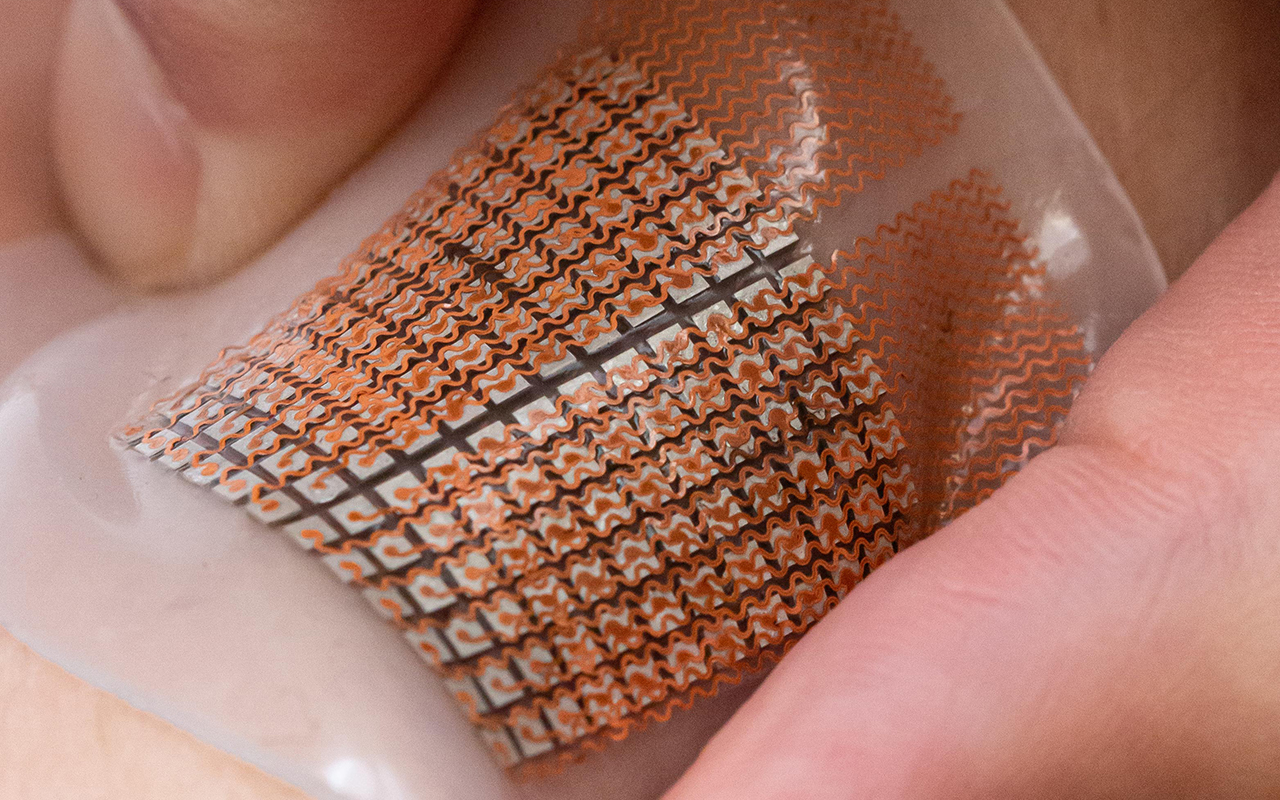
Two fingers press down on a soft, electronic patch against the skin.
This soft, stretchy skin patch uses ultrasound to monitor blood flow to organs like the heart and brain. This image was selected as the cover image for the July 2021 issue of Nature Biomedical Engineering.

Engineers at the University of California San Diego developed a soft and stretchy ultrasound patch that can be worn on the skin to monitor blood flow through major arteries and veins deep inside a person’s body.

Knowing how fast and how much blood flows through a patient’s blood vessels is important because it can help clinicians diagnose various cardiovascular conditions, including blood clots; heart valve problems; poor circulation in the limbs; or blockages in the arteries that could lead to strokes or heart attacks.

The new ultrasound patch developed at UC San Diego can con...

Read More

Fish Scales could make Wearable Electronics more Sustainable

This film derived from fish scales could someday be used in flexible electronic devices.
Credit:: Adapted from ACS Nano 2020, DOI: 10.1021/acsnano.9b09880

Flexible temporary electronic displays may one day make it possible to sport a glowing tattoo or check a reading, like that of a stopwatch, directly on the skin. In its current form, however, this technology generally depends on plastic. New research in ACS Nano describes a way to make these displays, which would likely be discarded after a single use, more environmentally friendly using a plentiful and biodegradable resource: fish scales.

Within such displays, electricity-conducting and light-emitting components are layered onto a transparent film...

Read More

A Wearable Device so Thin and Soft you Won’t Even Notice It

Yu wearable HMI
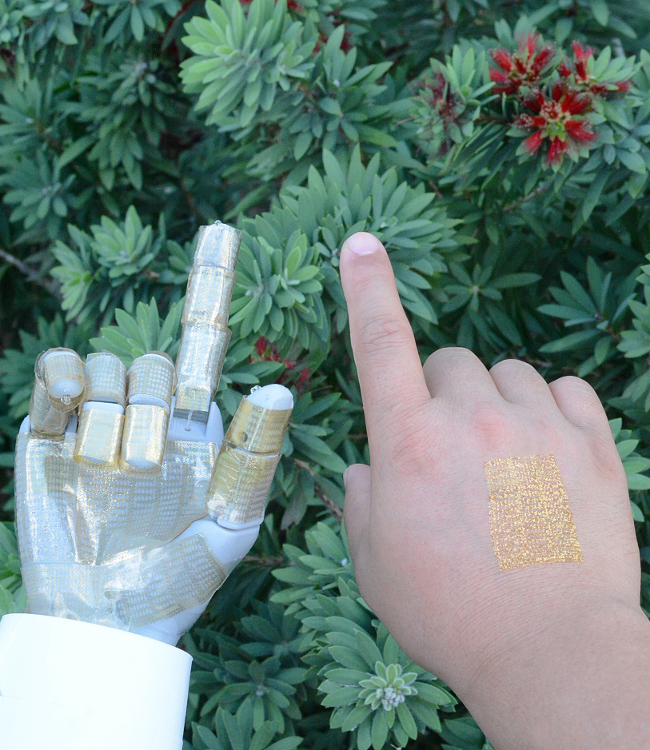
Cunjiang Yu, Bill D. Cook Associate Professor of Mechanical Engineering at UH, led a project to develop a multifunctional, ultra-thin wearable human-machine interface.

Device also can serve as robotic skin, relaying information back to the user. Wearable human-machine interfaces – devices that can collect and store important health information about the wearer, among other uses – have benefited from advances in electronics, materials and mechanical designs. But current models still can be bulky and uncomfortable, and they can’t always handle multiple functions at one time.

Researchers reported Friday, Aug. 2, the discovery of a multifunctional ultra-thin wearable electronic device that is imperceptible to the wearer.

The device allows the wearer to move naturally and is less no...

Read More