Courtesy of NASA/ESA/CSA/Alyssa Pagan (STScI)/Geronimo Villanueva (NASA-GSFC) SwRI contributed to new Cycle 1 JWST findings that show the plume of water escaping from Saturn’s moon Enceladus extends 6,000 miles or more than 40 times the moon’s size. In light of this discovery, SwRI’s Dr. Christopher Glein was awarded a NASA JWST Cycle 2 allocation to study the plume as well as the icy surface of Enceladus, to better understand the potential habitability of this ocean world.
Two Southwest Research Institute scientists were part of a James Webb Space Telescope (JWST) team that observed a towering plume of water vapor more than 6,000 miles long—roughly the distance from the U.S. to Japan—spewing from the surface of Saturn’s moon, Enceladus...
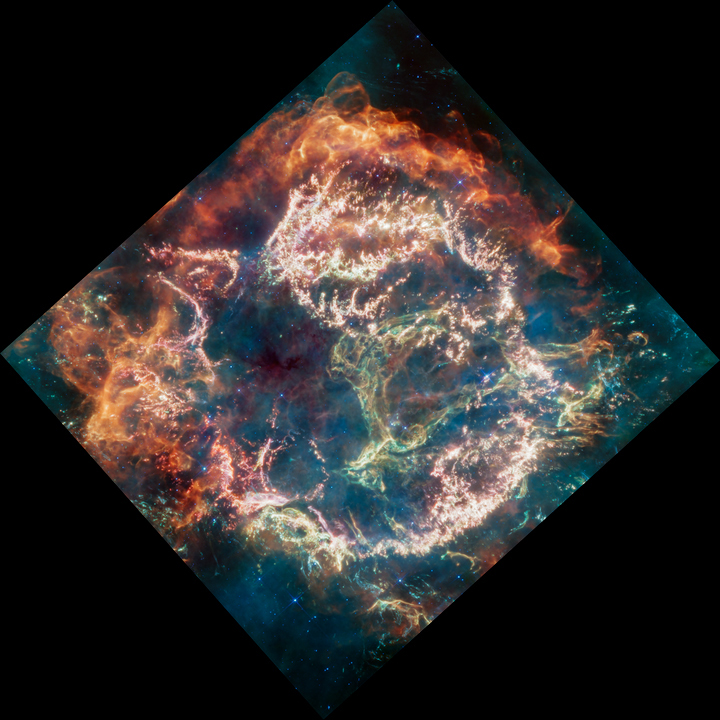
Danny Milisavljevic’s research on the James Webb Space Telescope led to his new detailed image of stellar remnant Cassiopeia A in which infrared light is translated into visible-light wavelengths. (NASA image)
To gaze at the stars is human. To be able to see them in 3D detail is very nearly divine. Divine vision is what the James Webb Space Telescope has granted Earthbound scientists in a new near-infrared, detailed image of Cassiopeia A (Cas A), a stellar remnant—the clouds of gas, dust and other material left behind when a star dies. Danny Milisavljevic, assistant professor of physics and astronomy in Purdue University’s College of Science, studies supernova remnants and leads a year one research team on the JWST examining Cas A.
“I have spent 17 years studying stars and their ...
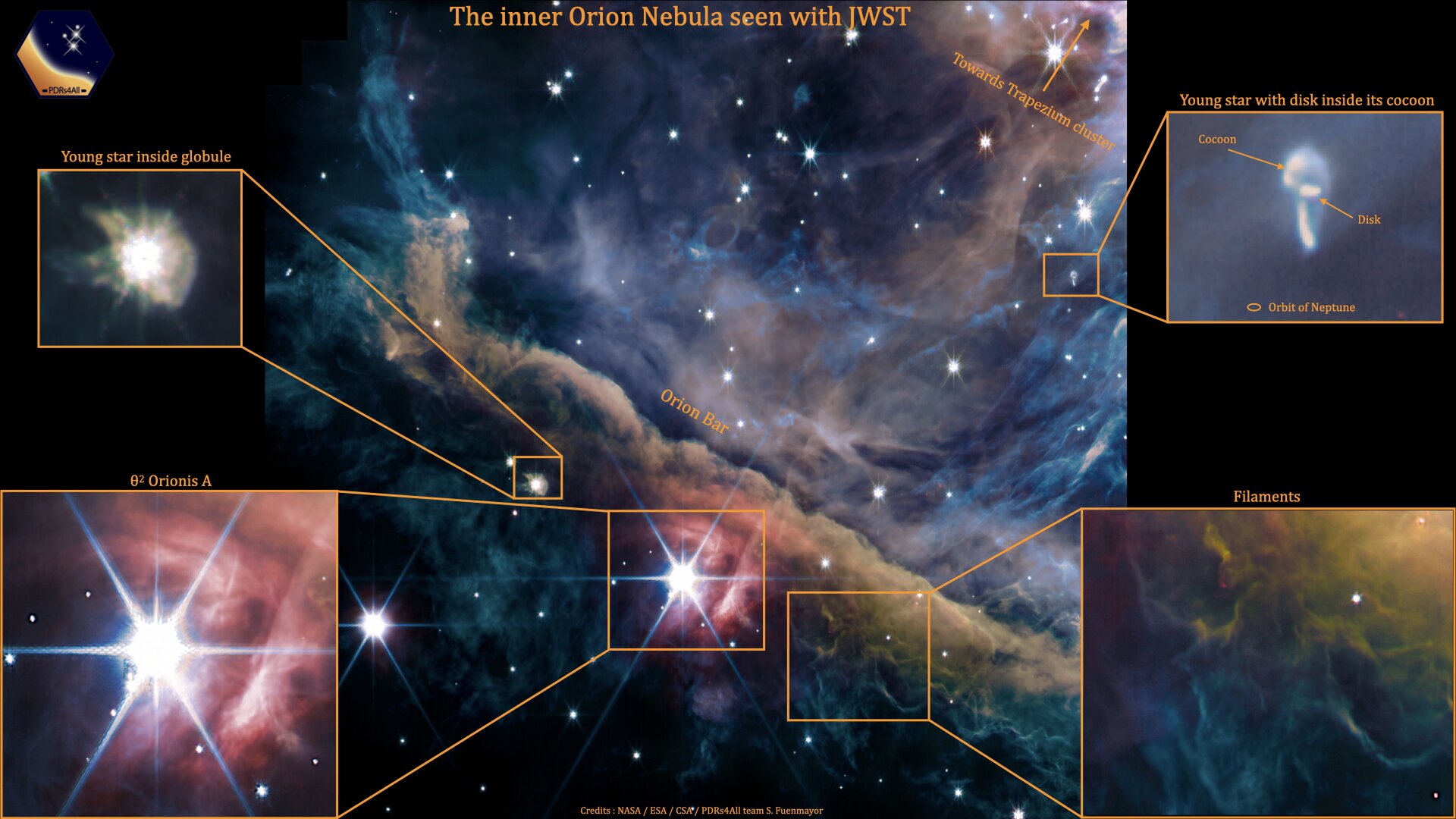
The wall of dense gas and dust resembles a massive winged creature, its glowing maw lit by a bright star as it soars through cosmic filaments.
An international research team on Monday revealed the first images of the Orion Nebula captured with the James Webb Space Telescope, leaving astronomers “blown away.”
The stellar nursery is situated in the constellation Orion, 1,350 light-years away from Earth, in a similar setting in which our own solar system was birthed more than 4.5 billion years ago.
Astronomers are interested in the region to better understand what happened during the first million years of our planetary evolution.
The images were obtained as part of the Early Release Science program and involved more than 100 scientists in 18 countries, with insti...
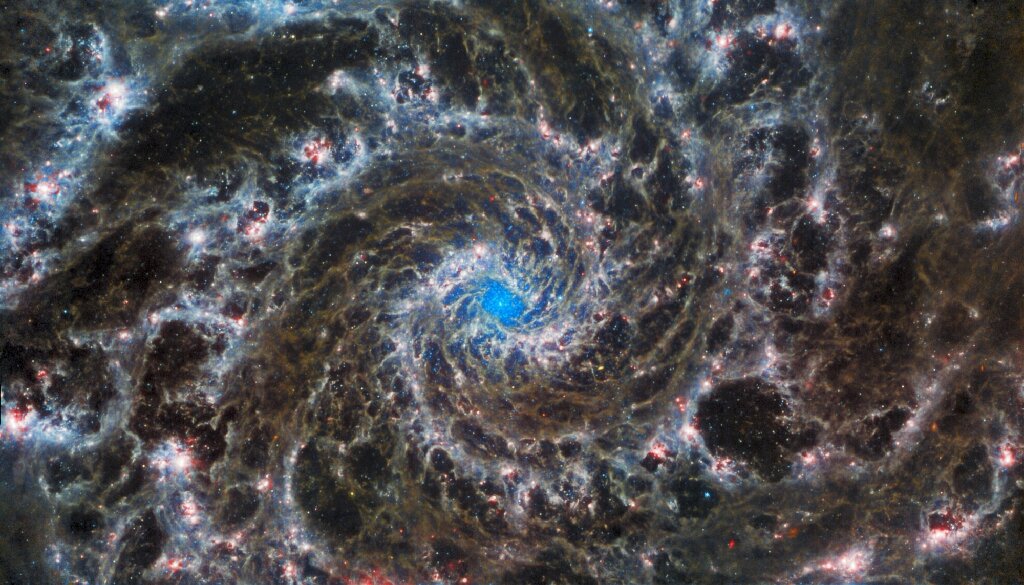
The Phantom Galaxy is a “favorite target for astronomers studying the origin and structure of galactic spirals,” NASA and the ESA said.
The James Webb space telescope has revealed dazzling new detail of a previously known slice of the cosmos 32 million light-years away, in a new picture released by NASA and the European Space Agency (ESA).
The infrared technology of the telescope, launched in December 2021, has allowed for an even clearer view of the so-called Phantom Galaxy than astronomers had ever seen before.
“Webb’s sharp vision has revealed delicate filaments of gas and dust in the grandiose spiral arms which wind outwards from the center of this image,” NASA and the ESA said Monday.
“A lack of gas in the nuclear region also provides an unobscured view of the nuclear sta...





Recent Comments