
Webb tagged posts

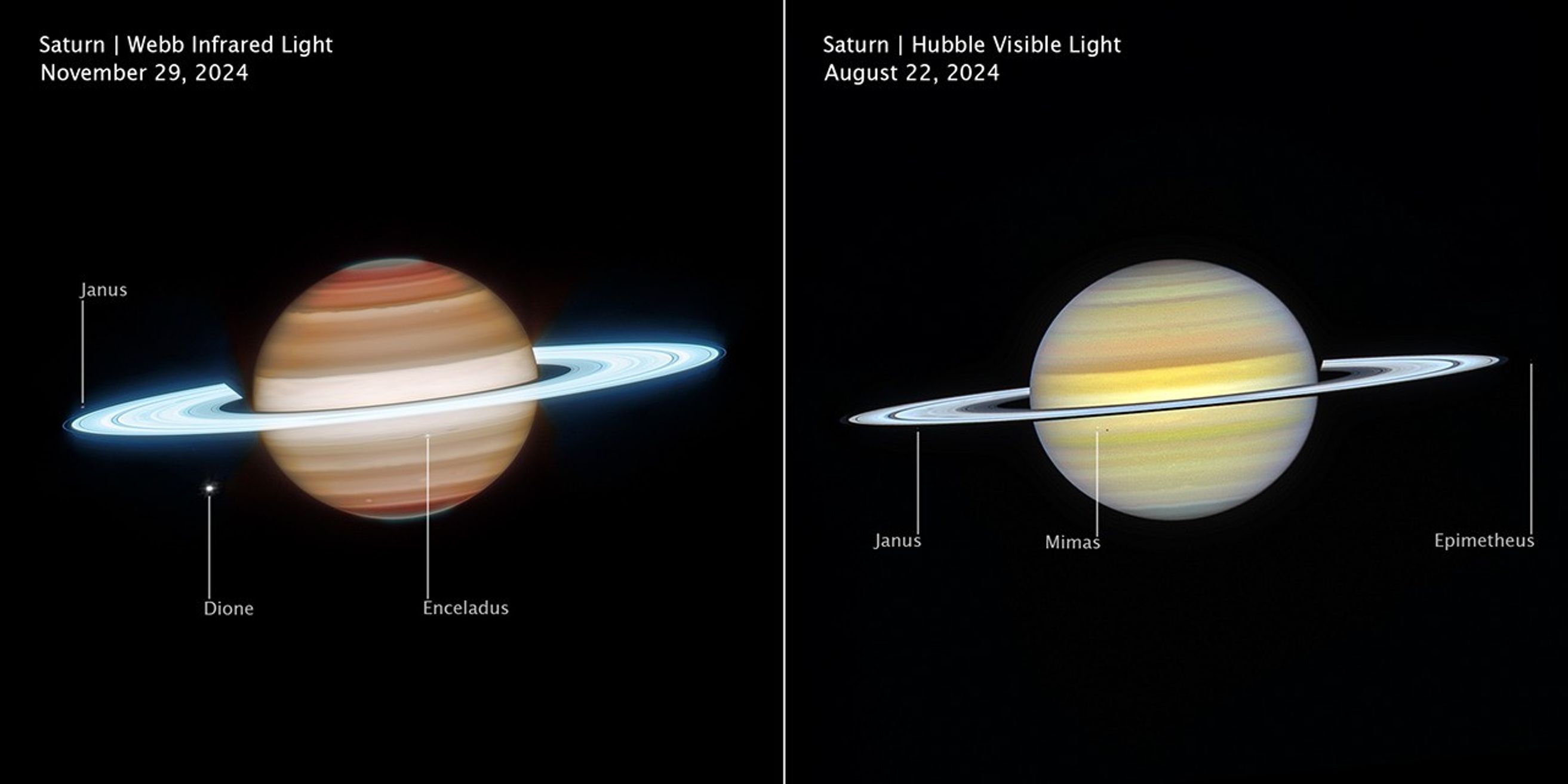
Webb and Hubble share the most comprehensive view of Saturn to date

Side-by-side comparison of Saturn observed at different wavelengths and times show how differently it appears in infrared, on the left, versus visible light, on the right. Left image is labeled Saturn, Webb Infrared Light, November 29, 2024. Right image is labeled Saturn, Hubble Visible Light, August 22, 2024.
In infrared, Saturn has horizontal bands, with bands at the north and south poles appearing darker orange and lightening to tan as they approach the equator. The north and south poles glow a greenish-grey. The rings appear in an icy neon white. White dots, representing several of Saturn’s moons, are labeled Janus, Dione, and Enceladus.
In visible, Saturn’s horizontal bands appear pale yellow, with some bands towards the north and south pole having a light blue hue. The rings appear bright white, glowing slightly less than Webb’s infrared image. White dots, representing several of Saturn’s moons, are labeled Janus, Mimas, and Epimetheus.
Complementary views of Saturn from NASA’s James Webb Space Telescope and Hubble Space Telescope show a dynamic planet with atmospheric features, orbiting moons, and bright rings.
Image: NASA, ESA, CSA, STScI, Amy Simon (NASA-GSFC), Michael Wong (UC Berkeley); Image Processing: Joseph DePasquale (STScI)

NASA’s James Webb Space Telescope and Hubble Space Telescope have teamed up to capture new views of Saturn, revealing the planet in strikingly different ways. Observing in complementary wavelengths of light, the two space observatories provide scientists with a richer, more layered understanding of the gas giant’s atmosphere.

Both sense sunlight reflected from Saturn’s banded clouds and hazes, but where Hubble reveals subtle color variations across the planet, Webb’s infrared view se...

Read More
Webb spots first hints of atmosphere on a potentially habitable world

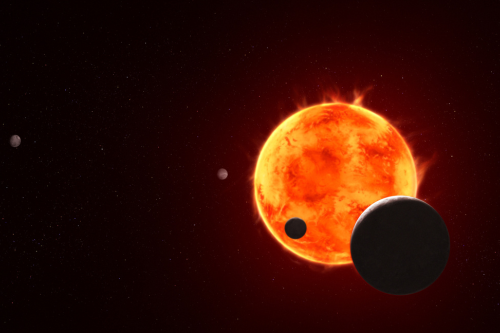
The Earth-size exoplanet TRAPPIST-1 e, depicted at the lower right, is silhouetted as it passes in front of its flaring host star in this artist’s concept of the TRAPPIST-1 system.
Image credit: NASA, ESA, CSA, J. Olmsted (STScI)

Hints of an atmosphere on TRAPPIST-1e raise hopes it could be a watery, potentially habitable world. Astronomers using the James Webb Space Telescope are unraveling the mysteries of TRAPPIST-1e, an Earth-sized exoplanet 40 light years away that could harbor liquid water. Early data suggests hints of an atmosphere, but much remains uncertain. Researchers have already ruled out a hydrogen-rich primordial atmosphere, pointing instead to the possibility of a secondary atmosphere that could sustain oceans or ice.

University of Bristol astrophysicists are helpin...

Read More

NASA’s Hubble, Webb probe surprisingly Smooth Disk around Vega

Teams of astronomers used the combined power of NASA’s Hubble and James Webb space telescopes to revisit the legendary Vega disk.

In the 1997 movie “Contact,” adapted from Carl Sagan’s 1985 novel, the lead character scientist Ellie Arroway (played by actor Jodi Foster) takes a space-alien-built wormhole ride to the star Vega. She emerges inside a snowstorm of debris encircling the star — but no obvious planets are visible.

It looks like the filmmakers got it right.

A team of astronomers at the University of Arizona, Tucson used NASA’s Hubble and James Webb space telescopes for an unprecedented in-depth look at the nearly 100-billion-mile-diameter debris disk encircling Vega. “Between the Hubble and Webb telescopes, you get this very clear view of Vega...

Read More

Webb Captures Iconic Horsehead Nebula in Unprecedented Detail

The NASA/ESA/CSA James Webb Space Telescope has captured the sharpest infrared images to date of one of the most distinctive objects in our skies, the Horsehead Nebula. These observations show a part of the iconic nebula in a whole new light, capturing its complexity with unprecedented spatial resolution.

Webb’s new images show part of the sky in the constellation Orion (The Hunter), in the western side of the Orion B molecular cloud. Rising from turbulent waves of dust and gas is the Horsehead Nebula, otherwise known as Barnard 33, which resides roughly 1,300 light-years away.

The nebula formed from a collapsing interstellar cloud of material, and glows because it is illuminated by a nearby hot star...

Read More