Parameter space showing the effect of GR on eccentricity oscillations due to an exterior planetary companion for a variety of combinations of the mass ratio m2/m1 and semi-major axis ratio a2/a1. Credit: arXiv (2025). DOI: 10.48550/arxiv.2509.26421
In the hunt for extraterrestrial life, we usually look for planets orbiting sun-like stars and icy moons. But there is another possible candidate—planets circling white dwarfs, the hot, dense remnants of dead stars.
A white dwarf is what is left when a star like our sun runs out of fuel and sheds its outer layers...
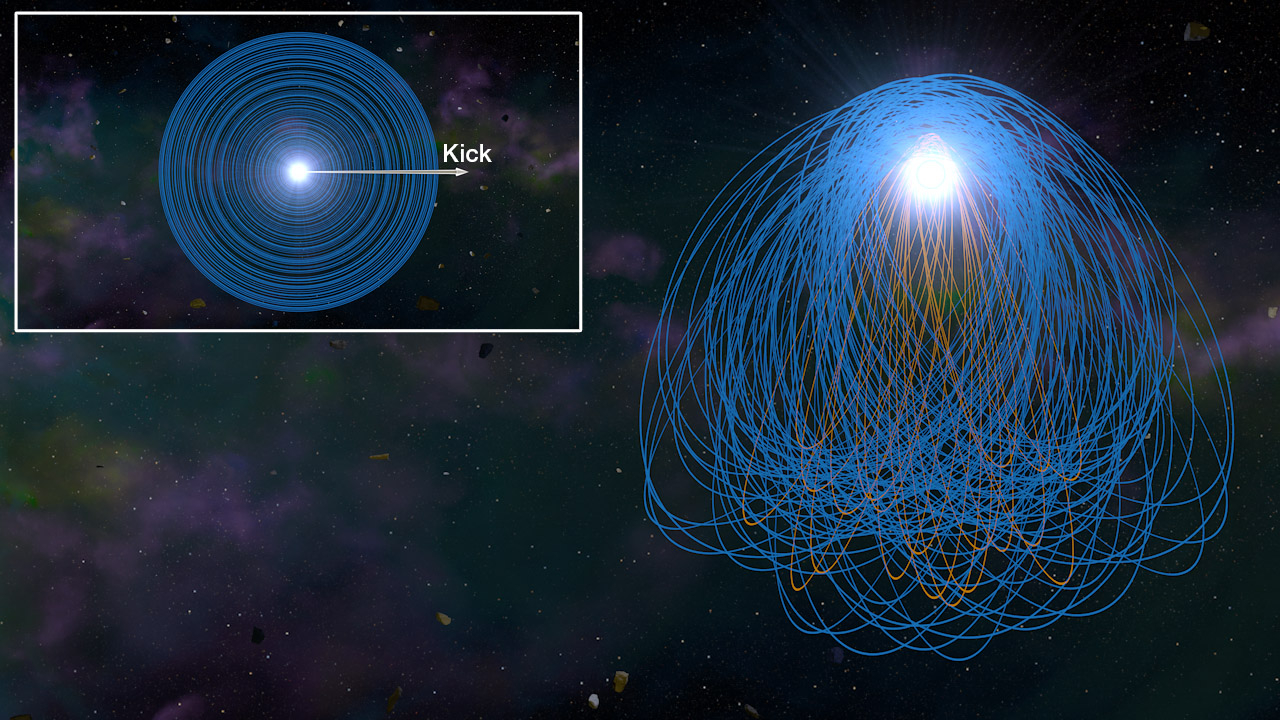
Planetesimal orbits around a white dwarf. Initially, every planetesimal has a circular, prograde orbit. The kick forms an eccentric debris disk which with prograde (blue) and retrograde orbits (orange). Image Credit Steven Burrows/Madigan group
Dead stars known as white dwarfs, have a mass like the sun while being similar in size to Earth. They are common in our galaxy, as 97% of stars are white dwarfs. As stars reach the end of their lives, their cores collapse into the dense ball of a white dwarf, making our galaxy seem like an ethereal graveyard.
Despite their prevalence, the chemical makeup of these stellar remnants has been a conundrum for astronomers for years...
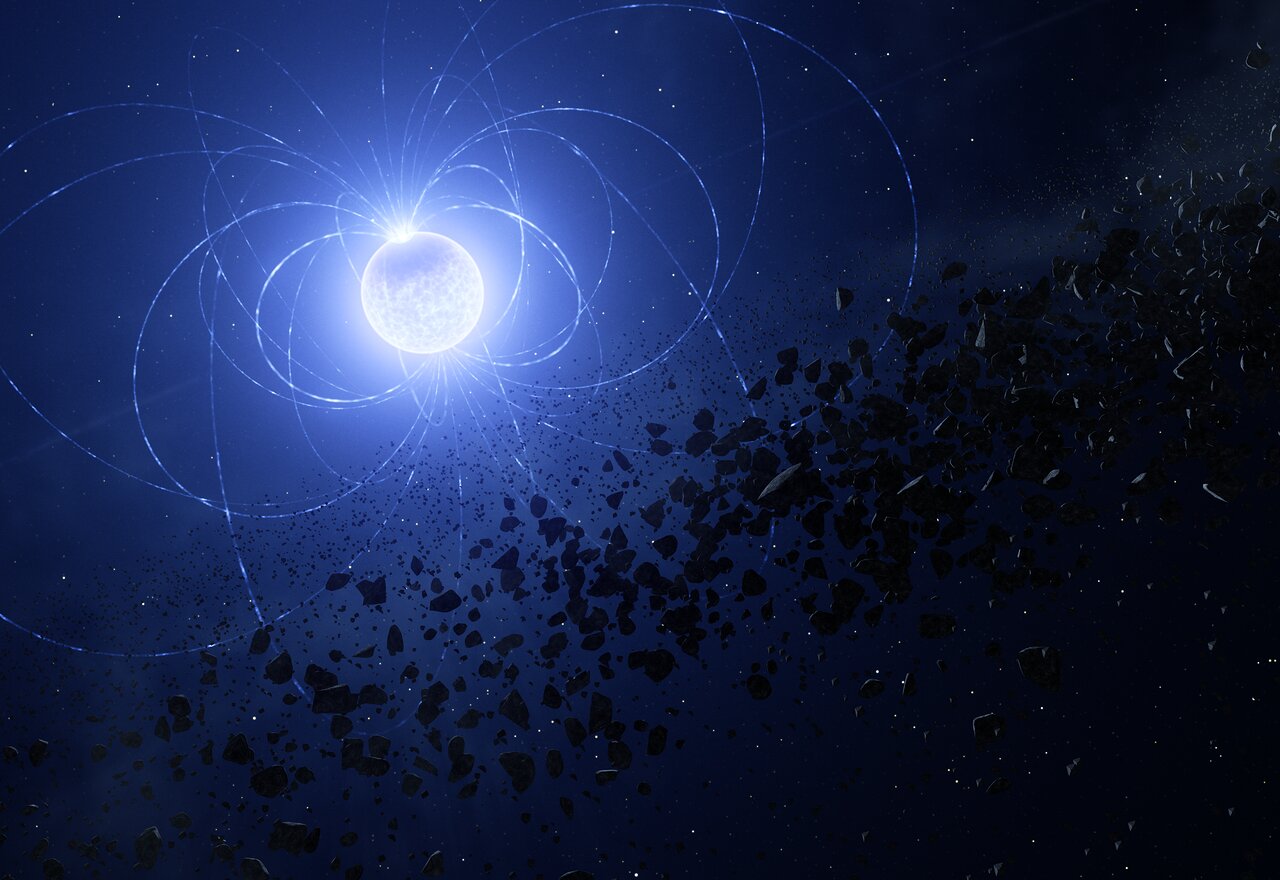
When a star like our Sun reaches the end of its life, it can ingest the surrounding planets and asteroids that were born with it. Now, using the European Southern Observatory’s Very Large Telescope (ESO’s VLT) in Chile, researchers have found a unique signature of this process for the first time — a scar imprinted on the surface of a white dwarf star. The results are published today in The Astrophysical Journal Letters.
When a star like our Sun reaches the end of its life, it can ingest the surrounding planets and asteroids that were born with it. Now, using the European Southern Observatory’s Very Large Telescope (ESO’s VLT) in Chile, researchers have found a unique signature of this process for the first time — a scar imprinted on the surface of a white dwarf star...
An impression of the high-mass X-ray binary called Cygnus X-1. It consists of a blue supergiant star (right) called HDE 226868, orbiting what is in all likelihood a black hole. The black hole is sucking gas from the blue star’s atmosphere, leading to the formation of an accretion disc around the black hole.
The moment that debris from destroyed planets impacts the surface of a white dwarf star has been observed for the first time by astronomers at the University of Warwick.
They have used Xrays to detect the rocky and gaseous material left behind by a planetary system after its host star dies as it collides and is consumed within the surface of the star.
Published today (9 February) in the journal Nature, the results are the first direct measurement of the accretion of rocky mate...







Recent Comments