white dwarfs tagged posts

How Stars form in the Smallest Galaxies

Image: ESO
Image: ESO

The question of how small, dwarf galaxies have sustained the formation of new stars over the course of the Universe has long confounded the world’s astronomers. An international research team led by Lund University in Sweden has found that dormant small galaxies can slowly accumulate gas over many billions of years. When this gas suddenly collapses under its own weight, new stars are able to arise.

There are around 2,000 billion galaxies in our Universe and, while our own Milky-Way encompasses between 200 and 400 billion stars, small dwarf galaxies contain only a thousand times less. How stars are formed in these tiny galaxies has long been shrouded in mystery.

However, in a new study published in the research journal Monthly Notices of the Royal Astronomical Society, a resea...

Read More

Dying Stars Breathe Life into Earth: Study

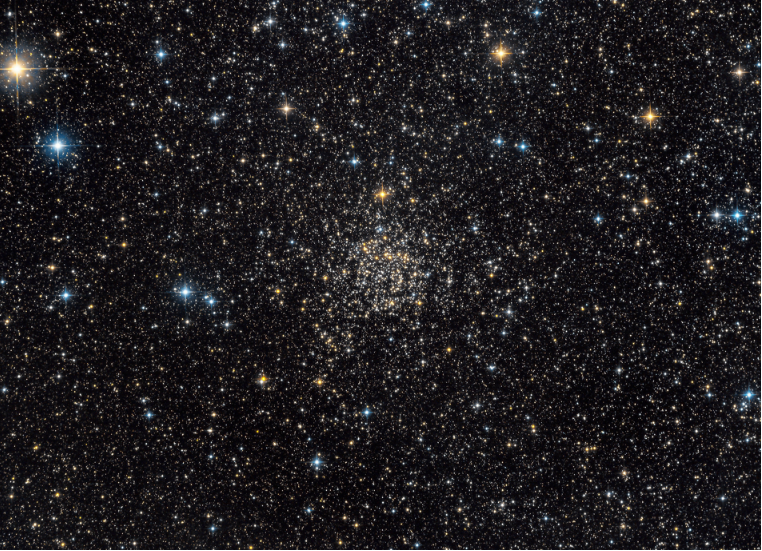
NGC 7789, also known as Caroline’s Rose, is an old open star cluster of the Milky Way, which lies about 8,000 light-years away toward the constellation Cassiopeia. It hosts a few White Dwarfs of unusually high mass, analyzed in this study.
Credit: Guillaume Seigneuret and NASA

As dying stars take their final few breaths of life, they gently sprinkle their ashes into the cosmos through the magnificent planetary nebulae. These ashes, spread via stellar winds, are enriched with many different chemical elements, including carbon.

Findings from a study published today in Nature Astronomy show that the final breaths of these dying stars, called white dwarfs, shed light on carbon’s origin in the Milky Way.

“The findings pose new, stringent constraints on how and when carbon was produce...

Read More

Detonating White Dwarfs as Supernovae

Hubble Space Telescope image of supernova 1994D in galaxy NGC 4526 © NASA/ESA

Hubble Space Telescope image of supernova 1994D in galaxy NGC 4526 © NASA/ESA

A new math model details a way that dead stars called white dwarfs could detonate, producing a type of explosion that is instrumental to measuring the extreme distances in our universe. The mechanism, described in the Monthly Notices of the Royal Astronomical Society, could improve our understanding of how Type Ia supernovae form. “Type Ia supernovae are extremely important objects in physics, best known for their role in revealing that the expansion of the universe is accelerating,” said Prof. Saavik Ford. “The problem is that people do not agree on exactly how Type Ia supernovae come to be.”

Current research indicates that Type Ia supernova explosions originate from binary star systems – two stars orbiting one...

Read More

Trigger for Milky Way’s Youngest Supernova identified

Supernova G1.9+0.3. Credit: NASA/CXC/CfA/S. Chakraborti et al.

Supernova G1.9+0.3. Credit: NASA/CXC/CfA/S. Chakraborti et al.

Scientists have used data from NASA’s Chandra X-ray Observatory and the NSF’s Jansky Very Large Array to determine the likely trigger for the most recent supernova in the Milky Way. They applied a new technique that could have implications for understanding other Type Ia supernovas, a class of stellar explosions that scientists use to determine the expansion rate of the Universe.

Astronomers had previously identified G1.9+0.3 as the remnant of the most recent supernova in our Galaxy, Type Ia category. It is estimated to have occurred about 110 years ago in a dusty region of the Galaxy that blocked visible light from reaching Earth...

Read More