
Wide-field Infrared Transient Explorer (WINTER) tagged posts

Webb confirms first-of-its-kind merger of a supergiant and smaller sun-like star

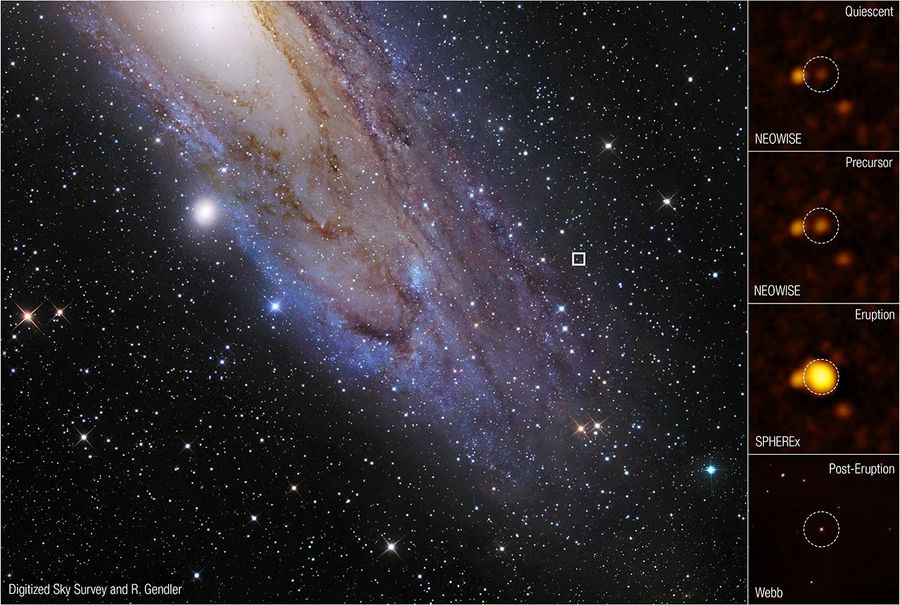
About half of the Andromeda galaxy takes up most of the view. The galaxy’s core, top left, looks like a bright white dot emanating light. The galaxy’s edges are bright blue, with irregular semi-circles of dark brown dust. The black background is dotted with stars and galaxies. A small box with a thick white outline is toward the right blue edge of Andromeda, with a white pinpoint within it. Label, bottom left: Digitized Sky Survey and R. Gendler. Four vertical boxes on the right show the star observed at different times by three telescopes. The star is circled at the center with a dashed line. Top to bottom: NEOWISE image of the quiescent phase shows a small, dim, blurry star that takes up about half the dotted circle; NEOWISE image of the precursor phase shows a slightly more opaque, larger orange blob; SPHEREx image of the eruption shows a large bright yellow circle that almost meets the edges of the dashed circle. Webb’s image of the post-eruption shows a tiny red-and-white dot.
In December 2025, observations from NASA’s James Webb Space Telescope provided the final evidence that allowed researchers to fully reconstruct what happened before, during, and after the merger of a binary star system nicknamed Bao in the Andromeda galaxy.
Image: NASA, ESA, CSA, STScI, Viraj Karambelkar (Columbia), Kishalay De (Columbia); Image Processing: Alyssa Pagan (STScI); Acknowledgment: DSS, Robert Gendler

Researchers recently identified a first of its kind: A star slightly less massive than the sun spiraled into and merged with a puffy supergiant star on the outskirts of our neighboring Andromeda galaxy. They nicknamed the newly single, potentially “rejuvenated” star Bao...

Read More