



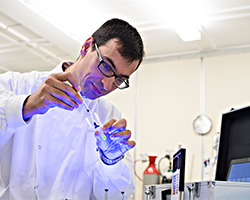
Image: Dr Nuno Reis demonstrates how the disposable microfluidic test strip works.
Academics hope to boost early detection rates of cancer in developing countries with their portable lab-in-a-briefcase that can operate even at high temperatures. Believed to be the 1st kit of its kind dedicated to the portable measurement of cancer biomarkers, the concept is the brainchild of Dr Nuno Reis, a Lecturer in Chemical Engineering.
The number of people dying from cancer in developing countries is on the increase, partly due to steadily ageing populations, but also due to limited access to proper diagnostic tools. Cancer is a leading cause of death worldwide, accounting for >8 million deaths/ yr, and 70% of the world’s cancer deaths occur in Africa, Asia and Central and South America. The number of new cancer cases is expected to rise by 70% over the next 2 decades.
One of the remarkable features of the lab-in-a-briefcase is that it uses whole blood without the need for any sample preparation -a previously challenging task outside of a laboratory setting. A new affordable and disposable microfluidic test strip – comprising of tiny tubes about the size of a human hair – is used specifically for the quick measurement of different types of cancer biomarkers in a whole blood sample. This technology has already been used successfully by Dr Reis in a separate study that detected prostate cancer with the help of a smartphone camera.
“This portable lab can really make a difference, boosting levels of cancer detection in developing countries where ordinarily people would not have such easy access to early diagnostics. I envisage that our lab-in-a-briefcase could also be developed further in the future to allow for rapid testing of infectious diseases and allergens.” http://www.lboro.ac.uk/news-events/news/2015/october/lab-in-a-briefcase.html
.


Recent Comments