



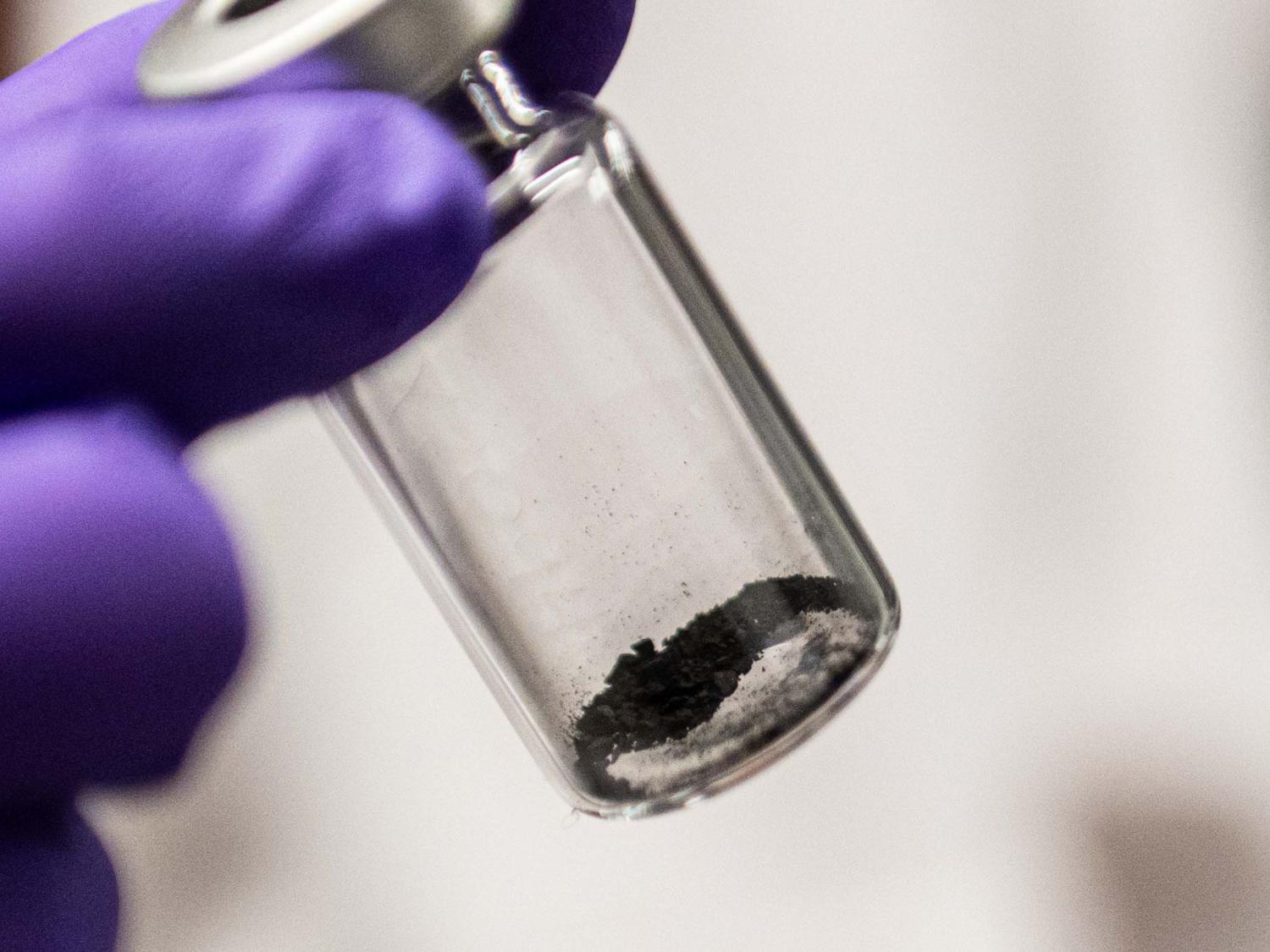
Amino acids, the building blocks necessary for life, were previously found in samples of 4.6-billion-year-old rocks from an asteroid called Bennu, delivered to Earth in 2023 by NASA’s OSIRIS-REx mission. How those amino acids—the molecules that create proteins and peptides in DNA—formed in space was a mystery, but new research led by Penn State scientists shows they could have originated in an icy-cold, radioactive environment at the dawn of Earth’s solar system.
According to the researchers, who published new findings in the Proceedings of the National Academy of Sciences, some amino acids in the asteroid Bennu samples likely formed in a different way than was previously thought, in the harsh conditions of the early solar system.
Rethinking how space amino acids form
“Our results flip the script on how we have typically thought amino acids formed in asteroids,” said Allison Baczynski, assistant research professor of geosciences at Penn State and co-lead author on the paper.
“It now looks like there are many conditions where these building blocks of life can form, not just when there’s warm liquid water. Our analysis showed that there’s much more diversity in the pathways and conditions in which these amino acids can be formed.”
Analyzing a precious bit of space dust no bigger than a teaspoon, the team used custom instruments capable of measuring isotopes, slight variations in the mass of atoms.
In studying Bennu, the researchers focused on glycine, the simplest amino acid, a tiny two‑carbon molecule that serves as one of life’s basic building blocks. Amino acids link together to form proteins, which carry out nearly every biological function—from building cells to catalyzing chemical reactions.
Glycine can form under a wide range of chemical conditions and it’s often considered a key indicator of early prebiotic chemistry, Baczynski explained. Finding glycine in asteroids or comets suggests that some of life’s fundamental ingredients may have formed in space and were delivered to early Earth.
Previously, the main hypothesis for glycine formation was Strecker synthesis, during which hydrogen cyanide, ammonia, and aldehydes or ketones react in the presence of liquid water.
Clues from frozen ice and meteorites
The new results, however, hint that Bennu’s glycine may not have formed in warm water at all, but instead in frozen ice exposed to radiation in the outer reaches of the early solar system, Baczynski explained.
“Here at Penn State, we have modified instrumentation that allows us to make isotopic measurements on really low abundances of organic compounds like glycine,” Baczynski said. “Without advances in technology and investment in specialized instrumentation, we would never have made this discovery.”
For decades, scientists have examined carbon-rich meteorites like the famous Murchison meteorite, which landed in Australia in 1969, to study the amino acids inside. The Penn State team compared its results from Bennu to an analysis of amino acids from the Murchison meteorite.
The Murchison molecules seemed to form through a process that required liquid water and mild temperatures, conditions that could have existed on the ancient parent bodies of such meteorites, conditions that also existed in early Earth.
“One of the reasons why amino acids are so important is because we think that they played a big role in how life started on Earth,” said Ophélie McIntosh, postdoctoral researcher in Penn State’s Department of Geosciences and co-lead author on the paper.
“What’s a real surprise is that the amino acids in Bennu show a much different isotopic pattern than those in Murchison, and these results suggest that Bennu and Murchison’s parent bodies likely originated in chemically distinct regions of the solar system.”
New mysteries in life’s building blocks
Looking forward, the results present many new mysteries for science. For example, amino acids come in two mirror-image forms, like left and right hands.
Previously, it had been assumed that these pairs should have the same isotopic signature. But in Bennu, the two forms of glutamic acid show drastically different nitrogen values. Why would two mirror-image molecules end up with such different nitrogen values? The team will be working to find out.
“We have more questions now than answers,” Baczynski said. “We hope that we can continue to analyze a range of different meteorites to look at their amino acids. We want to know if they continue to look like Murchison and Bennu, or maybe there is even more diversity in the conditions and pathways that can create the building blocks of life.” https://www.psu.edu/news/research/story/building-blocks-life-discovered-bennu-asteroid-rewrite-origin-story


Recent Comments