



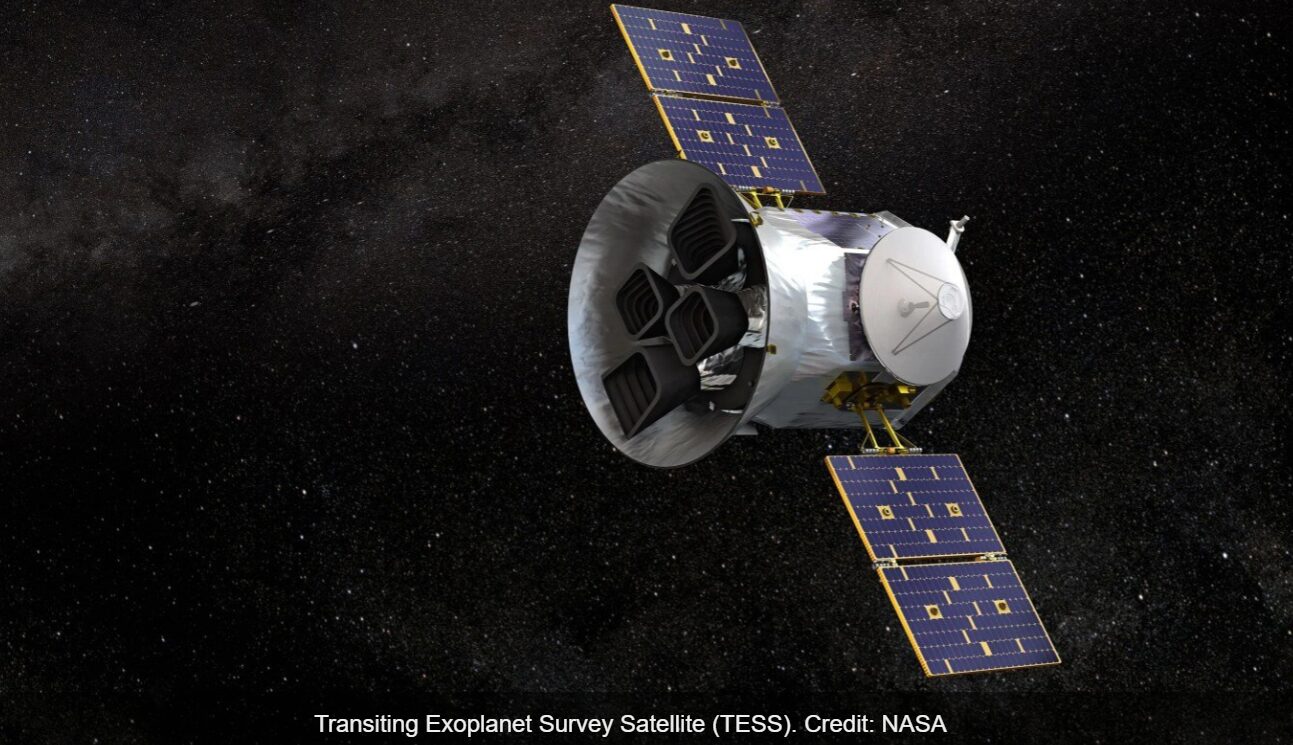
Using NASA’s Transiting Exoplanet Survey Satellite (TESS), astronomers have discovered a triply-eclipsing star system. The newfound system, designated TIC295741342, consists of two sun-like stars in an eclipsing binary and a giant tertiary companion, which orbits the binary. The finding was reported in a paper published May 19 on the arXiv pre-print server.
TESS is conducting a survey of about 200,000 bright stars near the sun with the aim of searching for transiting exoplanets. Besides identifying alien worlds, TESS is also a very useful tool in analyzing binary systems, tracking how mutual stellar eclipses twist and distort gravitational fields.
Triply and triple
Now, a team of astronomers led by Brian P. Powell of NASA Goddard Space Flight Center, reports the detection of a new binary with TESS, which in fact is a triple system as the stellar pair is orbited by a giant star every 1.13 years.
Using TESS, the astronomers identified a highly unusual dip in the light curve—a triply-eclipsing event. The observations show that when the smaller binary pair passed directly behind the massive giant star, it created what they called a “head-and-shoulders” light curve.
“The shape of the eclipse demonstrates the secondary of the eclipsing binary passing fully behind a larger star (first shoulder), followed by the primary together with the secondary (the head), followed by the primary emerging from behind the tertiary (second shoulder),” the researchers explained.
Parameters of the system
According to the paper, the inner binary TIC 295741342 A is composed of very similar main sequence stars (TIC 295741342 Aa and TIC 295741342 Ab), about the size and mass of our sun. The binary has an orbital period of approximately 4.75 days and both components have effective temperatures at a level of 6,400 K.
The tertiary companion, designated TIC 295741342 B, has a mass of some 1.7 solar masses and is 10.6 times larger than the sun. The star has an effective temperature of 4,839 K and is separated from the binary by approximately 1.7 AU.
The researchers estimate that the newfound triple system has a metallicity at a level of -0.337 dex and its age is about 1.46 billion years. The distance to TIC 295741342 was measured to be around 3,080 light years.
The authors of the paper note that the system is near-perfectly coplanar, with an estimated mutual inclination of just 0.25–0.33 degrees. The tertiary star dominates the system light in the TESS band at about 95%, with the primary and secondary of the eclipsing binary contributing about 2.7% and 2.3% of the system light in the TESS band, respectively.
Rare system formed through disk fragmentation
According to the study, the near-perfect coplanarity and compact configuration of TIC 295741342 suggest that it formed through disk fragmentation followed by inward orbital migration and gas dissipation.
Summing up the results, the astronomers underline the uniqueness of their discovery.
“TIC 295741342 is one of only a handful of known triply-eclipsing triple star systems with a giant tertiary, and it has by far the lowest mutual inclination among them,” they conclude. https://phys.org/news/2026-05-triply-eclipsing-triple-star-tess.html



Recent Comments