



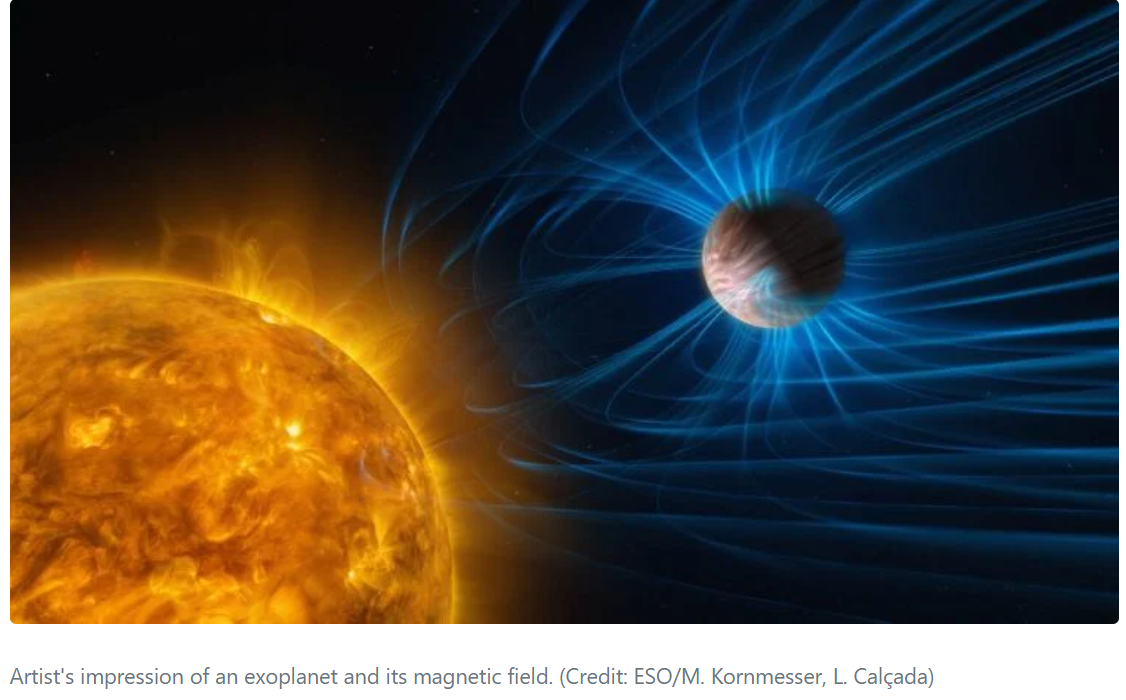
Studying exoplanets has given astronomers insights into the characteristics that could help them find life beyond Earth. For years, astronomers thought an exoplanet’s location in a star’s habitable zone was enough to make it an Earth-like world. But some stars are more active than our sun, exposing planets in their habitable zones to far more radiation than Earth receives. Astronomers have increasingly recognized that a planet’s magnetic field, which shields Earth from harmful radiation, could be a key characteristic in identifying Earth-like worlds.
Now, an international team of scientists is shedding light on how to study exoplanet magnetic fields in a chapter published in Advancing Astrophysics with the SKA II, a 2026 science book sponsored by the Square Kilometer Array Observatory (SKAO). The researchers discuss how the SKA could be used to study magnetic fields not only on exoplanets but also on ultracool dwarfs (UCDs). The chapter is also available on the arXiv preprint server.
As their name suggests, UCDs are stars smaller and cooler than our sun. Some are brown dwarfs, objects between Jupiter and the sun in size that did not grow large enough to achieve nuclear fusion.
Research into magnetic fields on exoplanets is still in its early infancy, with astronomers only recently detecting radio waves from an exoplanet that could indicate the presence of a magnetic field through the radio emissions from the exoplanet’s aurorae. However, this study discusses how UCDs could be prime targets since astronomers have been detecting radio waves from them for several decades.
Using mathematical equations and computer models, the researchers discuss how the SKA could build on decades of research into UCD magnetic fields to advance the search for magnetic fields on exoplanets. It could potentially detect auroral radio signals and use them to characterize an exoplanet’s magnetic field, radiation belt and even possible satellites. The researchers use the term “exomoon” only once in the paper.
The study says this could be accomplished through observational methods known as interferometry and astrometry, which involve collecting data from multiple telescopes and measuring distances and star movements, respectively. The researchers say these methods could enable astronomers to detect exoplanets only a few times more massive than Earth orbiting UCDs.
The study concludes: “Targeted observations will also be a viable detection strategy in specific cases, such as for monitoring the most promising exoplanetary systems and the known population of radio-emitting UCDs. New candidate systems detected in surveys with the SKA and other operating radio telescopes may also be suited to targeted follow-up. Detecting satellites around nearby radio-emitting stars and UCDs through astrometry will also demand targeted monitoring over multiple years. Any one of these approaches will likely deliver unprecedented insights into the formation and evolution of extrasolar worlds.”
Research into exoplanet magnetic fields is still in its early stages. Astronomers recently announced the discovery of radio signals from an exoplanet, Beta Pictoris b. About 63 light-years from Earth, the planet has about 10 to 12 times Jupiter’s mass and orbits its star every 23.7 years at a distance of about 10 astronomical units (AU). The researchers behind that study, available on arXiv, suggest Beta Pictoris b has a powerful magnetic field and that the radio signals could come from its aurorae. A June 2026 study published in Nature Astronomy also discussed the detection of a magnetic field around a hot Jupiter exoplanet. https://www.universetoday.com/articles/ska-may-detect-magnetic-fields-on-distant-exoplanets



Recent Comments