exoplanets tagged posts

Roman telescope aims to directly image exoplanets 1,000 times fainter than current limits

Enabling images of distant worlds
An artist’s concept of the Nancy Grace Roman Space Telescope. Credit: NASA/SVS

The Roman Space Telescope is designed to directly image exoplanets using complex optomechanical systems developed by the Max Planck Institute for Astronomy

The Roman Space Telescope has been under development for about a decade under NASA’s leadership and is scheduled to launch on Aug. 30, 2026, at 7:26 a.m. EDT. The telescope is named after Nancy Grace Roman, who was considered the architect of NASA’s modern science program and, among other efforts, dedicated herself to the success of the Hubble Space Telescope project.

Roman’s destination is the L2 Lagrange point, a specific location 1...

Read More

Signs of alien life may be hiding in these gases

Hycean planet illustration
Artist’s illustration of a Hycean world, where methyl halide gases would be detectable in the atmosphere. (Pablo Carlos Budassi)

-Advancing the search for weird life on weird planets

Scientists have identified a promising new way to detect life on faraway planets, hinging on worlds that look nothing like Earth and gases rarely considered in the search for extraterrestrials.

In a new Astrophysical Journal Letters paper, researchers from the University of California, Riverside, describe these gases, which could be detected in the atmospheres of exoplanets – planets outside our solar system – with the James Webb Space Telescope, or JWST.

Called methyl halides, the gases comprise a methyl group, which bears a carbon and three hydrogen atoms, attached to a halogen atom such as chlo...

Read More

A ‘Jupiter’ Hotter than the Sun

An aerial view of the European Southern Observatory’s Very Large Telescope in Paranal, Chile (Photo: J. L. Dauvergne & G. Hüdepohl, atacamaphoto.com/ESO)

The search for exoplanets—planets that orbit stars located beyond the borders of our solar system—is a hot topic in astrophysics. Of the various types of exoplanets, one is hot in the literal sense: hot Jupiters, a class of exoplanets that are physically similar to the gas giant planet Jupiter from our own neighborhood.

Unlike “our” Jupiter, hot Jupiters orbit very close to their stars, complete a full orbit in just a few days or even hours, and—as their name suggests—have extremely high surface temperatures. They hold great fascination for the astrophysics community...

Read More

Exoplanets can be made Less Habitable by Stars’ Flares

3D render of unreal Trappist-1 exoplanets system
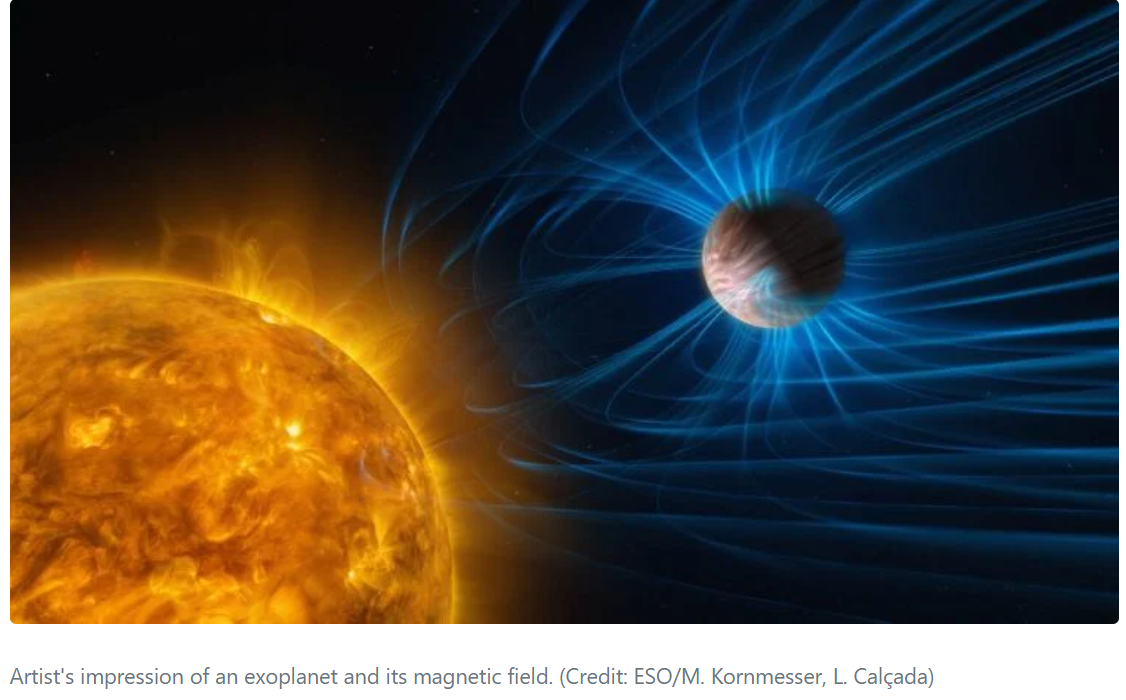
A researcher at NYUAD has discovered that exoplanets lacking sufficient shielding can be impacted by high radiation bursts from the star, known as ‘flares’

Astronomers found that not all exoplanets in habitable zones will be able to maintain hospitable conditions for life. Exoplanets in close proximity to stars are subject to radiation bursts which can disrupt habitable conditions unless the exoplanet has significant atmospheric or magnetic shielding.

The discovery of terrestrial exoplanets, planets that orbit stars outside the solar system, has been one of the most significant developments in modern astronomy...

Read More