



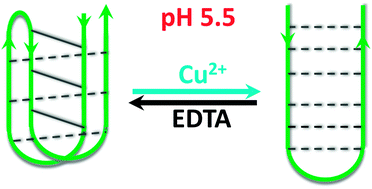
i-Motif DNA structures have previously been utilised for many different nanotechnological applications, but all have used changes in pH to fold the DNA. Herein we describe how copper(II) cations can alter the conformation of i-motif DNA into an alternative hairpin structure which is reversible by chelation with EDTA
Scientists can now ‘switch’ the structure of DNA using copper salts and EDTA. Ethylenediaminetetraacetic acid is an agent commonly found in shampoo and other household products. The applications for this discovery include nanotechnology – where DNA is used to make tiny machines, and in DNA-based computing – where computers are built from DNA rather than silicon. It could also be used for detecting the presence of copper cations, which are highly toxic to fish and other aquatic organisms, in water.
It was previously known that the structure of a piece of DNA could be changed using acid, which causes it to fold up into “i-motif.” No the structure can be switched a 2nd time into a hair-pin structure using copper cations.This change can also be reversed using EDTA.
Lead researcher Dr Zoë Waller, from UEA’s school of Pharmacy, said: “Our research shows how the structure of our genetic material – DNA – can be changed and used in a way we didn’t realise. “A single switch was possible before – but we show for the first time how the structure can be switched twice.
“A potential application of this finding could be to create logic gates for DNA based computing. Logic gates are an elementary building block of digital circuits – used in computers and other electronic equipment. They are traditionally made using diodes or transistors which act as electronic switches.
“This research expands how DNA could be used as a switching mechanism for a logic gate in DNA-based computing or in nano-technology.” https://www.uea.ac.uk/about/-/how-uea-research-could-help-build-computers-from-dna


Recent Comments