
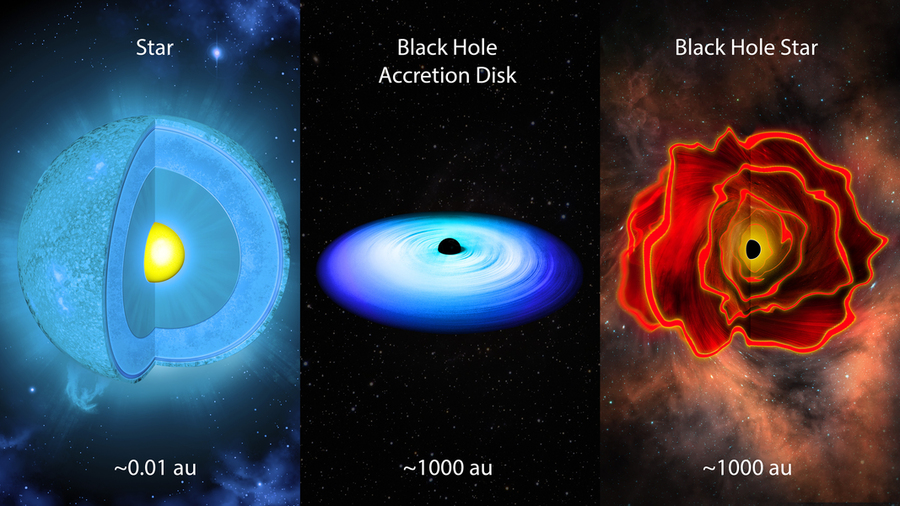
Image: iStock; Jose-Luis Olivares, MIT
Astronomers may have uncovered an entirely new cosmic object: a gigantic “black hole star” that could explain the mysterious red dots filling the early universe...
Read More

August 16, 2026,
 Astronomy/Space
Astronomers may have uncovered an entirely new cosmic object: a gigantic “black hole star” that could explain the mysterious red dots filling the early universe...
Read More
A popular myth about black holes is that they act like giant cosmic vacuum cleaners, sucking in everything around them. But Wladimir Lyra’s research found a new mechanism around supermassive black holes that is more like a cosmic nursery, giving birth to planets more massive than Jupiter.
“We’re finding objects that are a thousand times the mass of the Earth, but built of pure dust,” Lyra said. “And not only that, but also some of these objects are approaching the mass of the sun.”
Lyra, an associate professor of astronomy at New Mexico State University, began this line of research as a postdoctoral fellow collaborating with Barry McKernan, Saavik Ford and Mordecai-Mark Mac Low at the American Museum of Natural History in 2010.
Bhupendra Mishr...
Read More
August 13, 2026,
Astronomy/Space

Using the NASA/ESA/CSA James Webb Space Telescope, an international team of astronomers has discovered that dust and water can form and survive surprisingly close to the supermassive black hole at the center of the Milky Way galaxy. The observations reveal that the evolved star IRS3 continues to enrich its surroundings with newly formed material despite the intense radiation environment around SagittariusA*.
IRS 3 has reached a stage near the end of its life called the asymptotic giant branch phase. Stars in this phase of life are huge, cool and luminous, and they shed gas into space with their powerful stellar winds...
Read More
August 11, 2026,
Astronomy/Space
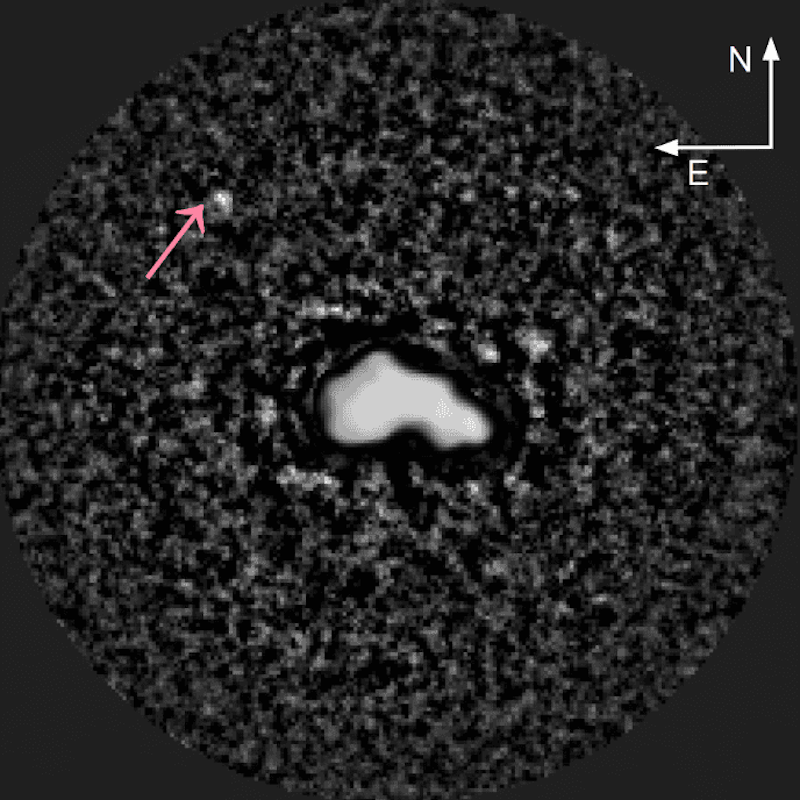
What shape is an asteroid? For (44) Nysa, the honest answer until now has been that nobody knew. It is one of the brightest and largest E-type asteroids in the main belt, a class with a surface rich in enstatite, and its oddness has made it a favorite target for well over a hundred years. Successive observations hinted that it was elongated, perhaps even two lumps stuck together, but the picture stayed frustratingly blurred.
An international team led by Kate Minker at Lowell Observatory has now brought two of the world’s heaviest instru...
Read More
Recent Comments