



Quantum computers, devices that process information by leveraging the laws of quantum mechanics, have been found to outperform classical computers in some advanced tasks. Instead of storing information in the form of classical binary bits (i.e., 0 or 1), quantum computers rely on quantum bits (i.e., qubits), which can also exist in combinations of 0 and 1 states.
Despite their potential, quantum computers are known to be highly prone to errors. This is because qubits are very sensitive to heat, magnetic fields and other changes in their surroundings, which can disrupt the delicate quantum states they rely on to store and process data.
Researchers at Princeton University recently introduced a new approach for developing quantum computers that make fewer errors and whose errors are easier to detect and correct.
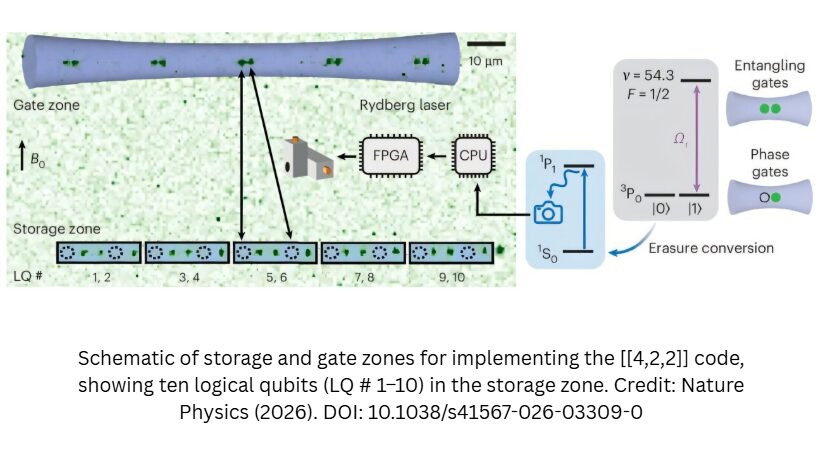
Their proposed strategy, published in Nature Physics, entails developing a quantum computing platform based on metastable ytterbium-171 atoms, neutral atoms of a specific ytterbium isotope that are in a long-lived excited energy state.
“One way to make quantum error correction work better is to engineer qubits where the inevitable errors are of a more favorable type,” Jeff D. Thompson, senior author of the paper, told Phys.org. “In the case of neutral atom qubits, we proposed a few years ago that you could make the errors detectable erasure errors, which are vastly easier to correct.”
Engineering atomic qubits that uncover their own mistakes
As part of their earlier studies, Thompson and his colleagues showed that it was possible to make errors detectable using carefully engineered qubits. However, they were unable to devise an effective and viable strategy for correcting detected errors.
“The only thing we could do with that information was to throw an erroneous qubit away,” explained Thompson. “In this work, we show that erasure conversion in conjunction with a logical qubit allows for better error correction than would be possible without erasure conversion.”
The researchers carefully designed qubits based on metastable ytterbium-171 atoms, ensuring that they produced so-called erasure errors. These errors allow a quantum computing system to identify the “problematic” qubit. To correct identified errors, the researchers proposed using a quantum error-correcting code that stores two logical qubits using four physical qubits.
“The purpose of this study was really to show that erasure conversion allows you to implement quantum error correction in a regime where you otherwise couldn’t,” said Thompson. “To that end, we picked a very small error-correcting code—a distance-2 code—that is too small to do any error correction with a normal error model, but that can correct a single erasure.”
A route toward scalable fault-tolerant quantum computing
The recent study offers an initial proof of concept that hints at the potential of the team’s approach for detecting and fixing quantum computation errors. Thompson and his colleagues are now planning new research aimed at implementing their approach on a larger scale and further testing its effectiveness.
“We showed that erasure conversion allows QEC in a regime where it is not otherwise possible. The next frontier is to apply it with larger distance codes where you can also correct non-erasure errors, and to really push down logical error rates,” added Thompson.
“To really probe large codes and low logical error rates, the field needs additional tools such as the ability to replace lost atoms in the middle of a circuit, faster logical operations and better gates. We have been tackling these challenges in parallel work focusing on fast atom reloading and improved gates. It will be exciting to see these all come together in the next year.”
Eventually, this research team’s efforts could contribute to the development of larger quantum processors that can reliably compute information while correcting errors that arise. This could, in turn, facilitate the use of quantum computers to solve some problems that classical computers cannot.
https://phys.org/news/2026-07-quantum-circuits-based-neutral-atoms.html


Recent Comments