Category Astronomy/Space

A New Trail to Exoplanets: Team successfully detects Ammonia Isotopologues in Atmosphere of Cold Brown Dwarf

An ammonia trail to exoplanets

They reveal the origin of wine, the age of bones and fossils, and they serve as diagnostic tools in medicine. Isotopes and isotopologues—molecules that differ only in the composition of their isotopes—also play an increasingly important role in astronomy. For example, the ratio of carbon-12 (12C) to carbon-13 (13C) isotopes in the atmosphere of an exoplanet allows scientists to infer the distance at which the exoplanet orbits its central star.

Until now, 12C and 13C bound in carbon monoxide were the only isotopologues that could be measured in the atmosphere of an exoplanet. Now a team of researchers has succeeded in detecting ammonia isotopologues in the atmosphere of a cold brown dwarf.

As the team has just reported in the journal Nature, ammonia could be measured in the f...

Read More

Mystery resolved: Blackhole Feeding and Feedback at the Center of an Active Galaxy

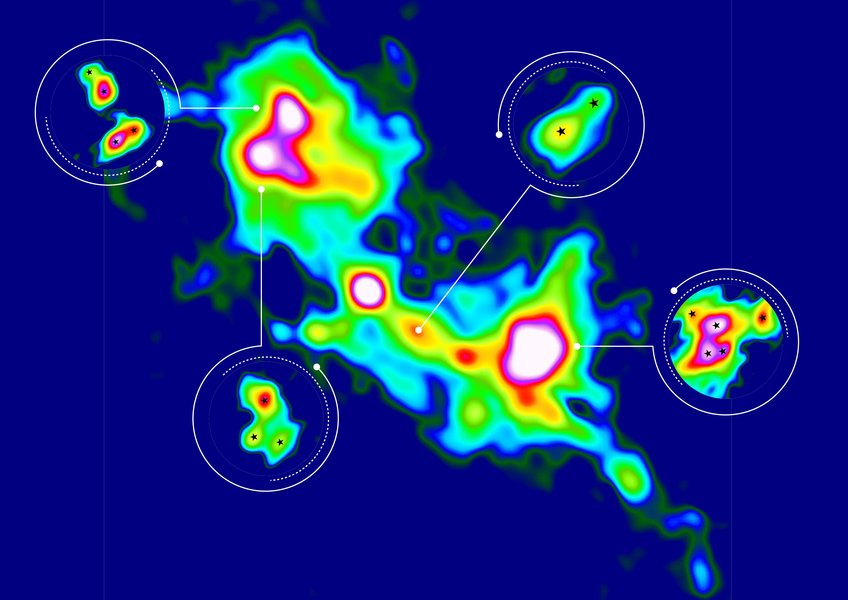
An international research team has recently observed the Circinus galaxy, which is one of the closest galaxies to the Milky Way, with high enough resolution to gain further insights into the gas flows to and from the black hole at its galactic nucleus.

An international research team led by Takuma Izumi, an assistant professor at the National Astronomical Observatory of Japan, has observed in high resolution (approximately 1 light year) the active galactic nucleus of the Circinus Galaxy — one of the closest major galaxies to the Milky Way. The observation was made possible by the Atacama Large Millimeter/Submillimeter Array (ALMA) astronomical observatory in Chile.

This breakthrough marks the world’s first quantitative measurement at this scale of gas flows and their structures o...

Read More

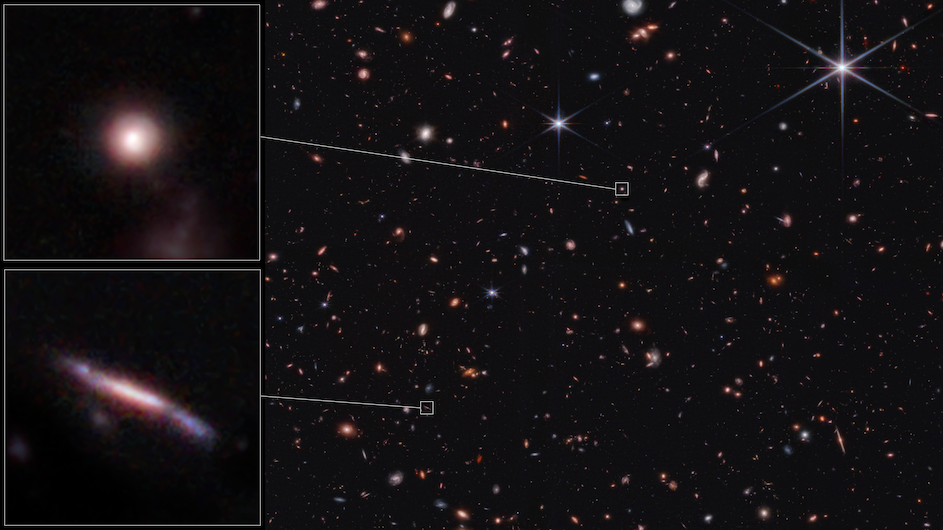
New Webb Images show Gas-rich Baby Galaxies Setting the Early Universe Alight

New images from the James Webb Space Telescope (JWST) have helped Australian astronomers unlock secrets of how infant galaxies started an explosion of star formation in the very early universe.

Some early galaxies were abundant with a gas that glowed so bright it outshone emerging stars. In research published today, astronomers have now discovered just how prevalent these bright galaxies were some 12 billion years ago.

Images from the JWST have shown that almost 90% of the galaxies in the early universe had this glowing gas, producing so-called “extreme emission line features.”

“The stars in these young galaxies were remarkable, producing just the right amount of radiation to excite the surrounding gas...

Read More

Scorching, Seven-Planet system revealed by New Kepler Exoplanet list

Artist’s concept showing two of the seven planets discovered orbiting a Sun-like star. The system, called Kepler-385, was identified using data from NASA’s Kepler mission.
NASA/Daniel Rutter

A system of seven sweltering planets has been revealed by continued study of data from NASA’s retired Kepler space telescope: Each one is bathed in more radiant heat from their host star per area than any planet in our solar system. Also unlike any of our immediate neighbors, all seven planets in this system, named Kepler-385, are larger than Earth but smaller than Neptune.

It is one of only a few planetary systems known to contain more than six verified planets or planet candidates...

Read More