Category Astronomy/Space

Webb reveals Intricate Details in the Remains of a Dying Star

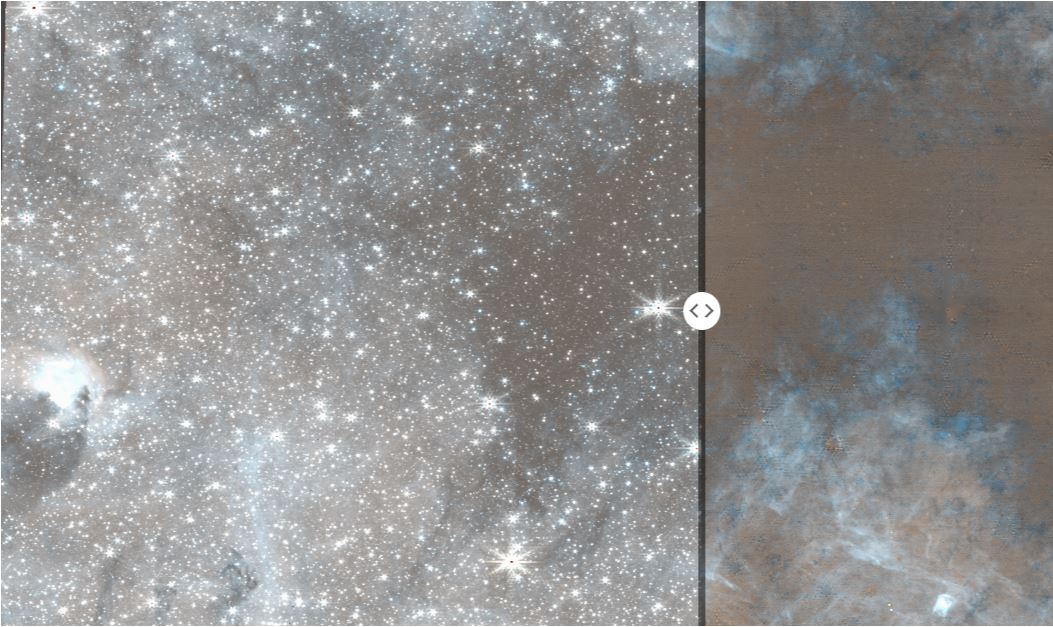
Side-by-side images of the Ring Nebula where the nebula appears as a distorted doughnut. On the right, the nebula’s inner cavity hosts shades of blue and green, while the detailed ring transitions through shades of orange in the inner regions and pink in the outer region. On the left, the nebula’s inner cavity hosts shades of red and orange, while the detailed ring transitions through shades of yellow in the inner regions and blue/purple in the outer region. The ring’s inner region has distinct filament elements.
New images from NASA’s James Webb Space Telescope of the well-known Ring Nebula provide unprecedented spatial resolution and spectral sensitivity. In the NIRCam (Near-Infrared Camera) image on the left, the intricate details of the filament structure of the inner ring are particularly visible in this dataset. On the right, the MIRI (Mid-InfraRed Instrument) image reveals particular details in the concentric features in the outer regions of the nebulae’s ring. Download the full-resolution NIRCam image and the full-resolution MIRI image from the Image gallery. Credit: ESA/Webb, NASA, CSA, M. Barlow (University College London), N. Cox (ACRI-ST), R. Wesson (Cardiff University).

NASA’s James Webb Space Telescope obtained images of the Ring Nebula, one of the best-known examples of a pla...

Read More

Spanish Astronomer discovers New Active Galaxy

Spanish astronomer discovers new active galaxy
Images of the newfound galaxy. Credit: Elio Quiroga Rodriguez (2023).

By analyzing the images of the Sombrero Galaxy obtained with the Hubble Space Telescope (HST), Elio Quiroga Rodriguez of the Mid Atlantic University in Spain, has identified a peculiar object, which turned out to be a galaxy hosting an active galactic nucleus (AGN). The finding was reported in a paper published August 11 on the pre-print server arXiv.

An AGN is a compact region at the center of a galaxy, more luminous than the surrounding galaxy light. Studies show that AGNs are very energetic due either to the presence of a black hole or star formation activity at the core of the galaxy.

Astronomers generally divide AGNs into two groups based on emission line features...

Read More

Using Supernovae to study Neutrinos’ Strange Properties

When supernovae explode, neutrinos from their core carry enormous amounts of energy in all directions.
Photo: Getty Images

New study offers hope to long-standing scientific problem. In a new study, researchers have taken an important step toward understanding how exploding stars can help reveal how neutrinos, mysterious subatomic particles, secretly interact with themselves.

One of the less well-understood elementary particles, neutrinos rarely interact with normal matter, and instead travel invisibly through it at almost the speed of light. These ghostly particles outnumber all the atoms in the universe and are always passing harmlessly through our bodies, but due to their low mass and lack of an electric charge they can be incredibly difficult to find and study.

But in a study p...

Read More

XRISM Spacecraft will Open New Window on the Xray Cosmos

Scientists studied NGC 7319, part of the visual grouping of galaxies called Stephan’s Quintet, using the Medium-Resolution Spectrometer (MRS) in the Mid-Infrared Instrument (MIRI) on NASA’s James Webb Space Telescope. The galaxy contains a supermassive black hole that is actively accreting material. The spectrometer features integral field units (IFUs) – each containing a camera and spectrograph. IFUs provided the Webb team with a collection of images of the galactic core’s spectral features, shown here. Blue-colored regions indicate movement toward the viewer and orange-colored regions represent movement away from the viewer. Powerful radiation and winds from the black hole ionize hot spots of super-heated gas, creating the argon and neon lines...
Read More