Category Astronomy/Space

Geomagnetic Field Protects Earth from Electron Showers

The Field Protects Earth from Electron Showers

Geophysicists studied the activity of high energy electrons and clarified the unexpected protective role of the geomagnetic field surrounding the Earth.

Understanding the ionosphere high in the Earth’s atmosphere is important due to its effects on communications systems, satellites and crucial chemical features including the ozone layer. New insights into the activity of high energy electrons have come from a simulation study led by geophysicist Yuto Katoh at Tohoku University, reported in the journal Earth, Planets and Space.

“Our results clarify the unexpected role of the geomagnetic field surrounding the Earth in protecting the atmosphere from high energy electrons,” says Katoh.

The ionosphere is a wide region between roughly 6...

Read More

James Webb Space Telescope Captures Stunning Images of the Ring Nebula

Ring Nebula

NASA’s James Webb Space Telescope (JWST) has recorded breath-taking new images of the iconic Ring Nebula, also known as Messier 57.

The images, released today by an international team of astronomers led by Professor Mike Barlow (UCL, UK) and Dr Nick Cox (ACRI-ST, France), with Professor Albert Zijlstra of The University of Manchester, showcase the nebula’s intricate and ethereal beauty in unprecedented detail, providing scientists and the public with a mesmerizing view of this celestial wonder.

For many sky enthusiasts, the Ring Nebula is a well-known object that is visible all summer long and is located in the constellation Lyra.

A small telescope will already reveal the characteristic donut-like structure of glowing gas that gave the Ring Nebula its name.

The Ring Nebula...

Read More

New Clues on the Source of the Universe’s Magnetic Fields

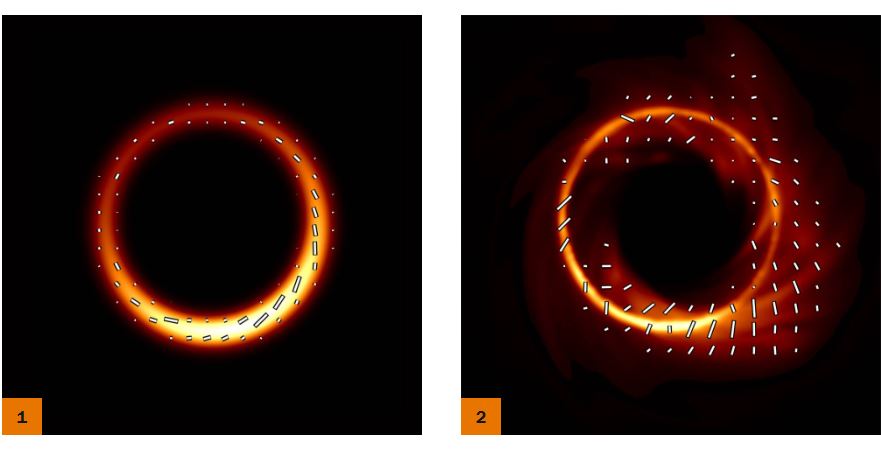
The magnetic field in the Whirlpool Galaxy (M51), captured by NASA's flying Stratospheric Observatory for Infrared Astronomy (SOFIA) observatory superimposed on a Hubble telescope picture of the galaxy. The image shows infrared images of grains of dust in the M51 galaxy. Their magnetic orientation largely follows the spiral shape of the galaxy, but it is also being pulled in the direction of the neighboring galaxy at the right of the frame.

The source of magnetic fields has long been debated: New research offers clues on their origins. It isn’t just your refrigerator that has magnets on it. The earth, the stars, galaxies, and the space between galaxies are all magnetized, too. The more places scientists have looked for magnetic fields across the universe, the more they’ve found them. But the question of why that is the case and where those magnetic fields originate from has remained a mystery and a subject of ongoing scientific inquiry.

A new paper by Columbia researchers offers insight into the source of these fields. The team used models to show that magnetic fields may spontaneously arise in turbulent plasma...

Read More

New Algorithm Ensnares its First ‘Potentially Hazardous’ Asteroid

Image showing the orbit of 2022 SF289 (green) at its closest approach to Earth (orbit in blue). Orbits of Venus and Mars are shown in orange and red, respectively.Joachim Moeyens/University of Washington/OpenSpace

An asteroid discovery algorithm – designed to uncover near-Earth asteroids for the Vera C. Rubin Observatory’s upcoming 10-year survey of the night sky – has identified its first “potentially hazardous” asteroid, a term for space rocks in Earth’s vicinity that scientists like to keep an eye on. The roughly 600-foot-long asteroid, designated 2022 SF289, was discovered during a test drive of the algorithm with the ATLAS survey in Hawaii...

Read More