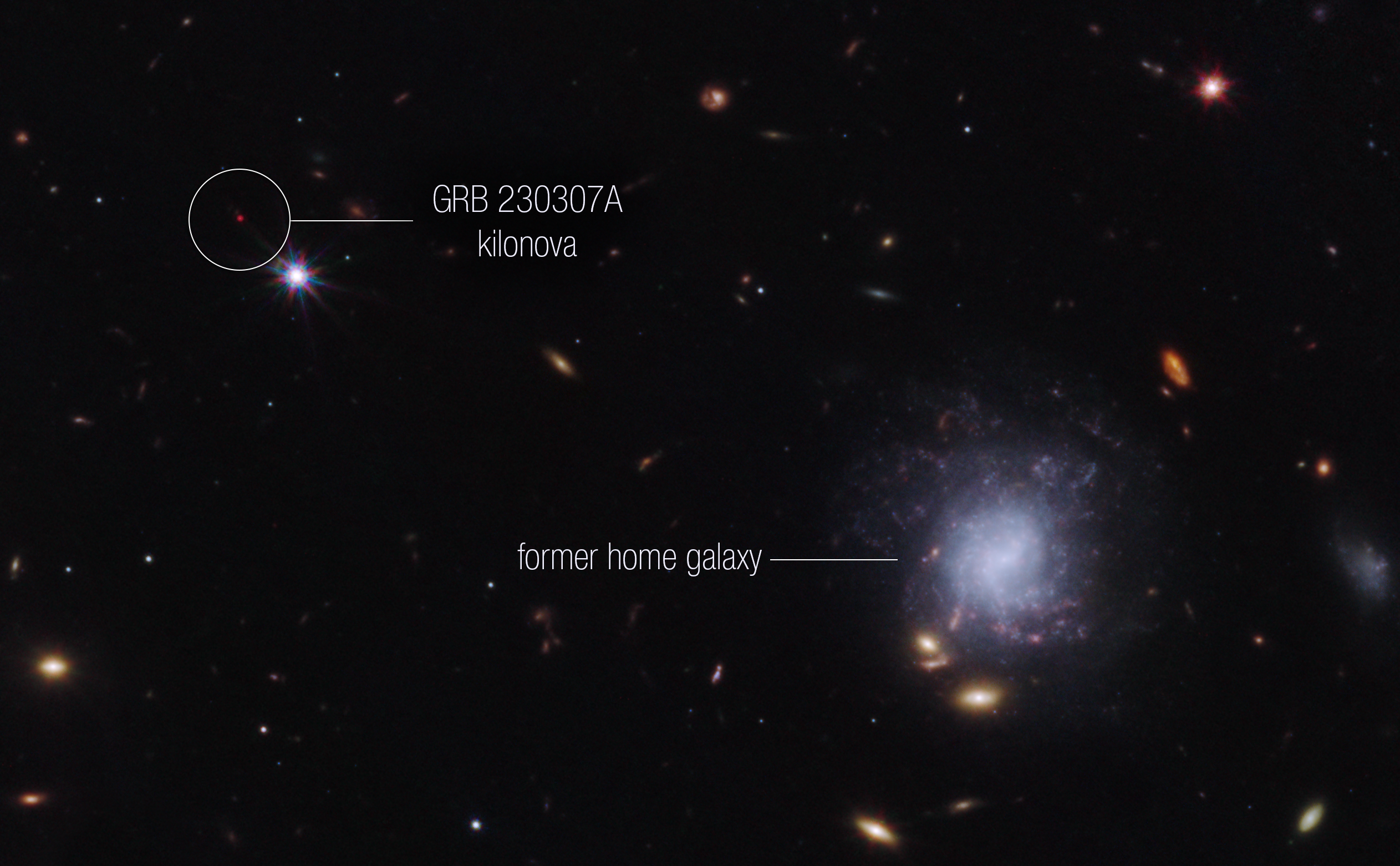
The University of Alabama in Huntsville (UAH) has announced that three researchers associated with the UAH Center for Space Plasma and Aeronomic Research (CSPAR) have discovered a gamma-ray burst (GRB) approximately 2...
Read More

The University of Alabama in Huntsville (UAH) has announced that three researchers associated with the UAH Center for Space Plasma and Aeronomic Research (CSPAR) have discovered a gamma-ray burst (GRB) approximately 2...
Read More
Magnetic activity plays key role in exoplanet habitability. Astronomers have found evidence that some stars boast unexpectedly strong surface magnetic fields, a discovery that challenges current models of how they evolve.
In stars like our sun, surface magnetism is linked to stellar spin, a process similar to the inner workings of a hand-cranked flashlight. Strong magnetic fields are seen in the hearts of magnetic sunspot regions, and cause a variety of space weather phenomena...
Read More
The NASA/ESA Hubble Space Telescope has captured a monster in the making in this observation of the exceptional galaxy cluster eMACS J1353.7+4329, which lies about eight billion light-years from Earth in the constellation Canes Venatici. This collection of at least two galaxy clusters is in the process of merging together to create a cosmic monster, a single gargantuan cluster acting as a gravitational lens.
Gravitational lensing is a dramatic example of Einstein’s general theory of relativity in action. A celestial body such as a galaxy cluster is sufficiently massive to distort spacetime, which causes the path of light around the object to be visibly bent as if by a vast lens...
Read More
Massive stars refer to stars that are more than ten times the mass of the sun. They can release powerful ultraviolet radiation, ionize the gas in the interstellar medium, and eventually produce the elements necessary for the birth of life through spectacular supernova explosions...
Read More
Recent Comments