Category Astronomy/Space

Evidence that Venus is Volcanically Active

Image from research paper.
The panels show the east-looking first (A) and west-looking second (B) images of the vent.

Venus appears to have volcanic activity, according to a new research paper that offers strong evidence to answer the lingering question about whether Earth’s sister planet currently has eruptions and lava flows.

Venus, although similar to Earth in size and mass, differs markedly in that it does not have plate tectonics. The boundaries of Earth’s moving surface plates are the primary locations of volcanic activity.

New research by University of Alaska Fairbanks Geophysical Institute research professor Robert Herrick revealed a nearly 1-square-mile volcanic vent that changed in shape and grew over eight months in 1991...

Read More

Where did Earth’s Water come from? Not Melted Meteorites, according to scientists

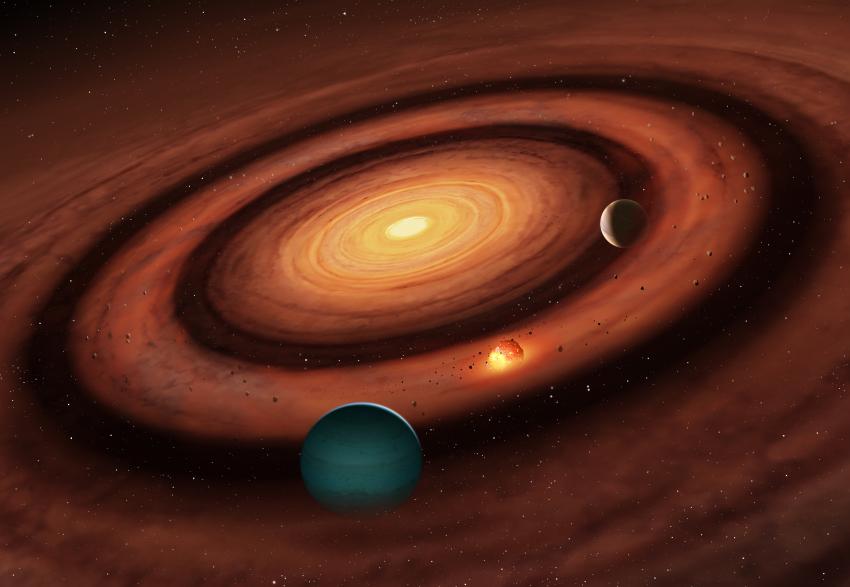
The dashed white line in this illustration shows the boundary between the inner solar system and outer solar system, with the asteroid belt positioned roughly in between Mars and Jupiter. A bubble near the top of the image shows water molecules attached to a rocky fragment, demonstrating the kind of object that could have carried water to Earth. Credit: Jack Cook/Woods Hole Oceanographic Institution. Click image to download hi-res version.

Water makes up 71% of Earth’s surface, but no one knows how or when such massive quantities of water arrived on Earth.

A new study published in the journal Nature brings scientists one step closer to answering that question...

Read More

Webb captures rarely seen Prelude to a Supernova

Wolf-Rayet 124 (NIRCam and MIRI composite image)

A Wolf-Rayet star is a rare prelude to the famous final act of a massive star: the supernova. As one of its first observations in 2022, the NASA/ESA/CSA James Webb Space Telescope captured the Wolf-Rayet star WR 124 in unprecedented detail. A distinctive halo of gas and dust frames the star and glows in the infrared light detected by Webb, displaying knotty structure and a history of episodic ejections.

Despite being the scene of an impending stellar “death,” astronomers also look to Wolf-Rayet stars for insight into new beginnings. Cosmic dust is forming in the turbulent nebulas surrounding these stars, dust that is composed of the heavy-element building blocks of the modern universe, including life on Earth.

The rare sight of a W...

Read More

A Distant Galaxy Ate All of its Friends. Now It’s All Alone

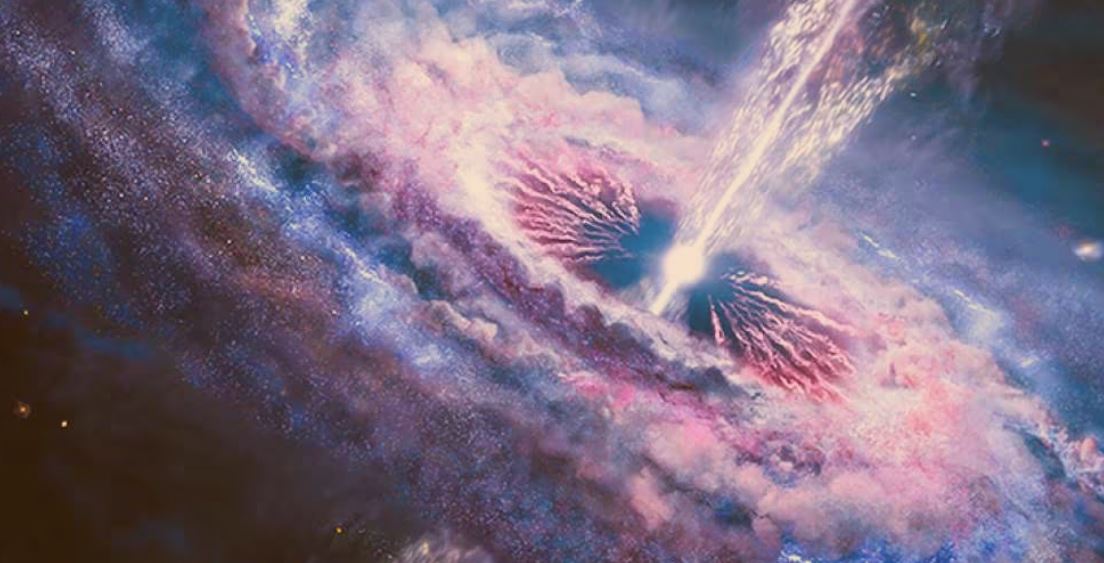
Composite image of a lonely galaxy containing a supermassive black hole, two jets, and an X-ray hotspot, all surrounded by hot gas. Credit: NASA MSFC/SAO/Chandra

Over 13 billion years ago, the first galaxies in the universe formed. They were elliptical, with intermediate black holes (IMBHs) at their centers surrounded by a halo of stars, gas, and dust. Over time, these galaxies evolved by flattening out into disks with a large bulge in the middle. They were then drawn together by mutual gravitational attraction to form galaxy clusters, massive collections that comprise the large-scale cosmic structure. This force of attraction also led to mergers, where galaxies and their central black holes came together to create larger spiral galaxies with central supermassive black holes (SMBHs).

...Read More