Category Astronomy/Space

The Planet that could End Life on Earth

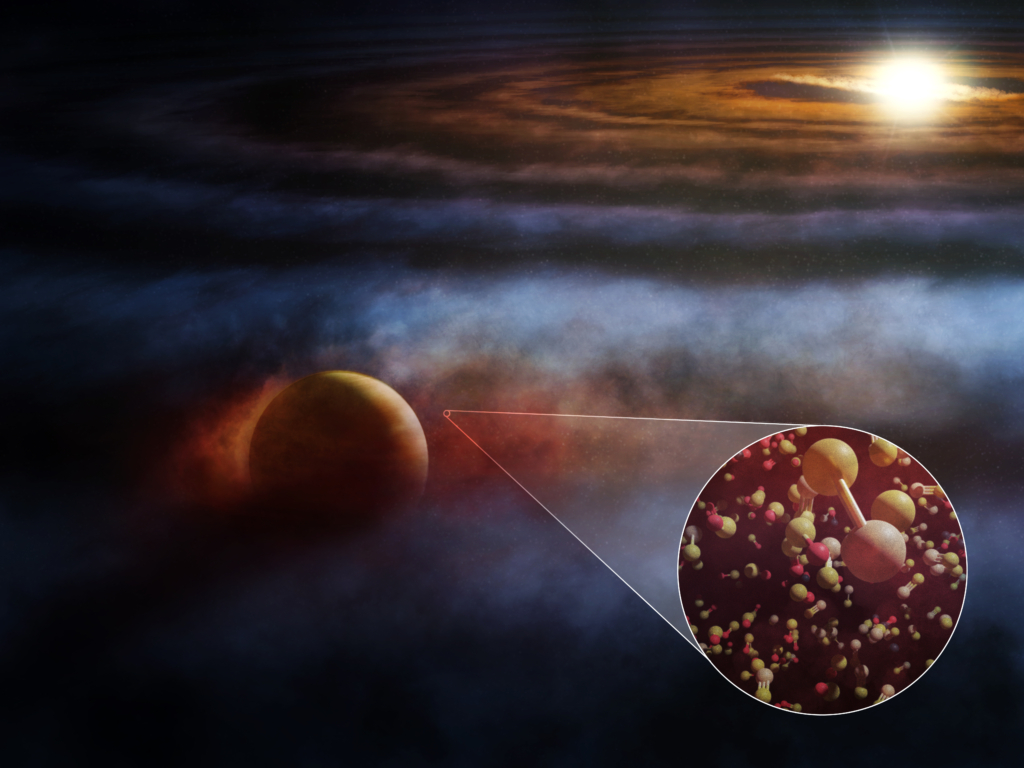
Artist’s concept of Kepler-62f, a super-Earth-size planet orbiting a star smaller and cooler than the sun, about 1,200 light-years from Earth. (NASA Ames/JPL-Caltech/Tim Pyle)

Experiment demonstrates solar system’s fragility. A terrestrial planet hovering between Mars and Jupiter would be able to push Earth out of the solar system and wipe out life on this planet, according to a UC Riverside experiment.

UCR astrophysicist Stephen Kane explained that his experiment was meant to address two notable gaps in planetary science.

The first is the gap in our solar system between the size of terrestrial and giant gas planets. The largest terrestrial planet is Earth, and the smallest gas giant is Neptune, which is four times wider and 17 times more massive than Earth...

Read More

The Universe may have started with a Dark Big Bang

The Big Bang may have not been alone. The appearance of all the particles and radiation in the universe may have been joined by another Big Bang that flooded our universe with dark matter particles. And we may be able to detect it.

In the standard cosmological picture the early universe was a very exotic place. Perhaps the most momentous thing to happen in our cosmos was the event of inflation, which at very early times after the Big Bang sent our universe into a period of extremely rapid expansion. When inflation ended, the exotic quantum fields that drove that event decayed, transforming themselves into the flood of particles and radiation that remain today.

When our universe was less than 20 minutes old, those particles began to assemble themselves into the first protons and ...

Read More

Astronomers Detect Radio Recombination Lines of Carbon/Oxygen Ions for first time

First detection of radio recombination lines of carbon/oxygen using TMRT. The white line shows the RRLs of ions of C and/or O detected by TMRT. The green areas are the modeled emission of ion RRLs. The green dotted lines are the modeled emission, taking into account all RLLs and molecular lines. The background is the image of the heart-shaped Orion nebula (M42), with Orion KL located within the lower-left bright region of M42, credit to Shawn Nielsen. (Image by SHAO)

A research team from the Shanghai Astronomical Observatory (SHAO) of the Chinese Academy of Sciences has detected radio recombination lines (RRLs) of ions heavier than helium for the first time, using the TianMa 65-m Radio Telescope (TMRT). These lines were assigned to carbon and/or oxygen ions.

The findings were publis...

Read More

Resurrected Supernova Provides Missing-link

An image of the central region of M77 taken by the Hubble space telescope (left). Right panels show the expanded view around SN 2018ivc based on the data taken by ALMA, at ~200 days (upper right) and ~ 1000 days (lower right)
An image of the central region of M77 taken by the Hubble space telescope (left), in which the position of SN 2018ivc is marked. Right panels show the expanded view around SN 2018ivc based on the data taken by ALMA, at ~200 days (upper right) and ~ 1000 days (lower right), clearly showing that the rebrightening happened at about one year after the SN explosion. Credit: (left) Based on observations made with the NASA/ESA Hubble Space Telescope, and obtained from the Hubble Legacy Archive, which is a collaboration between the Space Telescope Science Institute (STScI/NASA), the Space Telescope European Coordinating Facility (ST-ECF/ESA) and the Canadian Astronomy Data Centre (CADC/NRC/CSA). (right) ALMA (ESO/NAOJ/NRAO), K. Maeda et al.

Astronomers have discovered a supernova exhibiting un...

Read More