Category Astronomy/Space

Milky Way is embedded in a ‘large-scale sheet’ of dark matter, which explains motions of nearby galaxies

The Milky Way is embedded in a 'large-scale sheet' and this explains the motions of nearby galaxies
Various projections of the posterior mean density of the constrained simulation ensemble, normalized by the cosmic mean density. Credit: Nature Astronomy (2026). DOI: 10.1038/s41550-025-02770-w. https://www.nature.com/articles/s41550-025-02770-w

Computer simulations carried out by astronomers from the University of Groningen in collaboration with researchers from Germany, France and Sweden show that most of the (dark) matter beyond the Local Group of galaxies (which includes the Milky Way and the Andromeda galaxy) must be organized in an extended plane. Above and below this plane are large voids. The observed motions of nearby galaxies and the joint masses of the Milky Way and the Andromeda galaxy can only be properly explained with this “flat” mass distribution...

Read More

Astrophysicists discover largest sulfur-containing molecular compound in space

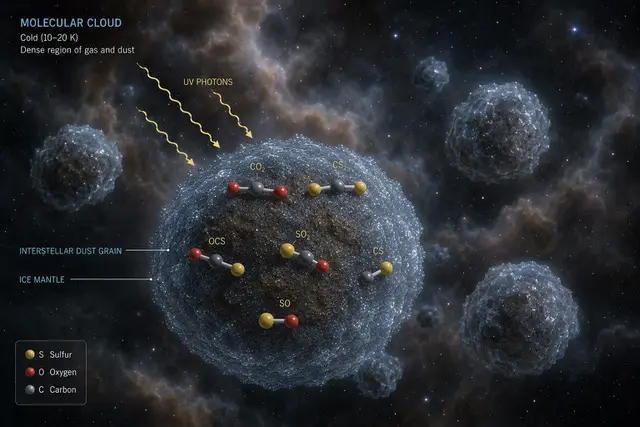
Researchers at the Max Planck Institute for Extraterrestrial Physics (MPE), in collaboration with astrophysicists from the Centro de Astrobiología (CAB), CSIC-INTA, have identified the largest sulfur-bearing molecule ever found in space: 2,5-cyclohexadiene-1-thione (C₆H₆S). They made this breakthrough by combining laboratory experiments with astronomical observations. The molecule resides in the molecular cloud G+0.693–0.027, about 27,000 light-years from Earth near the center of the Milky Way.

With a stable six-membered ring and a total of 13 atoms, it far exceeds the size of all previously detected sulfur-containing compounds in space. The study is published in Nature Astronomy.

Significance of the discovery for astrochemistry
“This is the first unambiguous detection of ...

Read More

Hubble uncovers the secret of blue straggler stars that defy aging

An example of a binary star system

Some stars appear to defy time itself. Nestled within ancient star clusters, they shine bluer and brighter than their neighbors, looking far younger than their true age. Known as blue straggler stars, these stellar oddities have puzzled astronomers for more than 70 years. Now, new results using the NASA/ESA Hubble Space Telescope are finally revealing how these “forever young” stars come to be and why they thrive in quieter cosmic neighborhoods.

Why blue stragglers puzzle astronomers
Blue straggler stars stand out in old star clusters because they appear hotter, more massive and younger than stars that should all have formed billions of years ago...

Read More

Spacecraft captures the “magnetic avalanche” that triggers giant solar explosions

New observations reveal how solar flares really ignite—and why they can be so powerful. Solar Orbiter has captured the clearest evidence yet that a solar flare grows through a cascading “magnetic avalanche.” Small, weak magnetic disturbances rapidly multiplied, triggering stronger and stronger explosions that accelerated particles to extreme speeds. The process produced streams of glowing plasma blobs that rained through the Sun’s atmosphere long after the flare itself.

Much like a snow avalanche that starts with a small shift before cascading downhill, new observations show that solar flares begin with subtle magnetic disturbances that rapidly intensify...

Read More