Category Astronomy/Space

Ultracool Dwarf Binary Stars Break Records

Credit: Adam Burgasser/University of California San Diego

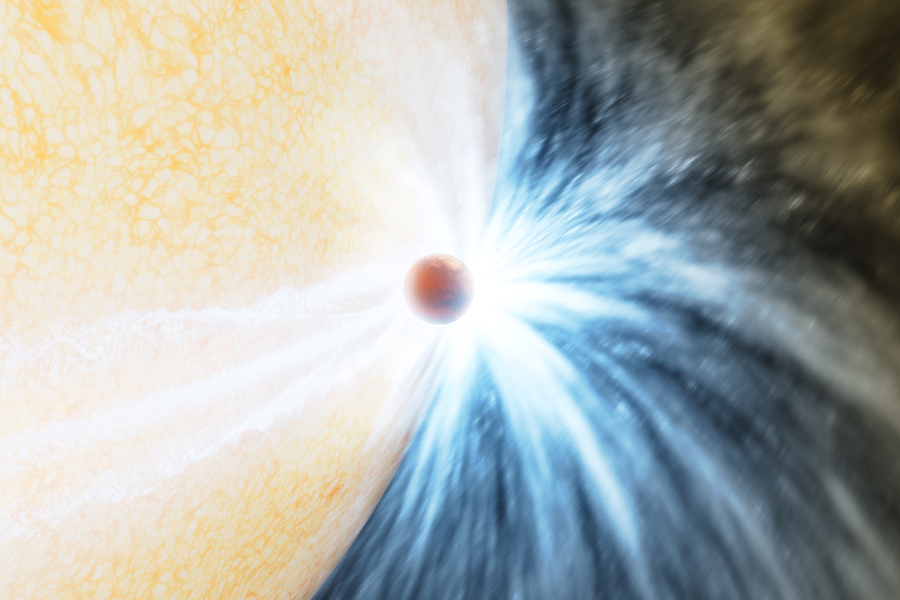
Northwestern University and the University of California San Diego (UC San Diego) astrophysicists have discovered the tightest ultracool dwarf binary system ever observed.

The two stars are so close that it takes them less than one Earth day to revolve around each other. In other words, each star’s “year” lasts just 20.5 hours.

The newly discovered system, named LP 413-53AB, is composed of a pair of ultracool dwarfs, a class of very low-mass stars that are so cool that they emit their light primarily in the infrared, making them completely invisible to the human eye. They are nonetheless one of the most common types of stars in the universe.

Previously, astronomers had only detected three short-period ultracool dwarf bi...

Read More

Scientists find evidence for Magnetic Reconnection between Ganymede and Jupiter

Colorful arrows and dashed lines of data characterizing the magnetic topology and electron flow direction for two different reconnection scenarios at Danymede's magnetopause
In June 2021, NASA’s Juno spacecraft flew close to Ganymede, Jupiter’s largest moon, observing evidence of magnetic reconnection. An SwRI-led team used Juno data to characterize the magnetic topology and electron flow direction for two different reconnection scenarios at Ganymede’s magnetopause. The yellow dashed line indicates Juno’s trajectory. Courtesy of SwRI/Jia et al. (2008)

Juno spacecraft discovered magnetospheric fireworks as magnetic field lines merge and snap between the gas giant and its largest moon. In June 2021, NASA’s Juno spacecraft flew close to Ganymede, Jupiter’s largest moon, observing evidence of magnetic reconnection...

Read More

Scientists find Pair of Black Holes Dining Together in Nearby Galaxy Merger

Credit: ALMA (ESO/NAOJ/NRAO); M. Weiss (NRAO/AUI/NSF)

While studying a nearby pair of merging galaxies using the Atacama Large Millimeter/submillimeter Array (ALMA) – an international observatory co-operated by the U.S. National Science Foundation’s National Radio Astronomy Observatory (NRAO) – scientists discovered two supermassive black holes growing simultaneously near the center of the newly coalescing galaxy. These super-hungry giants are the closest together that scientists have ever observed in multiple wavelengths. What’s more, the new research reveals that binary black holes and the galaxy mergers that create them may be surprisingly commonplace in the Universe...

Read More

NASA’s Webb Telescope reveals Links between Galaxies Near and Far

A trio of faint objects (circled) captured in the James Webb Space Telescope’s deep image of the galaxy cluster SMACS 0723 exhibit properties remarkably similar to rare, small galaxies called “green peas” found much closer to home. The cluster’s mass makes it a gravitational lens, which both magnifies and distorts the appearance of background galaxies. We view these early peas as they existed when the universe was about 5% its current age of 13.8 billion years. The farthest pea, at left, contains just 2% the oxygen abundance of a galaxy like our own and might be the most chemically primitive galaxy yet identified.
Credit: NASA, ESA, CSA, and STScI

A new analysis of distant galaxies imaged by NASA’s James Webb Space Telescope shows that they are extremely young and share some rem...

Read More