An artist’s conceptual rendering of interactions between a prospective exoplanet and its star. Plasma emitted from the star is deflected by the exoplanet’s magnetic field then interacts with the star’s magnetic field, resulting in an aurora on the star and the emission of radio waves. Credit: National Science Foundation/Alice Kitterman
Earth’s magnetic field does more than keep everyone’s compass needles pointed in the same direction. It also helps preserve Earth’s sliver of life-sustaining atmosphere by deflecting high energy particles and plasma regularly blasted out of the sun...
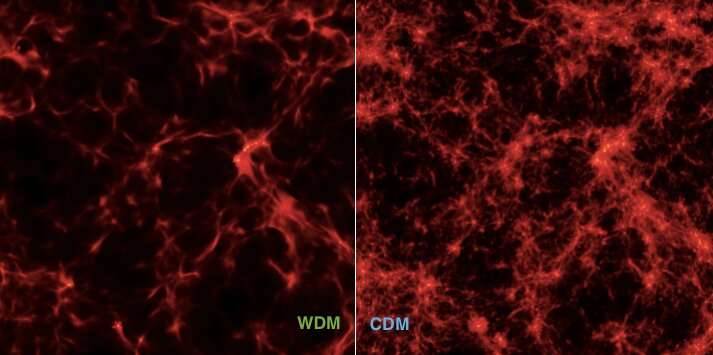
Distribution of primordial matter in cosmological models with hot dark matter (WDM, left) and cold dark matter. Credit: CDM, destra
Astrophysicists in Italy have shed new light on the nature of matter from the James Webb Space Telescope (JWST) detection of galaxies from 13 billion years ago and novel state-of-the-art numerical simulations of the first galaxies. The study adds another piece to the puzzle of the nature of matter in the universe.
While the commonly accepted paradigm of structure formation is based on non-relativistic matter that interacts only gravitationally, that is “cold” dark matter, alternative possibilities advocated to solve small-scale problems of the standard scenario rely on the hypothesis that dark matter is made of warm particles that possess a small, non-n...
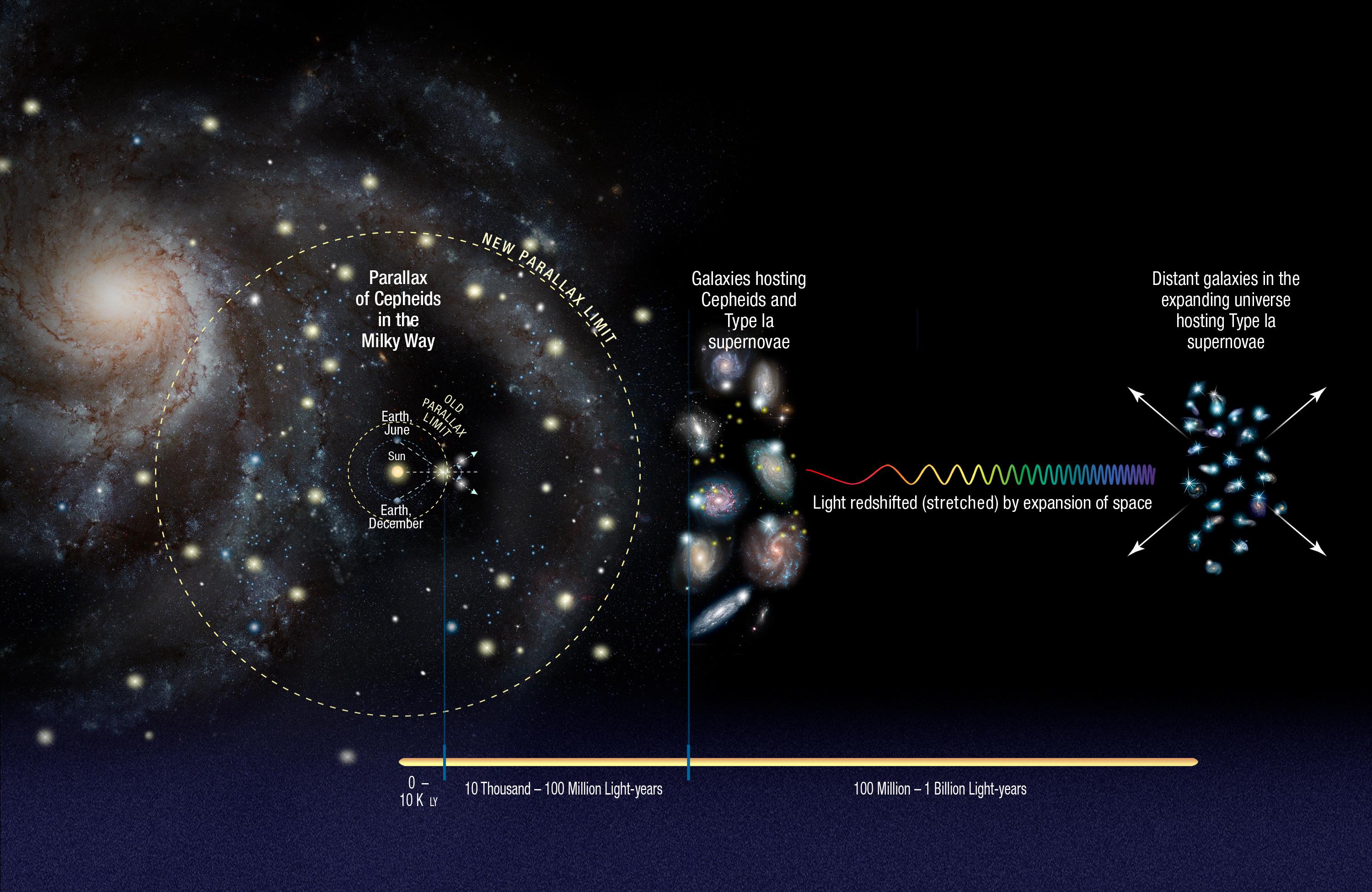
When it comes to measuring how fast the Universe is expanding, the result depends on which side of the Universe you start from. A recent study has calibrated the best cosmic yardsticks to unprecedented accuracy, shedding new light on what’s known as the Hubble tension.
The Universe is expanding — but how fast exactly? The answer appears to depend on whether you estimate the cosmic expansion rate — referred to as the Hubble’s constant, or H0 — based on the echo of the Big Bang (the cosmic microwave background, or CMB) or you measure H0 directly based on today’s stars and galaxies. This problem, known as the Hubble tension, has puzzled astrophysicists and cosmologists around the world.
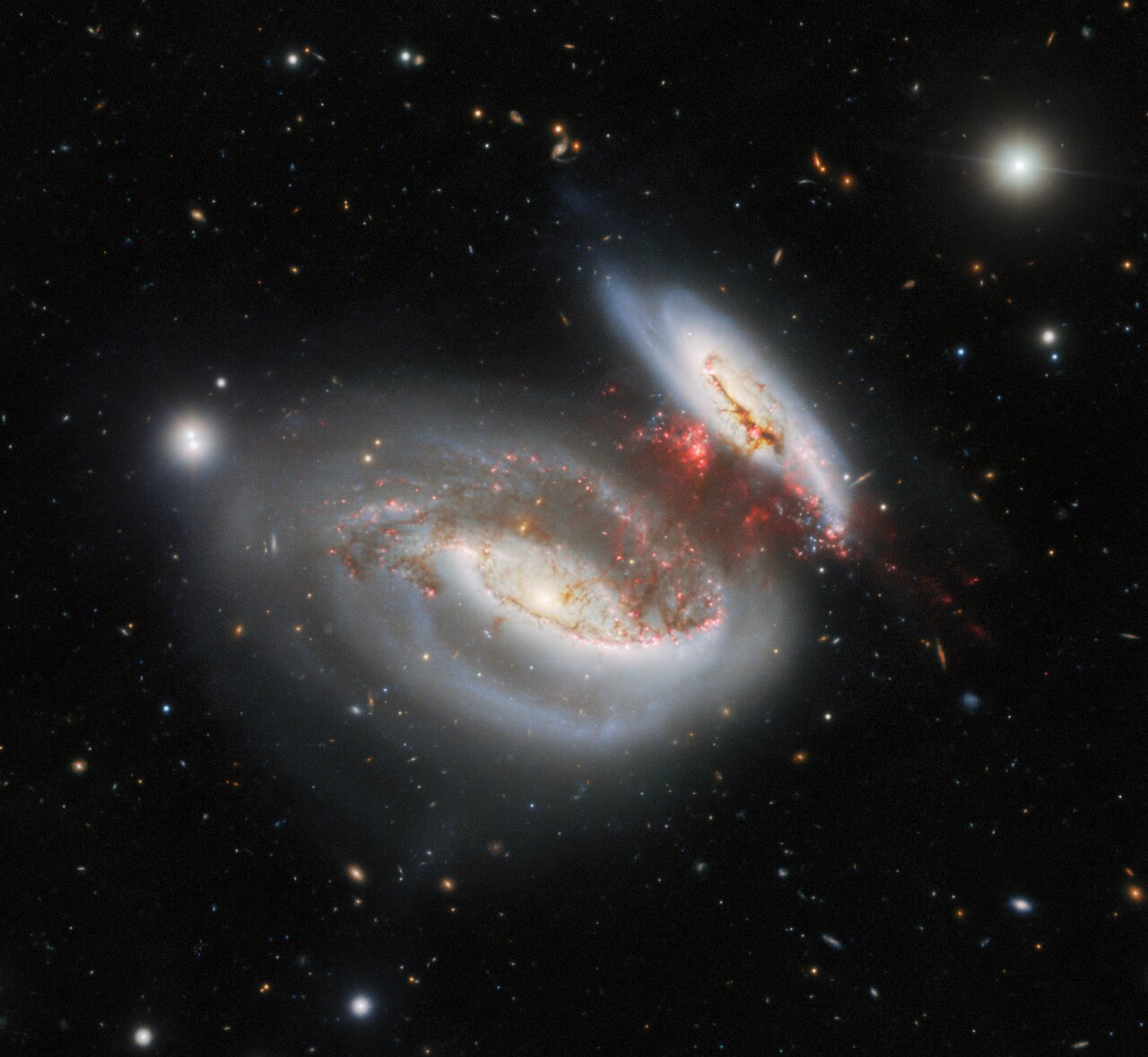
The Gemini North telescope, one half of the International Gemini Observatory, operated by NSF’s NOIRLab, captured this dazzling image of UGC 12914 and UGC 12915, which are nicknamed the Taffy Galaxies. Their twisted shape is the result of a head-on collision that occurred about 25 million years prior to their appearance in this image. A bridge of highly turbulent gas devoid of significant star formation spans the gap between the two galaxies.
Gemini North captures sprawling aftermath of head-on colllision between a pair of galaxies. The Gemini North telescope, one half of the International Gemini Observatory, operated by NSF’s NOIRLab, captured a dazzling image of UGC12914 and UGC312915, which are nicknamed the Taffy Galaxies...





Recent Comments