An international team of scientists has observed the narrowing of a quasar jet for the first time by using a network of radio telescopes across the world...
Read More

An international team of scientists has observed the narrowing of a quasar jet for the first time by using a network of radio telescopes across the world...
Read More
The JWST just scored another first: a detailed molecular and chemical portrait of a distant world’s skies. New observations of WASP-39 b reveal a never-before-seen molecule in the atmosphere of a planet – sulfur dioxide – among other details.
The telescope’s array of highly sensitive instruments was trained on the atmosphere of a “hot Saturn” – a planet about as massive as Saturn orbiting a star some 700 light-years away – known as WASP-39 b. While JWST and other space telescopes, including Hubble and Spitzer, previously have revealed isolated ingredients of this broiling planet’s atmosphere, the new readings provide a full menu of atoms, molecules, and even signs of active chemistry and clouds.
“The clarity of...
Read More
A research team has reconstructed the origin of an unusual gravitational wave signal. The signal GW190521 may result from the merger of two massive black holes that captured each other in their gravitational field and then collided while spinning around each other in a rapid, eccentric motion.
When black holes collide in the universe, the clash shakes up space and time: the amount of energy released during the merger is so great that it causes space-time to oscillate, similar to waves on the surface of water...
Read More
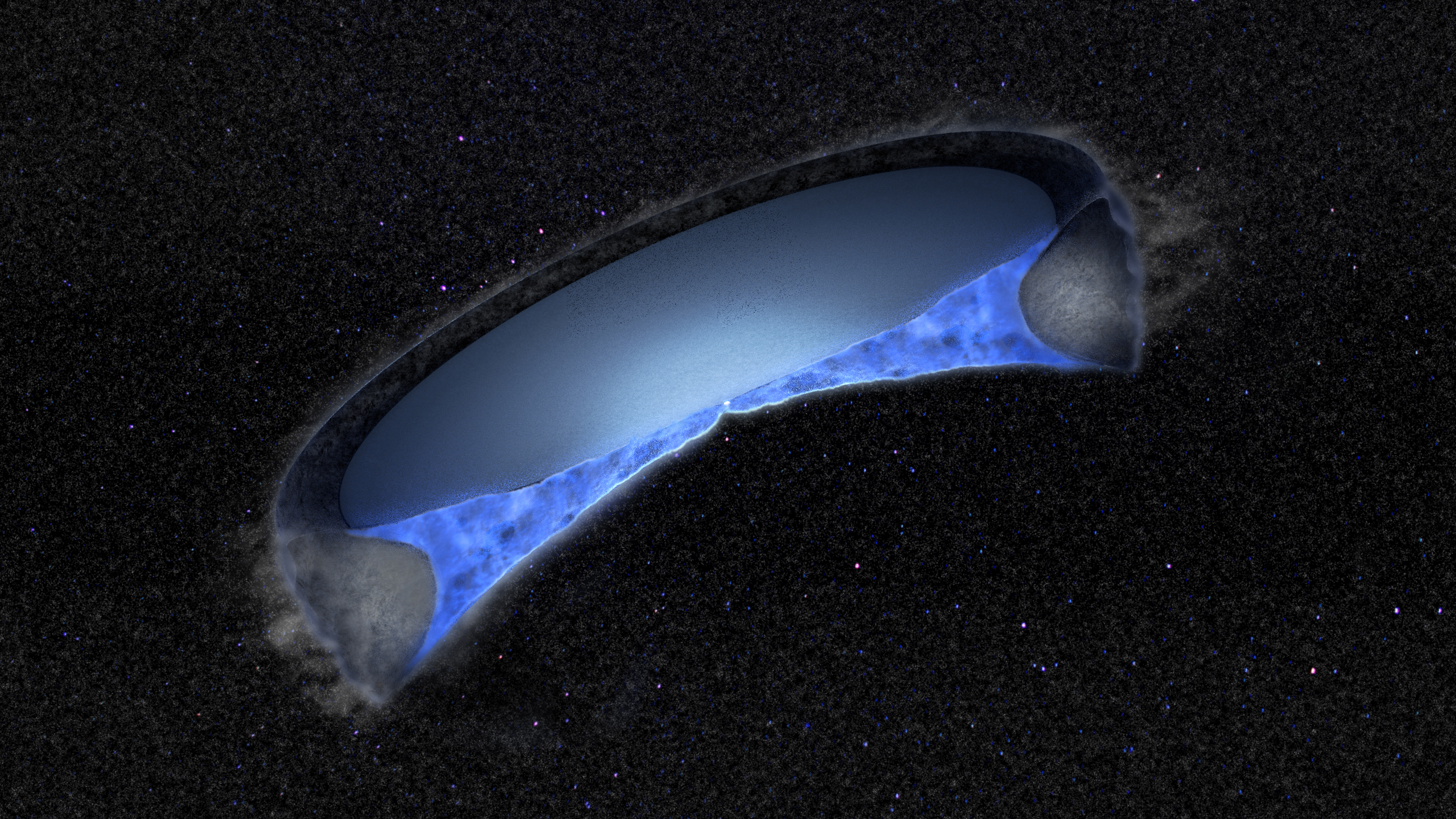
The long-sought after innermost dusty ring was detected with the highest spatial resolution in the infrared wavelengths ever used. An international team of scientists has achieved the milestone of directly observing the long-sought, innermost dusty ring around a supermassive black hole, at a right angle to its emerging jet. Such a structure was thought to exist in the nucleus of galaxies but had been difficult to observe directly because intervening material obscured our line of sight.
Now the inner disk is detected using the highest spatial resolution in the infrared wavelengths ever done for an extragalactic object. The new discovery was just published in The Astrophysical Journal.
“This is a very exciting step forward to view the inner region of a distant galaxy with such fin...
Read More
Recent Comments