EPFL chemical engineers have invented a solar-powered artificial leaf, built on a novel electrode which is transparent and porous, capable of harvesting water from the air for conversion into hydrogen fuel. The semiconductor-based technology is scalable and easy to prepare.
A device that can harvest water from the air and provide hydrogen fuel — entirely powered by solar energy — has been a dream for researchers for decades. Now, EPFL chemical engineer Kevin Sivula and his team have made a significant step towards bringing this vision closer to reality...
Credit: NASA / Goddard Space Flight Center / Jeremy Schnittman
Black holes form natural time machines that allow travel to both the past and the future. But don’t expect to be heading back to visit the dinosaurs any time soon.
At present, we don’t have spacecraft that could get us anywhere near a black hole. But, even leaving that small detail aside, attempting to travel into the past using a black hole might be the last thing you ever do.
What are black holes?
A black hole is an extremely massive object that is typically formed when a dying star collapses in on itself.
Like planets and stars, black holes have gravitational fields around them. A gravitational field is what keeps us stuck to Earth, and what keeps Earth revolving around the Sun.
IoIO image of Jovian sodium nebula in outburst Credit: Jeff Morgenthaler, PSI.
A large volcanic outburst was discovered on Jupiter’s moon Io by Jeff Morgenthaler of the Planetary Science Institute using PSI’s Io Input/Output observatory (IoIO).
PSI Senior Scientist Morgenthaler has been using IoIO, located near Benson, Arizona, to monitor volcanic activity on Io since 2017. The observations show some sort of outburst nearly every year, but the largest yet was seen in the fall of 2022.
Io is the innermost of Jupiter’s four large moons and is the most volcanic body in the Solar System thanks to the tidal stresses it feels from Jupiter and two of its other large satellites, Europa and Ganymede.
IoIO uses a coronagraphic technique which dims the light coming from Jupiter to enable ...
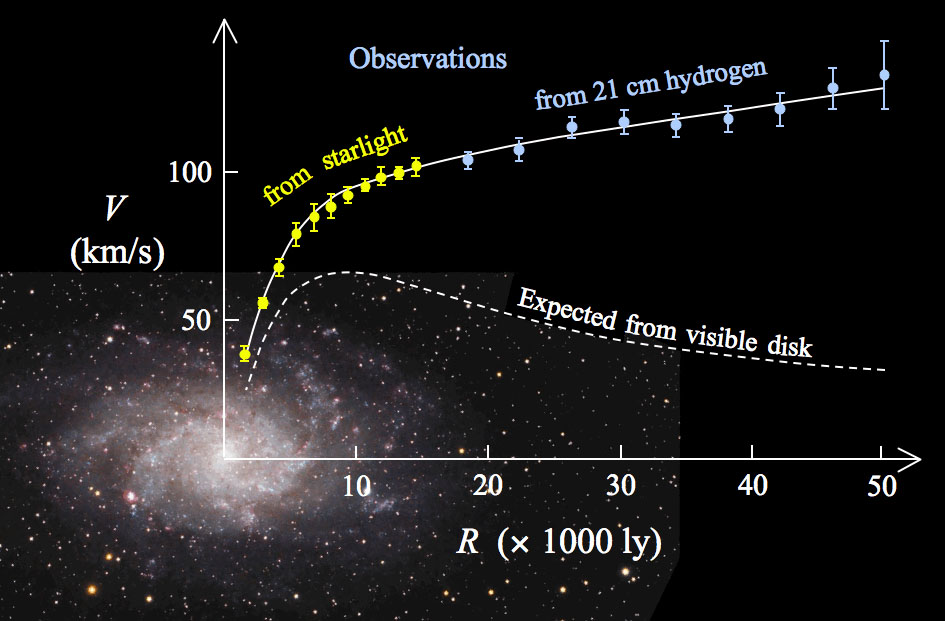
Rotation curve of the typical spiral galaxy M 33 (yellow and blue points with errorbars) and the predicted one from distribution of the visible matter (white line). The discrepancy between the two curves is accounted for by adding a dark matter halo surrounding the galaxy. Credit: Public domain / Wikipedia
Although dark matter is a central part of the standard cosmological model, it’s not without its issues. There continue to be nagging mysteries about the stuff, not the least of which is the fact that scientists have found no direct particle evidence of it.
Despite numerous searches, we have yet to detect dark matter particles. So some astronomers favor an alternative, such as modified Newtonian dynamics (MoND) or modified gravity model...








Recent Comments