Category Astronomy/Space

Ultra-hot lava world has thick atmosphere, upending expectations

An emission spectrum captured by NIRSpec (the Near-Infrared Spectrograph) on NASA’s James Webb Space Telescope in May 2024 shows the brightness of different wavelengths of 3- to 5-micron light coming from the ultra-hot super-Earth exoplanet TOI-561 b. Comparisons of the data to theoretical models suggest that the planet is not a bare rock, but is instead surrounded by a volatile-rich atmosphere. 

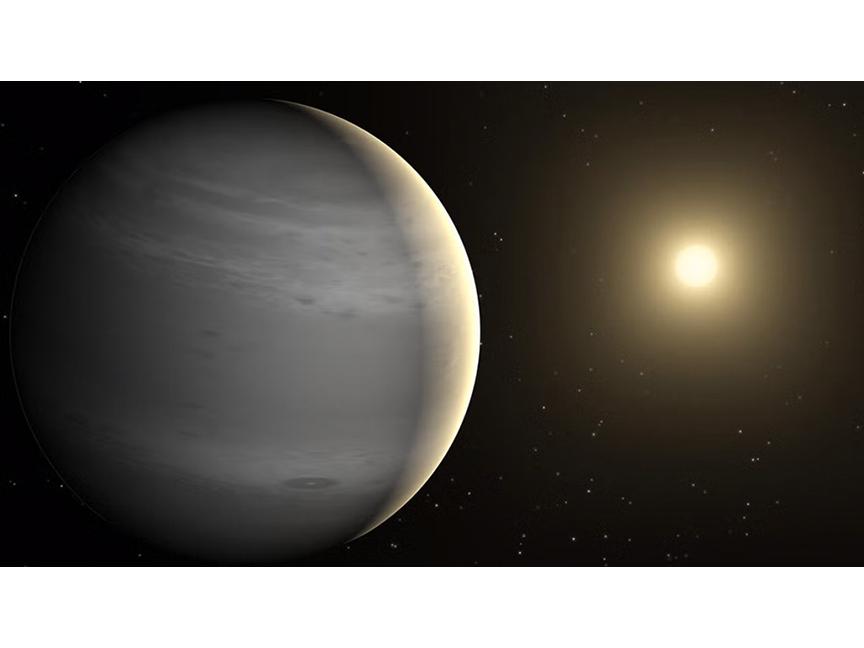
A Carnegie-led team of astronomers detected the strongest evidence yet of an atmosphere around a rocky planet beyond our solar system. Their work, published in The Astrophysical Journal Letters, used NASA’s JWST to reveal an alien atmosphere in an unexpected place—an ancient, ultra-hot super-Earth that likely hosts a magma ocean.

TOI-561 b is a rocky world that’s about twice Earth’s ma...

Read More

Astronomers explore the double nucleus of galaxy NGC 4486B

Astronomers explore the double nucleus of galaxy NGC 4486B

Using the James Webb Space Telescope (JWST), an international team of astronomers has observed an elliptical galaxy known as NGC 4486B. Results of the observational campaign, published Dec. 16 on the arXiv preprint server, deliver important insights into the properties of the double nucleus of this galaxy.

Why does NGC 4486B have a double nucleus?
NGC 4486B (also known as VCC1279) is a compact elliptical galaxy at the center of the Virgo Cluster. It has a small effective radius of about 620 light years, an absolute magnitude of 17.6 mag, and its total stellar mass is estimated to be approximately 6 billion solar masses.

Hubble Space Telescope observations of NGC 4486B have revealed that it hosts a double nucleus, as does the Andromeda galaxy...

Read More

Supernova from the dawn of the universe captured by James Webb Space Telescope

Luminous Fast Blue Optical Transient (Artist’s Concept) Caption: This is an artist’s concept of one of brightest explosions ever seen in space. Credits: Artwork – NASA, ESA, NSF’s NOIRLab, Mark Garlick , Mahdi Zamani

An international team of astronomers has achieved a first in probing the early universe, using the James Webb Space Telescope (JWST), detecting a supernova—the explosive death of a massive star—at an unprecedented cosmic distance.

The explosion, designated SN in GRB 250314A, occurred when the universe was only about 730 million years old, placing it deep in the era of reionization. This remarkable discovery provides a direct look at the final moments of a massive star from a time when the first stars and galaxies were just beginning to form.

The event, which has ...

Read More

Supermassive black holes show selective feeding habits during galaxy mergers

Black holes are notorious for gobbling up everything that comes their way, but astronomers using the Atacama Large Millimeter/submillimeter Array (ALMA) have discovered that even supermassive black holes can be picky eaters, and this can have a significant impact on their growth.

This discovery, now published in The Astrophysical Journal, was made by an international team of astronomers led by Makoto A. Johnstone, a Ph.D. candidate with the University of Virginia. The team used ALMA to study seven nearby galaxy mergers hosting supermassive black holes separated by only a few thousand light-years.

How galaxy mergers affect black holes
When two massive, gas-rich galaxies merge, gravity drives vast amounts of cold molecular gas toward the centers of both systems, where supermassive ...

Read More