Panels A-D (clockwise from upper left) show several different stages of the supernova: the location of the host galaxy after the supernova faded, the three images of the host galaxy and the supernova at different phases in its evolution, the three different faces of the evolving supernova, and the different colors of the cooling supernova. Photo credit: Wenlei Chen, NASA
Detailed telescope images help scientists learn more about the Universe two billion years after the Big Bang. An international research team led by the University of Minnesota Twin Cities has measured the size of a star dating back 2 billion years after the Big Bang, or more than 11 billion years ago...
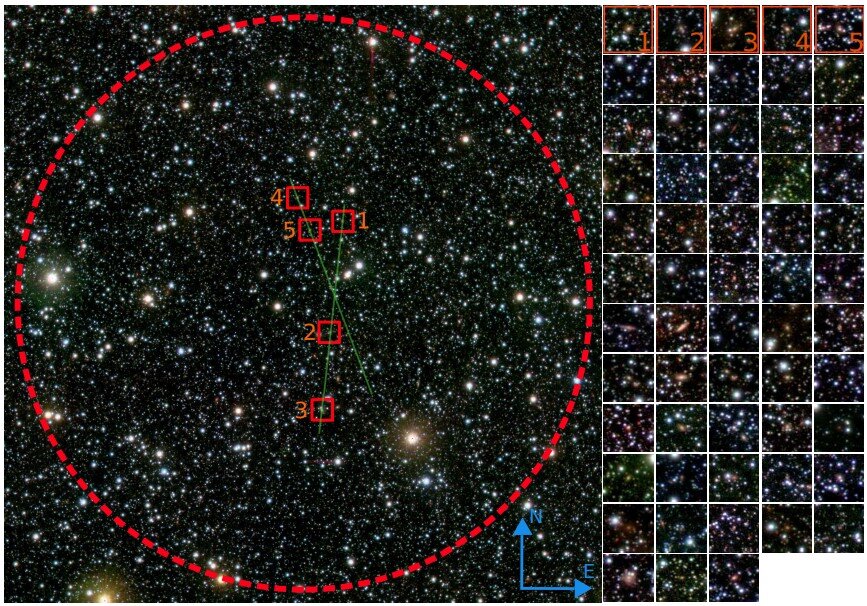
False-color Z (blue), J (green), and Ks (red) image of a region corresponding to the galaxy group/cluster candidate. The red dashed circle delimits the six arcmin radius central area, the green lines indicate the two long-slit positions and the red squares show the five galaxies observed with F2. In the right panels we zoomed the 58 galaxy candidates within the studied area. The length of each box side is 20 arcsec. Credit: arXiv (2022). DOI: 10.48550/arxiv.2210.16332
A team of researchers with members from Universidad Nacional de San Juan, Universidade Federal do Rio Grande do Sul and Universidad Andres Bello has found evidence of a large extragalactic assembly hiding behind one part of the Milky Way galaxy...
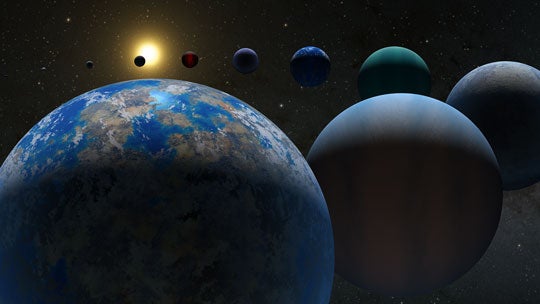
An illustration of the variations among the more than 5,000 known exoplanets discovered since the 1990s. (Image courtesy of NASA/JPL-Caltech)
Model accounts for scarcity of planets with masses between super-Earths and mini-Neptunes. Computer simulations by Rice University scientists and their collaborators are the first to integrate a model of planet formation and evolution that explains two puzzling observations of exoplanets orbiting distant stars: the rarity of worlds about 1.8 times larger than Earth and the near-identical size of adjacent planets in hundreds of planetary systems.
A new model that accounts for the interplay of forces acting on newborn planets can explain two puzzling observations that have cropped up repeatedly among the more than 3,800 planetary systems catalog...
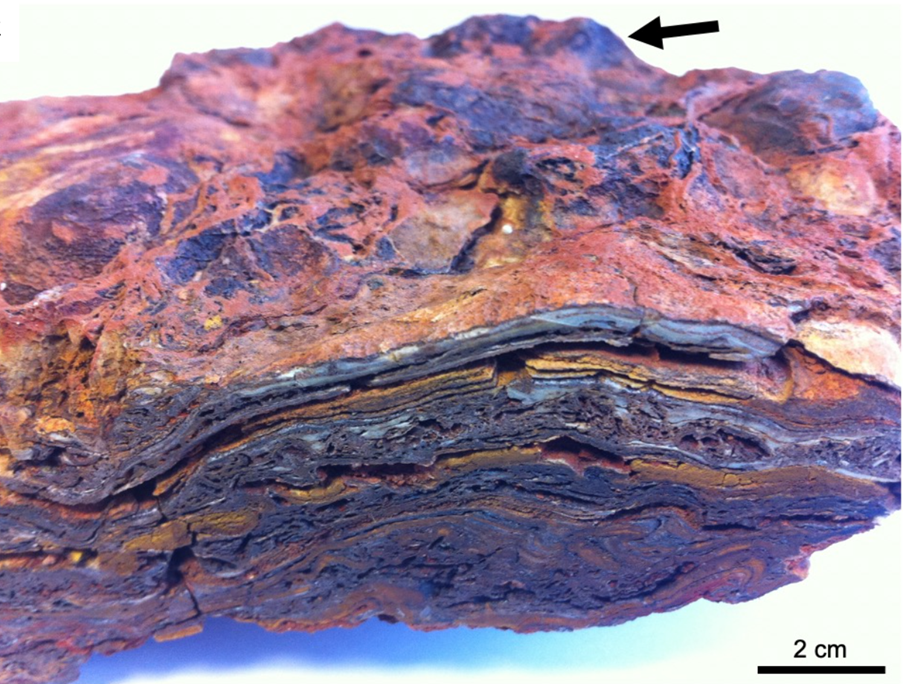
Hand sample of Dresser Formation stromatolite, showing a complex layered structure formed of hematite, barite, and quartz, and a domed upper surface (arrow).
The earliest morphological traces of life on Earth are often highly controversial, both because non-biological processes can produce relatively similar structures and because such fossils have often been subjected to advanced alteration and metamorphism. Stromatolites, layered organo-sedimentary structures reflecting complex interplays between microbial communities and their environment, have long been considered key macrofossils for life detection in ancient sedimentary rocks; however, the biological origin of ancient stromatolites has frequently been criticized...





Recent Comments