This schematic of Supernova 2014C shows the various ejecta and winds (red and purple) given off by the exploding star (left, yellow). The common-envelope disk (blue) surrounds both stars, the one exploding as a supernova and its binary partner (not shown). The boundary layer around the common-envelope disk is the source of the hydrogen the team detected. (credit: B. Thomas et al./UT Austin)Â Â
An international group of astronomers led by Benjamin Thomas of The University of Texas at Austin has used observations from the Hobby-Eberly Telescope (HET) at the university’s McDonald Observatory to unlock a puzzling mystery about a stellar explosion discovered several years ago and evolving even now...
Artist’s conceptual image of the 25 exoplanets examined in this study. (Credit: ESA/Hubble, N. Bartmann)
An international team of researchers examined data for 25 exoplanets and found some links among the properties of the atmospheres, including the thermal profiles and chemical abundances in them. This marks the first time exoplanet atmospheres have been studied as populations, rather than individually. These findings will help establish a generalized theory of planet formation which will improve our understanding of all planets, including the Earth.
Today there are more than 3000 confirmed exoplanets, planets orbiting stars other than the Sun. Because they are far away from Earth, it is difficult to study them in detail...
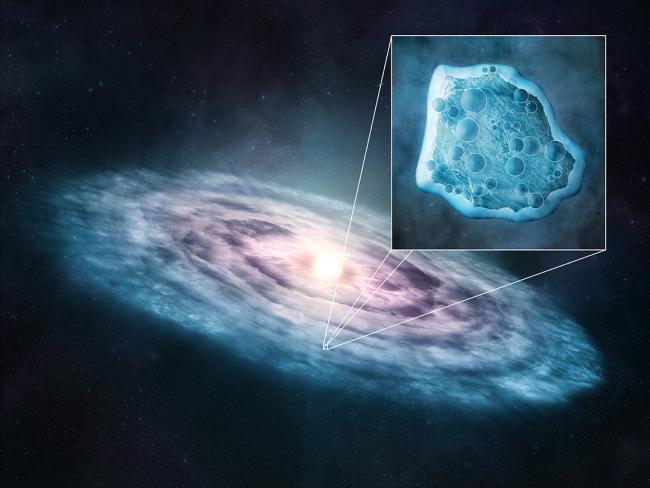
Credit: ALMA (ESO/NAOJ/NRAO)/S. Dagnello (NRAO/AUI/NSF)
Post-starburst galaxies were previously thought to scatter all of their gas and dust — the fuel required for creating new stars — in violent bursts of energy, and with extraordinary speed. Now, new data from the Atacama Large Millimeter/submillimeter Array (ALMA) reveals that these galaxies don’t scatter all of their star-forming fuel after all. Instead, after their supposed end, these dormant galaxies hold onto and compress large amounts of highly-concentrated, turbulent gas. But contrary to expectation, they’re not using it to form stars.
In most galaxies, scientists expect gas to be distributed in a way similar to starlight. But for post-starburst galaxies, or PSBs, this isn’t the case...
These three mosaics of Titan were composed with data from Cassini’s visual and infrared mapping spectrometer taken during the last three Titan flybys, on Oct. 28, 2005 (left), Dec. 26, 2005 (middle), and Jan. 15, 2006 (right). In a new study, researchers have shown how Titan’s distinct dunes, plains, and labyrinth terrains could be formed. (Image credit: NASA / JPL / University of Arizona)
Saturn’s moon Titan looks very much like Earth from space, with rivers, lakes, and seas filled by rain tumbling through a thick atmosphere. While these landscapes may look familiar, they are composed of materials that are undoubtedly different — liquid methane streams streak Titan’s icy surface and nitrogen winds build hydrocarbon sand dunes.
The presence of these materials — whose mechanical ...
Recent Comments