Category Astronomy/Space

Giant Stars undergo Dramatic Weight Loss Program

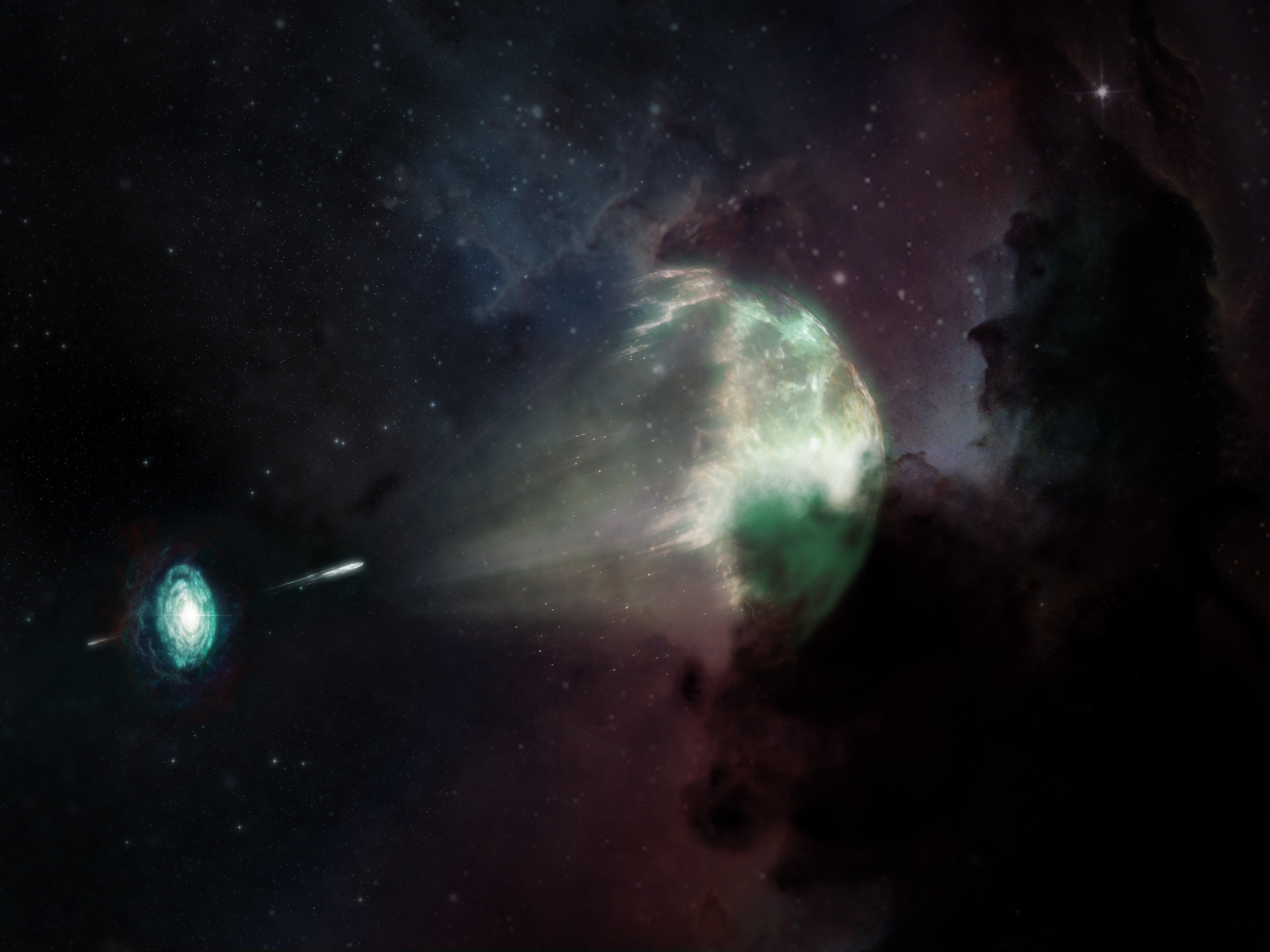
In the binary named Mira, a red giant star transfers mass to a white dwarf. © NASA/CXC/M.Weiss.

Astronomers at the University of Sydney have found a slimmer type of red giant star for the first time. These stars have undergone dramatic weight loss, possibly due to the presence a greedy neighbour. Published in Nature Astronomy, the discovery is an important step forward to understanding the life of stars in the Milky Way – our closest stellar neighbours.

There are millions of ‘red giant’ stars found in our galaxy. These cool and luminous objects are what our Sun will become in four billion years. For some time, astronomers have predicted the existence of slimmer red giants. After finding a smattering of them, the University of Sydney team can finally confirm their existence.

“It’...

Read More

4 billion-year-old Relic from Early Solar System heading our way – But we’re in no danger, professor assures

Comet C/2014 UN271 could be as large as 85 miles across

An enormous comet – approximately 80 miles across, more than twice the width of Rhode Island – is heading our way at 22,000 miles per hour from the edge of the solar system. Fortunately, it will never get closer than 1 billion miles from the sun, which is slightly farther from Earth than Saturn; that will be in 2031.

Comets, among the oldest objects in the solar system, are icy bodies that were unceremoniously tossed out of the solar system in a gravitational pinball game among the massive outer planets, said David Jewitt. The UCLA professor of planetary science and astronomy co-authored a new study of the comet in the Astrophysical Journal Letters...

Read More

Neptune is Cooler than we thought: Study reveals unexpected Changes in Atmospheric Temperatures

Observed changes in Neptune’s thermal-infrared brightness, a measure of temperature in Neptune’s atmosphere. The plot shows the relative change in the thermal-infrared brightness from Neptune’s stratosphere with time for all existing images taken by ground-based telescopes. Brighter images are interpreted as warmer. Corresponding thermal-infrared images (top) at wavelengths of ~12 µm show Neptune’s appearance in 2006, 2009, 2018 (observed by the European Southern Observatory’s Very Large Telescope’s VISIR instrument), and 2020 (observed by Subaru’s COMICS instrument). The south pole appears to have become dramatically warmer in just the past few years. Credit: Michael Roman/NASA/JPL/Voyager-ISS/Justin Cowart

New research led by space scientists at the University of Leice...

Read More

Differences between the Moon’s Near and Far Sides linked to Colossal Ancient Impact

New research shows how the impact that created the Moon’s South Pole – Aitken basin is linked to the stark contrast in composition and appearance between the two sides of the Moon.

The face that the Moon shows to Earth looks far different from the one it hides on its far side. The nearside is dominated by the lunar mare – the vast, dark-colored remnants of ancient lava flows. The crater-pocked farside, on the other hand, is virtually devoid of large-scale mare features. Why the two sides are so different is one of the Moon’s most enduring mysteries.

Now, researchers have a new explanation for the two-faced Moon – one that relates to a giant impact billions of years ago near the Moon’s south pole.

A new study published in the journal Science Advances shows that the impact that...

Read More