Category Astronomy/Space

Mounds of Ice in Craters give New Insight into Mars’ Past Climate

Layered ice in Burroughs crater on Mars, with imagery from THEMIS (left) and HiRISE (right panels). The ice layers here record climate oscillations now linked precisely to changes in Mars’ orbit and tilt, according to a new study in the AGU journal Geophysical Research Letters.
Credit: Sori et al./Geophysical Research Letters

Honing the ways Mars’ orbit and orientation impacted climate over time can help scientists find periods of potential habitability. Newly discovered deposits of layered ice in craters scattered around Mars’ southern hemisphere provide insights into how the planet’s orientation controlled the planet’s climate over the past 4 million years, according to a new study...

Read More

Scientists Achieve Record Efficiency for Ultra-Thin Solar Panels

Light scattering from a thin silicon membrane absorbing 65% of sunlight

A team co-led team by the University of Surrey has successfully increased the levels of energy absorbed by wafer-thin photovoltaic panels by 25%. Their solar panels, just one micrometre thick (1μm), convert light into electricity more efficiently than others as thin and pave the way to make it easier to general more clean, green energy.

In a paper published in the American Chemical Society’s Photonics journal, the team detail how they used characteristics of sunlight to design a disordered honeycomb layer which lies on top of a wafer of silicon. Their approach is echoed in nature in the design of butterfly wings and bird eyes...

Read More

Scientists observe Mysterious Death of a Star Emitting Six Rings

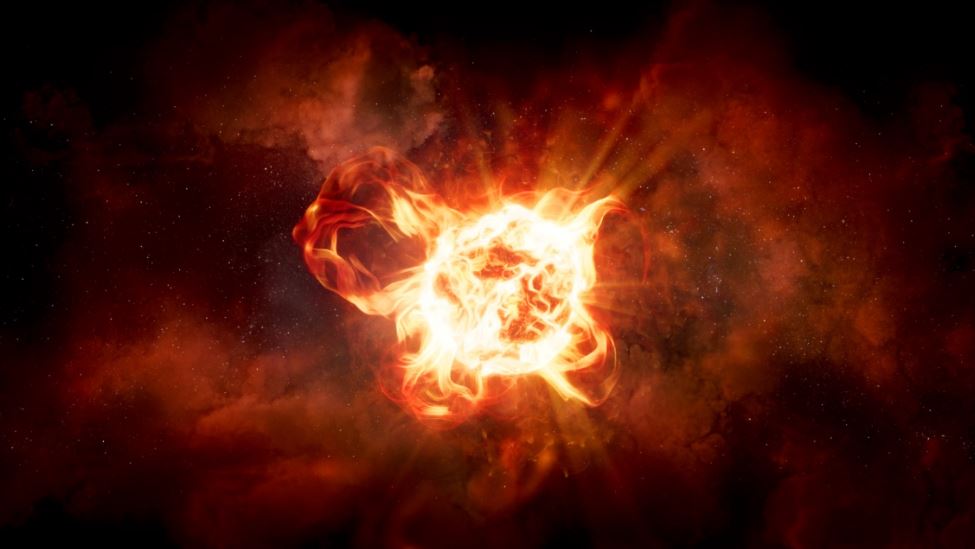
A rendering of the star V Hydrae, or V Hya for short. In its death throes, the star has emitted a series of expanding rings that scientists calculated are being formed every few hundred years, said Mark Morris, a UCLA professor of physics and astronomy.

Astrophysicists studying in unprecedented detail a red giant star named V Hydrae — abbreviated as V Hya — have witnessed the star’s mysterious death throes.

Researchers from UCLA and NASA’s Jet Propulsion Laboratory discovered that the carbon-rich star has expelled six slowly expanding molecular rings and an hourglass-shaped structure ejecting matter out into space at high speeds, signaling that the star is undergoing rapid evolution as it ends its life in a blaze of glory before shutting down its energy production.

“This is the f...

Read More

Scientists Solve Solar Secret

This conceptual image shows the Parker Solar Probe about to enter the solar corona. Credit NASA / John Hopkins APL / Ben Smith.

The further we move away from a heat source, the cooler the air gets. Bizarrely, the same can’t be said for the Sun, but University of Otago scientists may have just explained a key part of why.

Study lead Dr Jonathan Squire, of the Department of Physics, says the surface of the Sun starts at 6000 degree C, but over a short distance of only a few hundred kilometers, it suddenly heats up to more than a million degrees, becoming its atmosphere, or corona.

“This is so hot that the gas escapes the Sun’s gravity as ‘solar wind’, and flies into space, smashing into Earth and other planets.

“We know from measurements and theory that the sudden temperature ju...

Read More