
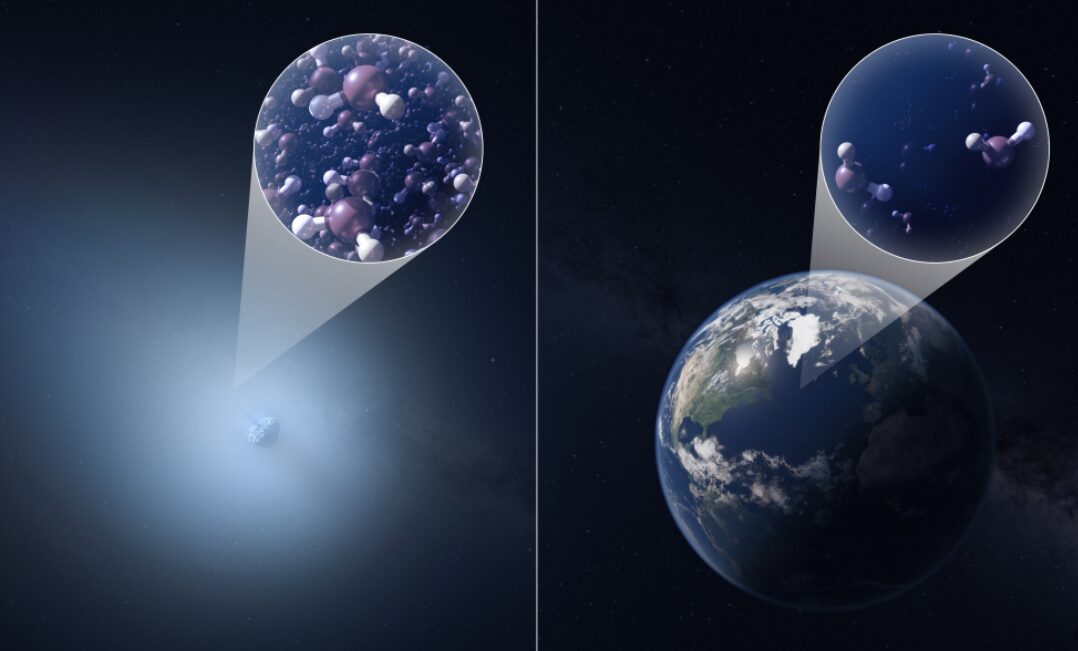
Credit: NSF/AUI/NSF NRAO/M.Weiss
New observations of the interstellar comet 3I/ATLAS include the first measurement of the abundance of deuterated water relative to ordinary water in an interstellar object...
Read More

April 24, 2026,
 Astronomy/Space
New observations of the interstellar comet 3I/ATLAS include the first measurement of the abundance of deuterated water relative to ordinary water in an interstellar object...
Read More
April 24, 2026,
Astronomy/Space
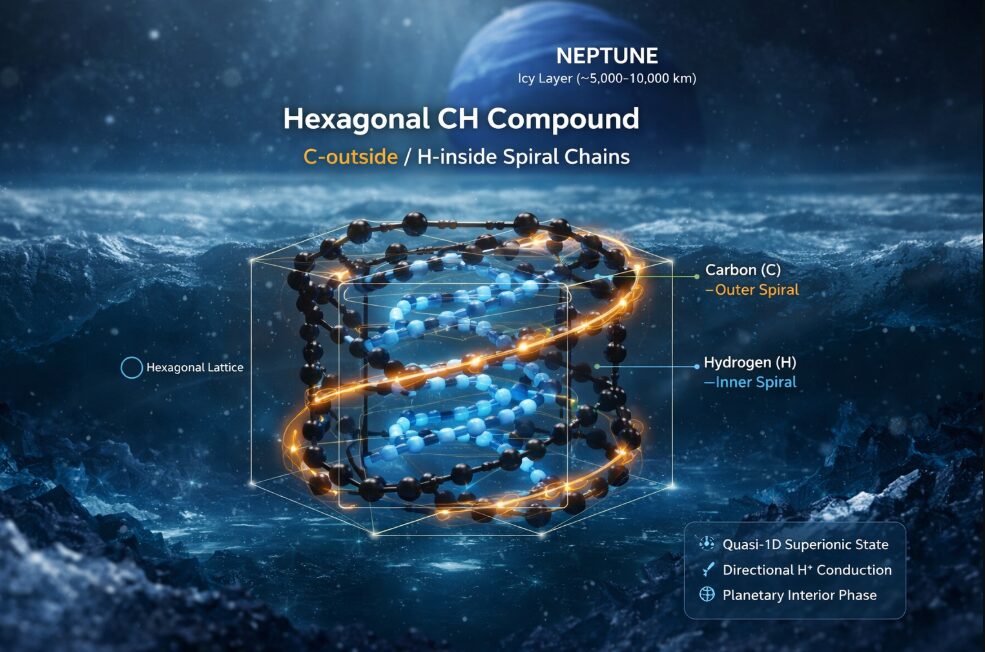
Deep inside planets like Uranus and Neptune, scientists may have uncovered a bizarre new state of matter where atoms behave in unexpected ways. Advanced simulations suggest that carbon and hydrogen, under crushing pressures and scorching temperatures, can form a strange hybrid phase—part solid, part fluid—where hydrogen atoms spiral through a rigid carbon framework. This unusual “superionic” structure could reshape how heat and electricity flow inside these distant worlds, potentially helping explain their mysterious magnetic fields.
The deep interiors of ice giant planets such as Uranus and Neptune may contain a previously unknown form of matter. This possibility comes from new computer simulations conducted by Carnegie scientists Cong Liu and Ronald Cohen.
Their study,...
Read More
April 21, 2026,
Astronomy/Space
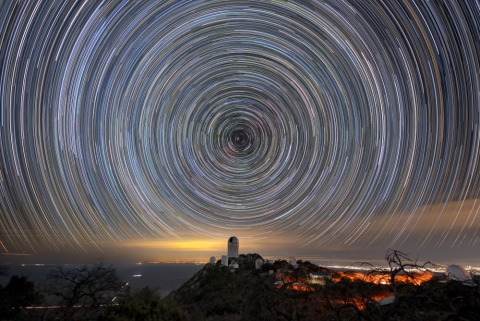
The Dark Energy Spectroscopic Instrument (DESI) has successfully completed the largest high-resolution 3D map of the universe ever made, a major milestone in understanding the force driving cosmic expansion. The milestone was reached when DESI’s 5,000 fiberoptic sensors captured their final scheduled observations, targeting a region of sky near the Little Dipper.
Many institutions globally are involved in the project, including the University of Portsmouth, University College London and Durham University along with Berkeley Lab and the Science and Technology Facilities Council.
The survey was completed ahead of schedule and has delivered significantly more data than orig...
Read More
April 19, 2026,
Astronomy/Space

European astronomers have used the Atacama Large Millimeter Array (ALMA) and the James Webb Space Telescope (JWST) to observe a recently discovered giant disk galaxy known as ADF22.1. Results of the new observations, published April 8 on the arXiv preprint server, shed more light on the formation and evolution of this galaxy.
A unique laboratory
ADF22.1, also known as ADF22.A1, is a giant disk barred spiral galaxy residing in a protocluster known as SSA22 at a redshift of 3.09. It has an effective radius of some 22,800 light years and a stellar mass of about 100 billion solar masses...

Recent Comments