Category Astronomy/Space

How Plasma Swirling around Black Holes can produce Heat and Light

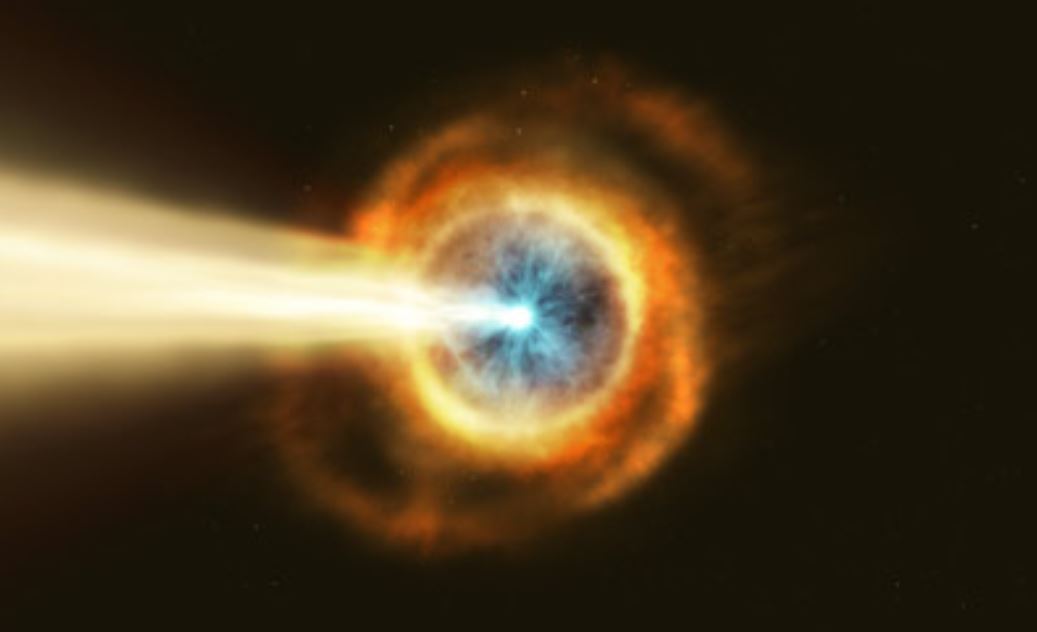
Researchers at the U.S. Department of Energy’s (DOE) Princeton Plasma Physics Laboratory (PPPL) have uncovered a process in the swirling masses of plasma surrounding black holes and neutron stars that can cause previously unexplained emissions of light and heat. The process, known as magnetic reconnection, also jettisons huge plumes of plasma billions of miles in length. These findings can increase basic understanding of fundamental astrophysical processes throughout the universe.

Plasma, known as the fourth state of matter, comprises free-floating electrons and atomic nuclei, or ions, and makes up 99 percent of the visible universe...

Read More

A Young, Sun-like Star may hold Warnings for Life on Earth

Artist’s depiction of the star EK Draconis ejecting a coronal mass ejection as two planets orbit. (Credit: National Astronomical Observatory of Japan)

Astronomers spying on a stellar system located dozens of lightyears from Earth have, for the first time, observed a troubling fireworks show: A star, named EK Draconis, ejected a massive burst of energy and charged particles much more powerful than anything scientists have seen in our own solar system.

The researchers, including astrophysicist Yuta Notsu of the University of Colorado Boulder, will publish their results Dec. 9 in the journal Nature Astronomy.

The study explores a stellar phenomenon called a “coronal mass ejection,” sometimes known as a solar storm...

Read More

Record-Breaking Simulations of Large-Scale Structure Formation in the Universe

Researchers led by the University of Tsukuba present computer simulations that capture the complex dynamics of elusive neutrinos left over from the Big Bang

Current simulations of cosmic structure formation do not accurately reproduce the properties of ghost-like particles called neutrinos that have been present in the Universe since its beginning. But now, a research team from Japan has devised an approach that solves this problem.

In a study published this month in SC ’21: Proceedings of the International Conference for High Performance Computing, Networking, Storage and Analysis, researchers at the University of Tsukuba, Kyoto University, and the University of Tokyo report simulations that precisely follow the dynamics of such cosmic relic neutrinos...

Read More

Iron integral to the Development of Life on Earth – and the Possibility of Life on Other Planets

Early Earth on the left, had seas infused with life-enhancing iron, whereas Earth today, seen on the right, does not.

Researchers at the University of Oxford uncover the importance of iron for the development of complex life on Earth – which also may hint at the likelihood of complex life on other planets.

Iron is an essential nutrient that almost all life requires to grow and thrive. Iron’s importance goes all the way back to the formation of the planet Earth, where the amount of iron in the Earth’s rocky mantle was ‘set’ by the conditions under which the planet formed and went on to have major ramifications for how life developed...

Read More