Category Astronomy/Space

Evidence Emerges for Dark-Matter Free Galaxies

Artist’s impression of the planetary system V1298 Tau. Crédito: Gabriel Pérez Díaz, SMM (IAC)

An international team of astronomers led by researchers from the Netherlands has found no trace of dark matter in the galaxy AGC 114905, despite taking detailed measurements over a course of forty hours with state-of-the-art telescopes. They will present their findings in Monthly Notices of the Royal Astronomical Society.

When Pavel Mancera Piña (University of Groningen and ASTRON, the Netherlands) and his colleagues discovered six galaxies with little to no dark matter, they were told “measure again, you’ll see that there will be dark matter around your galaxy”...

Read More

Breakthrough in understanding Cosmic Forces that Shape Earth’s Heliosphere

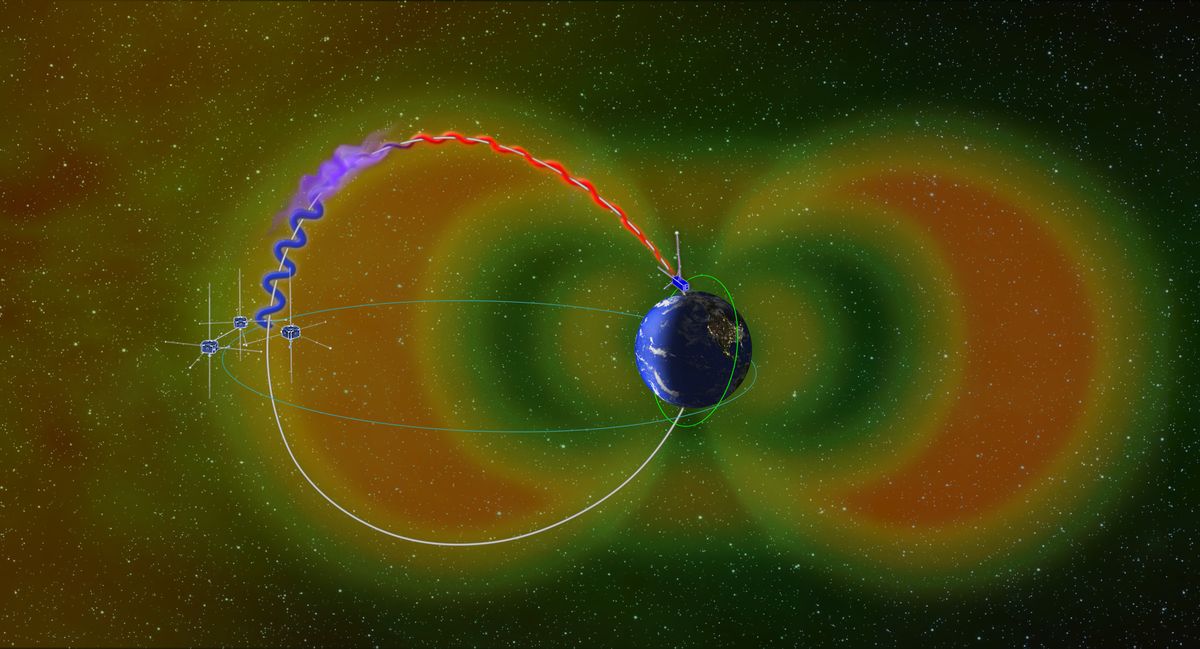
New research led by BU astrophysicist Merav Opher could explain why the heliosphere, a protective magnetic “force field” emanating from our sun and encompassing our solar system, is likely unstable and irregularly shaped. “The universe is not quiet,” Opher says. “Our BU model doesn’t try to cut out the chaos.” Image courtesy of Merav Opher, et. al

Astrophysicists reach another milestone on their quest to understand the heliosphere...

Read More

Beads of Glass in Meteorites help scientists piece together how Solar System formed

An artist’s conception shows dust and debris floating around a young star—similar to how the early days of our solar system might have looked. Illustration by NASA/SOFIA/Lynette Cook . Inset: A cross-section of a piece of the Allende meteorite, containing beads of glass called chondrules. University of Chicago scientists analyzed such chondrules to find new clues about how our solar system evolved. Photo courtesy of James St. John

Scientists reveal conditions in early solar system. Ever since scientists started looking at meteorites with microscopes, they’ve been puzzled — and fascinated — by what’s inside. Most meteorites are made of tiny beads of glass that date back to the earliest days of the solar system, before the planets were even formed.

Scientists with the University of ...

Read More

TESS discovers a Planet the size of Mars but with the Makeup of Mercury

Caption:An illustration of a red dwarf star orbited by an exoplanet.
Credits:Credit: NASA/ESA/G. Bacon (STScI)

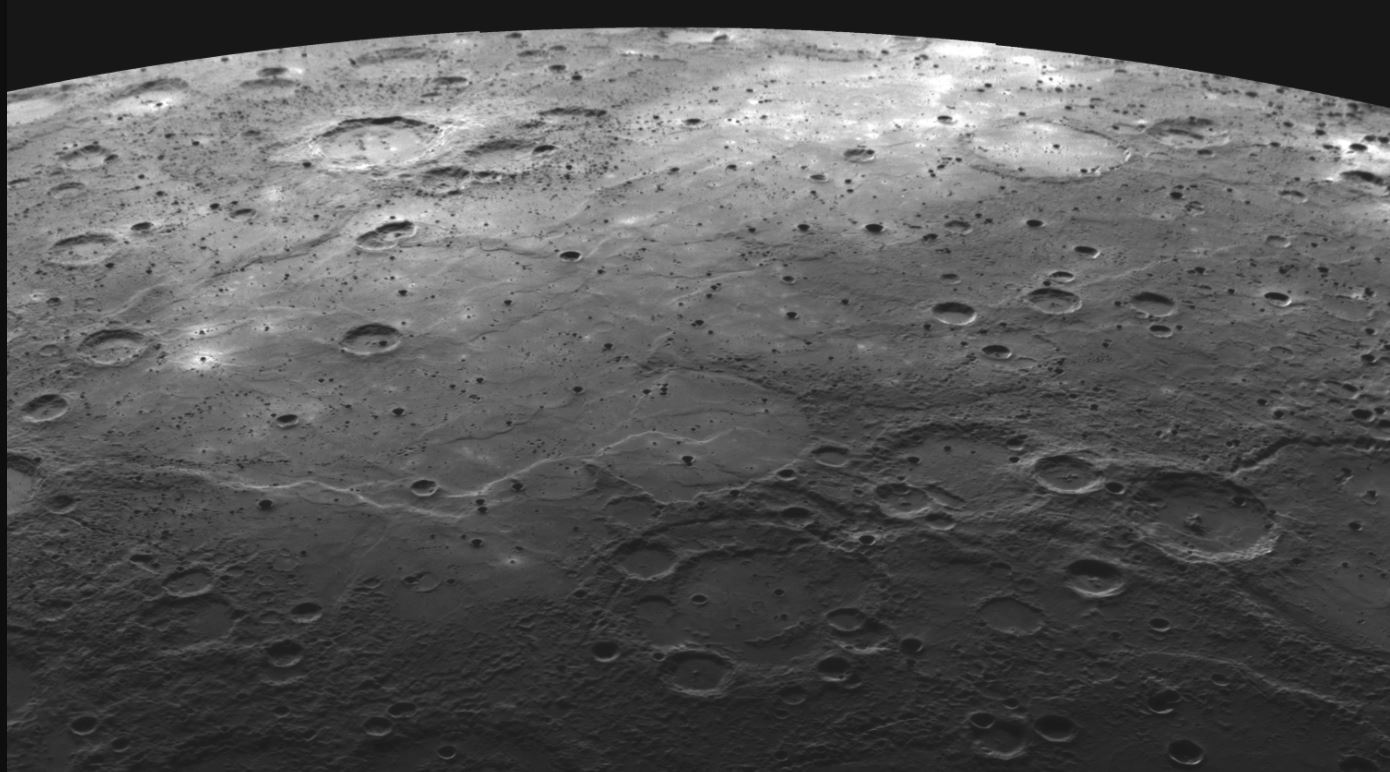
The boiling new world, which zips around its star at ultraclose range, is among the lightest exoplanets found to date. The TESS mission has discovered an ultra-short-period planet (USP) that is also super light. The planet is named GJ 367 b, and it orbits its star in just eight hours. The planet is about the size of Mars, and half as massive as the Earth, making it one of the lightest planets discovered to date.

Ultra-short-period planets are small, compact worlds that whip around their stars at close range, completing an orbit — and a single, scorching year — in less than 24 hours...

Read More