Category Astronomy/Space

BICEP3 Tightens the Bounds on Cosmic Inflation

A telescope pokes out from a metal dish.
The BICEP3 telescope at the South Pole. (BICEP/Keck Collaboration)

Physicists looking for signs of primordial gravitational waves by sifting through the earliest light in the cosmos – the cosmic microwave background (CMB) – have reported their findings: still nothing.

But far from being a dud, the latest results from the BICEP3 experiment at the South Pole have tightened the bounds on models of cosmic inflation, a process that in theory explains several perplexing features of our universe and which should have produced gravitational waves shortly after the universe began.

“Once-promising models of inflation are now ruled out,” said Chao-Lin Kuo, a BICEP3 principal investigator and a physicist at Stanford University and the Department of Energy’s SLAC National Accelerator Laborato...

Read More

The Upside-Down Orbits of a Multi-Planetary System

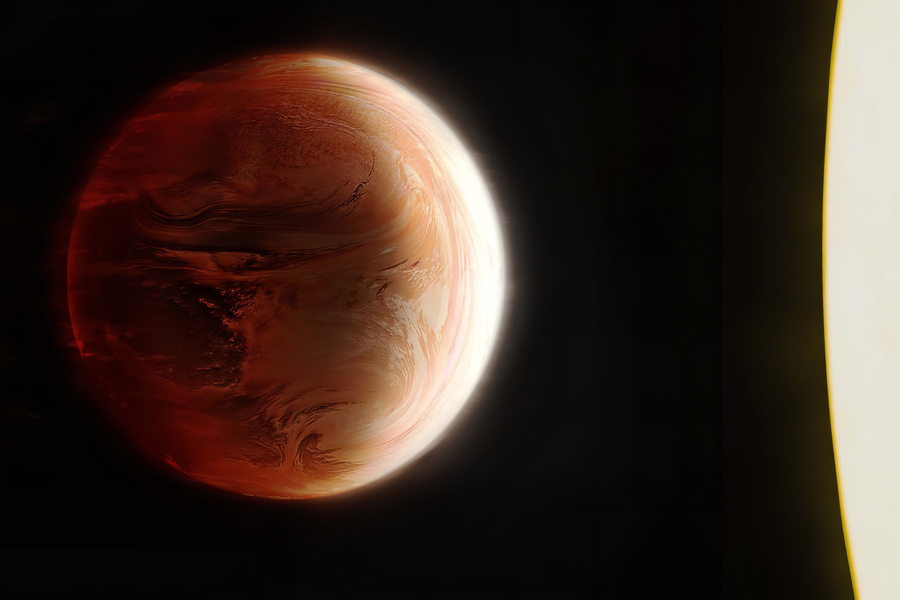
Astronomers have discovered exoplanets that orbit in planes at 90 degrees from each other. When planets form, they usually continue their orbital evolution in the equatorial plane of their star. However, an international team, led by astronomers from the University of Geneva (UNIGE), Switzerland, has discovered that the exoplanets of a star in the constellation Pisces orbit in planes perpendicular to each other, with the innermost planet the only one still orbiting in the equatorial plane. Why so? This radically different configuration from our solar system could be due to the influence of a distant companion of the star that is still unknown...

Read More

Juno Peers Deep into Jupiter’s Colorful Belts and Zones

Juno peers deep into Jupiter's colourful belts and zones
Artist’s impression based on JunoCam image of Jupiter acquired on July 21, 2021. Enhanced to highlight features, clouds, colours, and the beauty of Jupiter. Credit: NASA/SwRI/MSSS/Tanya Oleksuik

Leicester study of data captured in orbit around Jupiter has revealed new insights into what’s happening deep beneath the gas giant’s distinctive and colourful bands.

Data from the microwave radiometer carried by NASA’s Juno spacecraft shows that Jupiter’s banded pattern extends deep below the clouds, and that the appearance of Jupiter’s belts and zones inverts near the base of the water clouds. Microwave light allows planetary scientists to gaze deep beneath Jupiter’s colourful clouds, to understand the weather and climate in the warmer, darker, deeper layers.

At altitudes shallower than...

Read More

Making Martian Rocket Biofuel on Mars

Artist's conception of astronauts and human habitats on Mars. Courtesy: NASA
Artist’s conception of astronauts and human habitats on Mars. Courtesy: NASA

New study outlines biotechnology process to produce rocket fuel on red planet. Researchers at the Georgia Institute of Technology have developed a concept that would make Martian rocket fuel, on Mars, that could be used to launch future astronauts back to Earth.

The bioproduction process would use three resources native to the red planet: carbon dioxide, sunlight, and frozen water. It would also include transporting two microbes to Mars. The first would be cyanobacteria (algae), which would take CO2 from the Martian atmosphere and use sunlight to create sugars...

Read More